Technical Materials: Carbon Fiber and High-Temperature Polymers Go Mainstream
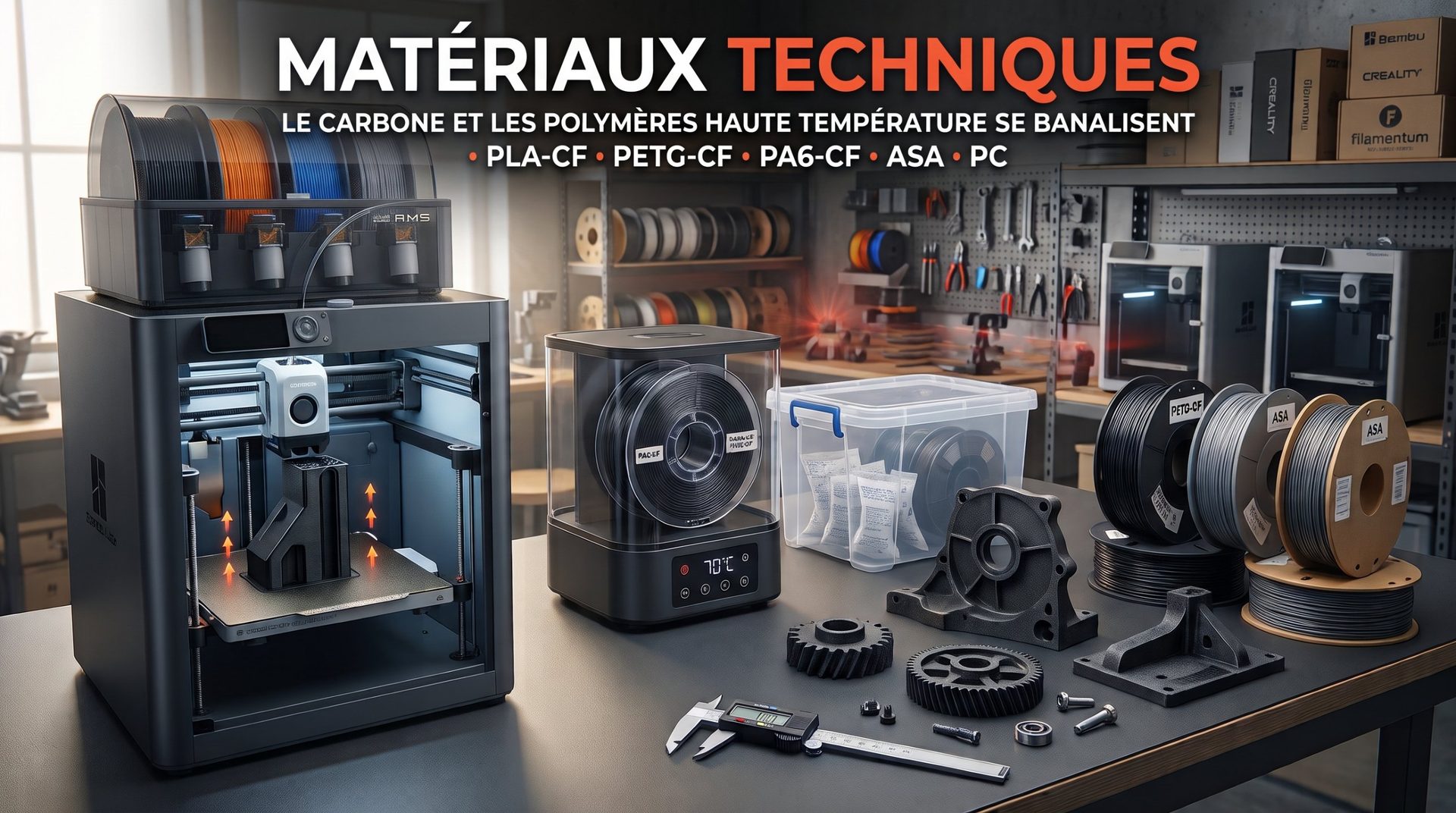
FDM 3D printing is definitively shedding its image as a technology reserved for prototyping and trinkets. Standard PLA long dominated build plates thanks to its ease of printing, but makers and workshops now have more demanding needs: mechanical parts under stress, auto parts exposed to heat, rigid fixtures for tooling…
This shift is explained by a technological leap: consumer-grade printers now often come standard with a hardened nozzle (hardened steel, sometimes tungsten carbide as an option) and a closed enclosure, sometimes even heated. Result: two families of materials once reserved for industry are becoming commonplace in the workshop.
1. Carbon Fiber-Filled Filaments (CF): Rigidity and Matte Finish
Filaments enriched with short carbon fibers (PLA-CF, PETG-CF, PA6-CF) have become the go-to choice for technical parts.
- Nearly invisible layer lines: the fibers scatter light and deliver a matte, silky look that greatly reduces the appearance of layer lines.
- More rigid and stable: fibers limit plastic shrinkage during cooling. Parts warp less and bed adhesion issues (warping) are easier to manage than with unfilled versions.
- PA6-CF (Carbon Nylon) in focus: it combines nylon's impact resistance with carbon's rigidity. It's the ideal material for gears, fixtures near motors, drone or robotics parts.
Important note: these filaments are highly abrasive. A brass nozzle wears out quickly and print quality deteriorates. A hardened steel or tungsten carbide nozzle is essential, and reinforced drive gears are highly recommended. To choose wisely, read our comparison on brass, hardened steel, ruby, or tungsten carbide nozzles.
2. High-Temperature Technical Plastics: ASA, Polycarbonate, and Nylon
Printing parts that resist temperatures above 80 to 100 °C or UV exposure is no longer a nightmare.
- ASA: the worthy successor to ABS. It offers comparable mechanical and thermal resistance, with the added bonus of excellent UV and weather resistance. It's the standard for outdoor parts: motorcycle brackets, garden accessories, drone parts.
- Polycarbonate (PC): the champion of impact and heat resistance, performing above 110 °C. It requires a nozzle at 270–300 °C and a build plate at 100–115 °C.
- Nylon (PA): highly resistant to wear and friction, ideal for moving parts, but very moisture-sensitive.
The End of DIY Enclosures
A few years ago, printing ABS or ASA meant enclosing your machine in a tent or homemade box to prevent bed adhesion issues and layer delamination. Today, closed enclosure printers are affordable at just a few hundred euros. Their chamber stays warm during printing (often around 40 to 50 °C), and some models even actively heat their chamber for the most demanding materials. Open or closed? Our article on open or closed 3D printers helps you decide.
Quick Comparison: Which Material for Which Use?
| Material | Nozzle | Build Plate | Closed Enclosure | Key Strength | Typical Use |
|---|---|---|---|---|---|
| PLA-CF | 210 – 230 °C | 50 – 60 °C | Not required | Rigidity, matte finish | Design housings, lightweight jigs |
| PETG-CF | 240 – 260 °C | 70 – 80 °C | Recommended | Rigidity and chemical resistance | Common mechanical parts, tooling |
| ASA | 250 – 270 °C | 90 – 105 °C | Essential | UV and weather resistance | Outdoor auto and motorcycle parts, drones |
| PA6-CF | 280 – 300 °C | 80 – 100 °C | Essential | Very high strength, shock absorption | Gears, structural parts, robotics |
| PC | 270 – 300 °C | 100 – 115 °C | Essential | Heat and impact resistance | Hot fittings, protective housings |
These values are starting points: always follow the spool manufacturer's guidelines. To compare these materials based on your needs and rule out those unsuitable for your printer (open frame, brass nozzle…), use our selector:
The Golden Rule: Master Humidity
These technical plastics demand real discipline in the workshop: drying. Nylon and polycarbonate are highly hygroscopic and absorb moisture from the air within hours. PETG is also sensitive to it, though to a lesser extent.
Wet filament is easy to spot: bubbles and crackling at the nozzle exit, stringing between parts, rough surface, and significantly weaker prints.
A filament dryer capable of reaching around 70 °C (for Nylon and PC) and airtight boxes with desiccant packets are now standard equipment for the "technical" maker. All our tips are in our guide: should you dry your 3D printing filament?