High-Temperature 3D Printing: Mastering Advanced Polymers and Securing Your Workshop
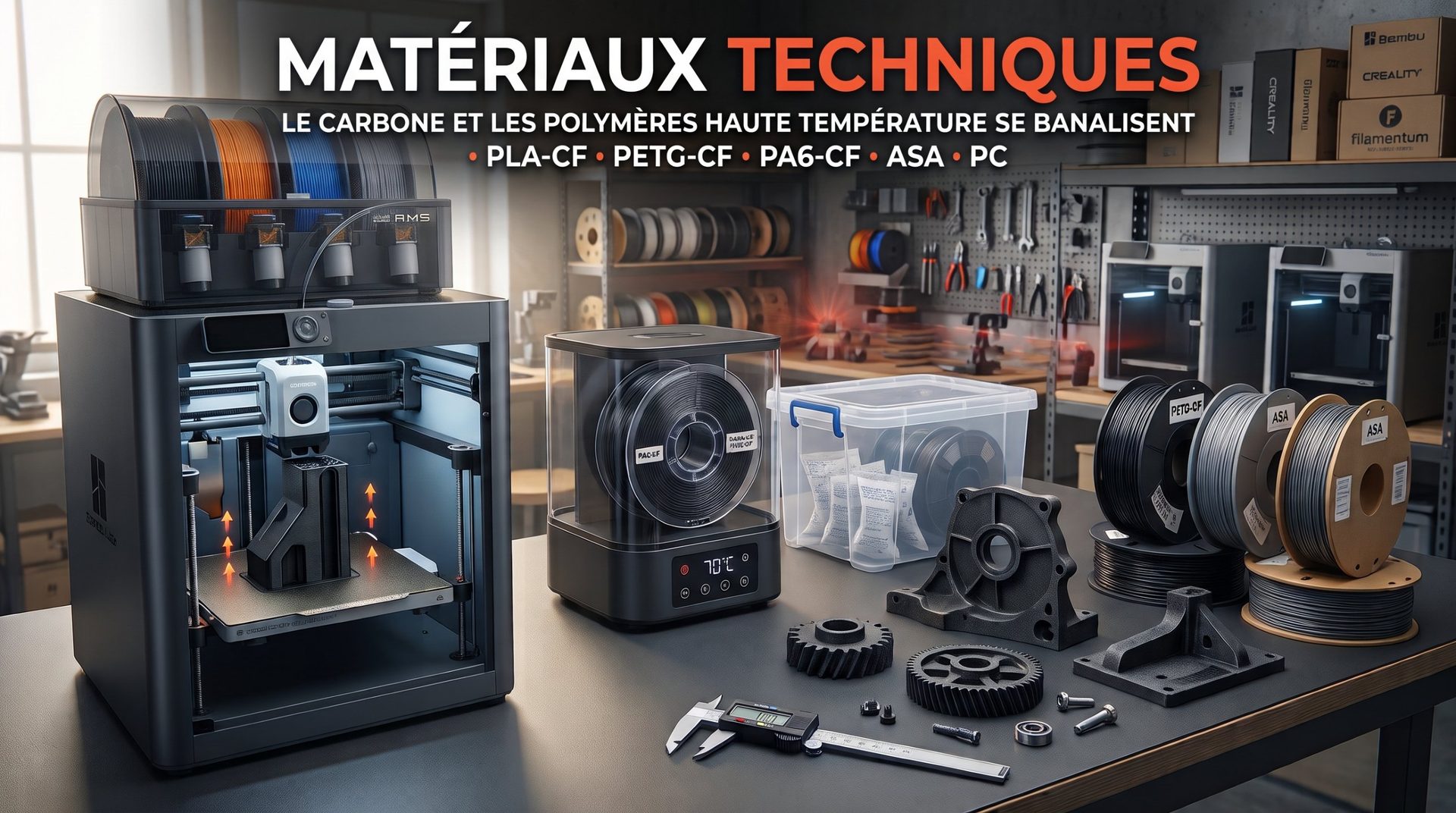
FDM 3D printing has moved far beyond simple PLA figurines. With nozzles exceeding 300 °C and increasingly affordable enclosed printers, workshops are equipping themselves to print engineering-grade materials: carbon-filled filaments (PA6-CF, PETG-CF), ASA, Nylon, and polycarbonate.
But this upgrade comes with a downside: heating these plastics to high temperatures releases ultrafine particles and volatile organic compounds (VOCs). To succeed with technical parts without compromising your health, you now need to think about both print settings and air quality.
1. Technical materials in a nutshell
Carbon-filled filaments bring rigidity and matte finishes, ASA resists UV and weather, polycarbonate holds up beyond 110 °C, and nylon handles impacts and friction. These materials demand a hardened nozzle, often an enclosed chamber, and properly dried filament spools. We cover them in detail in our article on technical materials in 3D printing.
2. The downside: fine particles and VOCs
Pushing the nozzle to 250–300 °C to print ASA or PA6-CF doesn't just release a strong smell—it also emits invisible pollutants.
- Ultrafine particles (under 0.1 micron): they're so small they penetrate deep into the lungs. All prints emit them, but ABS, ASA, and materials printed at very high temperatures produce far more than PLA.
- VOCs: ABS and ASA mainly release styrene, an irritating gas with a characteristic hot plastic odor. Nylons (polyamides) can emit caprolactam.
The challenge is two-fold: to prevent the part from cracking or warping, the chamber must stay hot. Simple ventilation that continuously pulls air outside cools the part and ruins the print. Filtration must therefore be done intelligently, in a closed loop.
3. Solutions: two-stage filtration and controlled ventilation
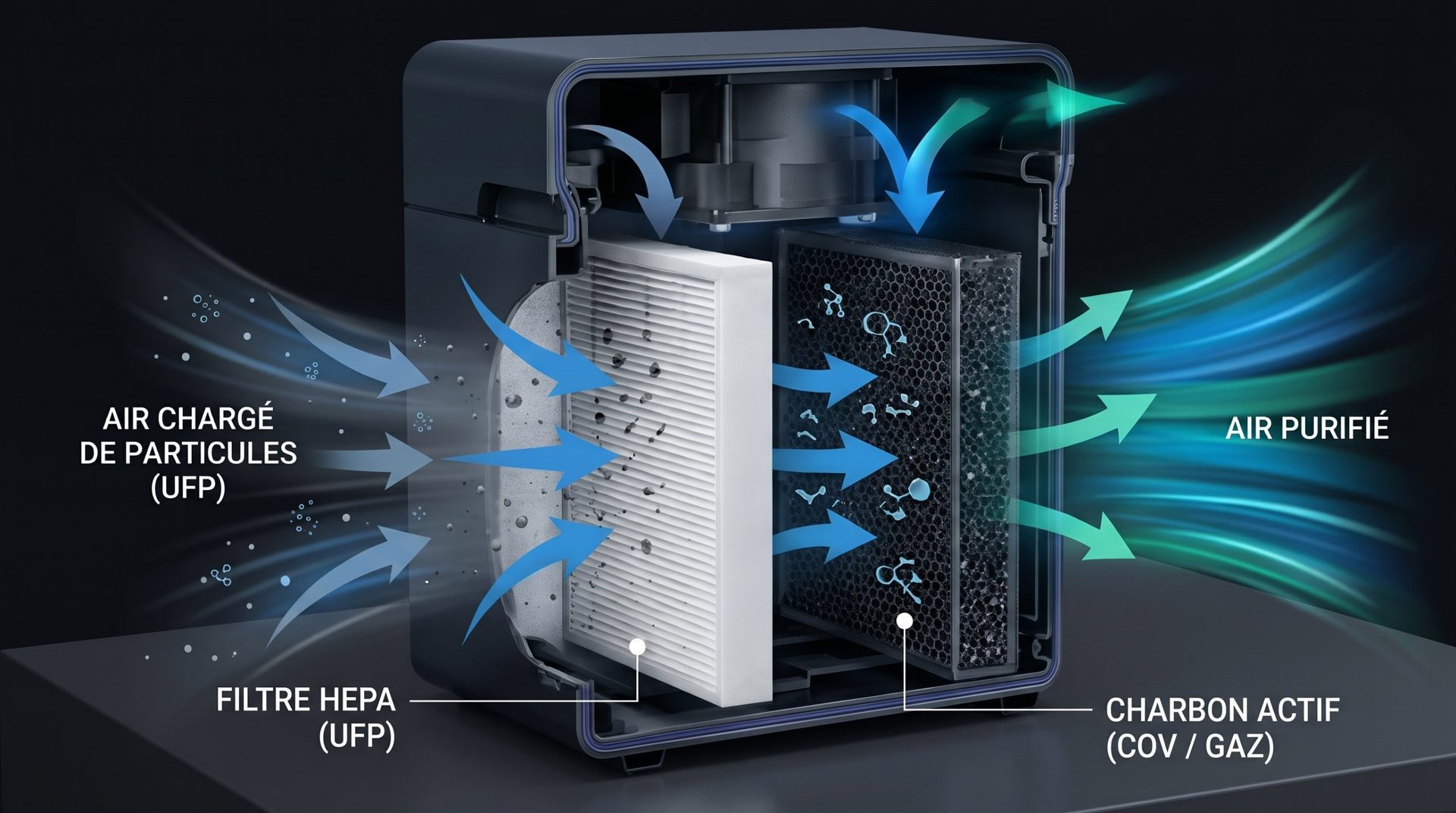
To keep the heat while cleaning the air, the most effective solution combines two filters:
- A HEPA filter (H13 or H14): it captures at least 99.95% of fine particles, including carbon fiber dust.
- An activated charcoal filter: it traps gases like styrene and solvents. It saturates over time and must be replaced regularly.
On recent printers, ventilation is increasingly controlled by firmware and slicer (OrcaSlicer, Bambu Studio, PrusaSlicer):
- During printing: air circulates in a closed loop through the filters inside the chamber (like the community "Bento Box" filter). Vapors are purified without heat loss.
- At the end of printing: some machines continue to filter or extract air for a few minutes before you open the door. A good habit to adopt manually: wait a few minutes before opening.
4. Overview of printers ready for technical materials
| Printer | Heat management | Built-in filtration | Target materials |
|---|---|---|---|
| Bambu Lab X1-Carbon / P1S | Unheated enclosed chamber | Activated charcoal filter on X1-Carbon, often supplemented by community HEPA filter | PETG-CF, PA-CF, ASA, PC |
| Bambu Lab H2D | Actively heated chamber (up to 65 °C) | Combined particle and charcoal filter | PA-CF, PC, ASA, PPS |
| Prusa CORE One | Enclosed chamber with regulated temperature (up to 55 °C) | Advanced filtration module (HEPA and charcoal) as option | ASA, PC, filled Nylons |
| Qidi Plus4 / X-Max 3 | Actively heated chamber (up to 65 °C) | Activated charcoal filter with air circulation | PA6-CF, PC, ABS, ASA, PPS |
| Creality K2 Plus | Large actively heated chamber | Integrated air filtration (charcoal and HEPA filters as accessories) | PLA-CF, PETG-CF, ASA, PA-CF |
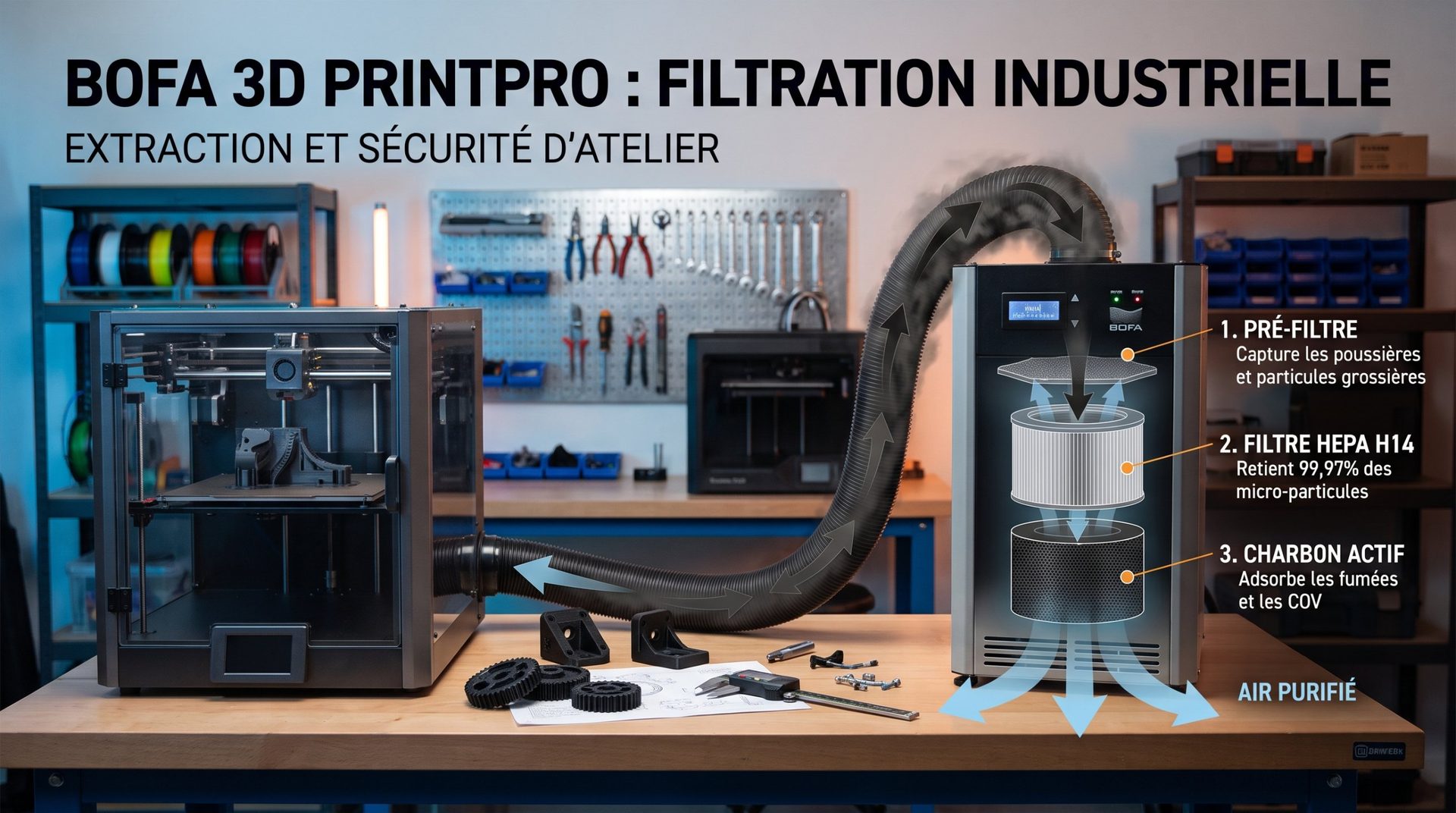
For multi-machine shops, schools, or shared workspaces, professional extraction systems (like the BOFA 3D PrintPRO) complement this setup by venting air outdoors in a controlled manner. In all cases, ventilate the room regularly and avoid installing a printer printing ABS or ASA in an enclosed bedroom.
The modern workshop: mechanical rigor and clean air
Printing technical plastics is no longer experimental. By combining proper settings (hardened nozzle, dried filament, heated chamber) and appropriate filtration, makers and professionals have a true desktop production tool: highly durable parts made in a healthy environment. For best practices in daily use, also check the safety section of our 3D printing FAQ.