3D Printer Nozzles: Brass, Hardened Steel, Ruby, and Tungsten Carbide Compared
Brass has dominated FDM 3D printing since the beginning for two reasons: it's inexpensive to machine and it conducts heat exceptionally well. But the rise of technical filaments is challenging that reign: carbon fiber-filled filaments (PETG-CF, PA-CF) and glass-filled filaments, metal powders, phosphorescent pigments…
These fillers act like sandpaper under pressure. After just a few hundred grams of abrasive filament, the nozzle opening of a 0.4 mm brass nozzle can widen noticeably, without your slicer catching on. Faced with this wear, several alternatives exist, each with its own trade-off between durability and thermal performance.
1. Invisible wear: the brass nozzle trap
Abrasion doesn't just enlarge the exit hole. It also wears down the small flat surface surrounding it (tip flat), that plane area that compresses and smooths the plastic bead. The consequences of a worn nozzle:
- Miscalibrated settings: your slicer calculates a 0.42 mm line, but the nozzle deposits an irregular, wider bead, causing over-extrusion and stringing.
- Degraded first layer: as it wears, the tip shortens and the distance between nozzle and build plate changes.
- Thin walls tear: the roughened, flared exit pulls the filament instead of depositing it cleanly.
The telltale sign: prints that gradually degrade even though you haven't changed any settings.
2. Hardness and thermal conductivity: the great trade-off
A wear-resistant nozzle poses a physical problem: the worse the metal conducts heat, the harder it becomes to melt filament quickly without raising temperature.
| Nozzle | Hardness | Thermal Conductivity (W/m·K) | Abrasion Resistance | In Practice |
|---|---|---|---|---|
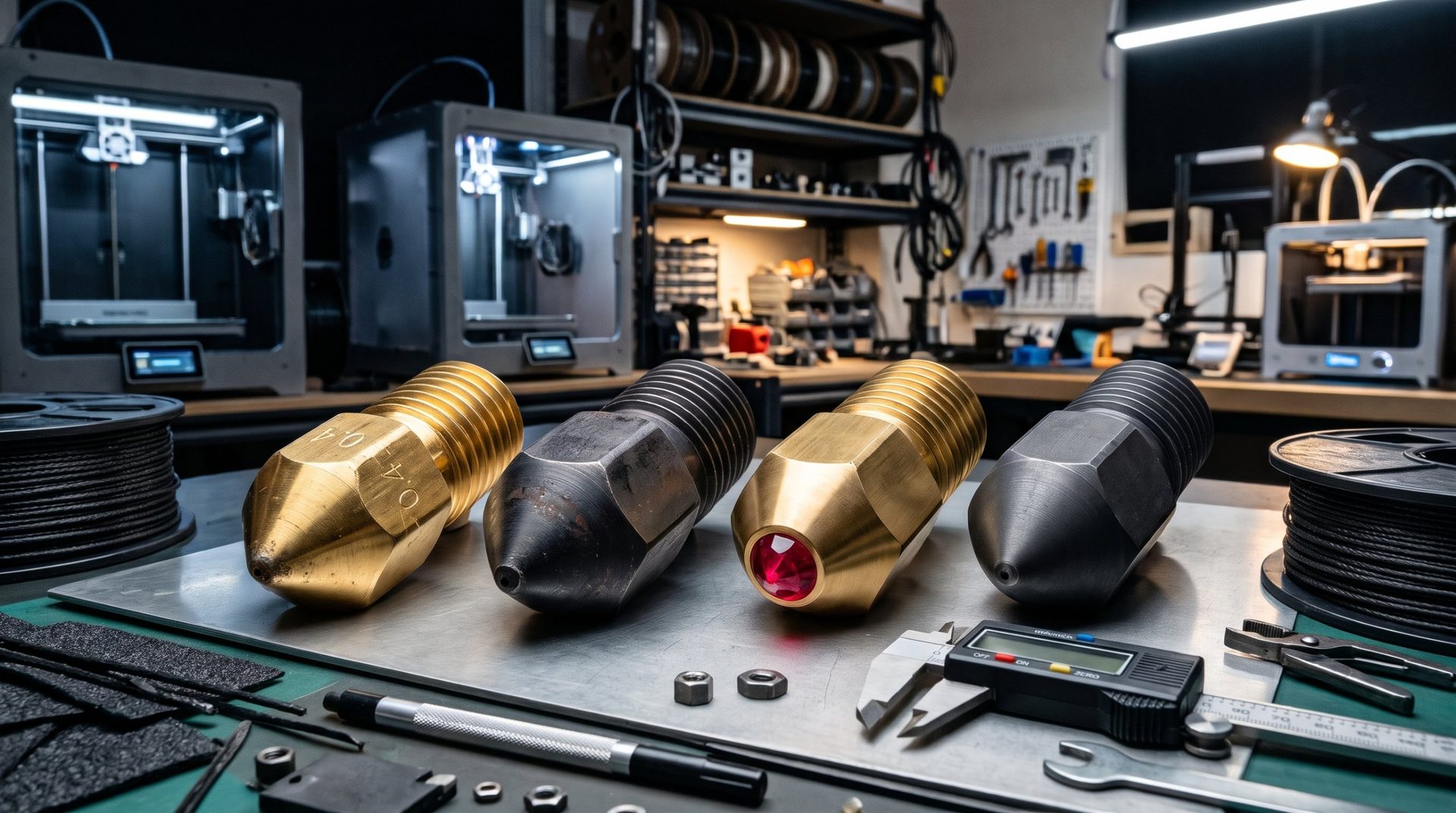
| Brass | Mohs ~3 | ~110 to 120 | Very low | Excellent melting, the benchmark for throughput. |
| Hardened Steel | Mohs ~7 to 8 | ~20 to 45 | Good (several kilos of composite) | Less efficient melting: often +10 to 15 °C and reduced max throughput. |
| Ruby Tip | Mohs ~9 (insert) | Brass body | Excellent at the tip | Good thermal compromise, but insert is fragile on impact. |
| Tungsten Carbide | Mohs ~9 | ~85 to 90 (common grades) | Nearly indestructible in 3D printing | Nearly as effective as brass, with cutting-tool hardness. |
Values are indicative and vary by alloy and manufacturer.
3. Alternatives in detail
Hardened steel: the budget choice
It's the most common solution for getting started with composites, and often the stock nozzle on recent printers. The price is accessible, but it conducts heat poorly (roughly two to five times less than brass):
- at high speed, the filament core doesn't have time to melt properly;
- at the same temperature, max throughput is often 15 to 25% lower than brass. You compensate by raising temperature 10 to 15 °C.
Ruby tip: precision set in stone
It combines a brass body with a small synthetic ruby stone set at the tip. This keeps brass's excellent heat conduction while offering a nearly indestructible exit.
Its limits: the insert fears impacts (nozzle collisions with the plate, rough cleaning) and sharp temperature swings. Its price remains high.
Tungsten carbide: the best compromise
The material of industrial machine tools, tungsten carbide is nearly as hard as diamond. Its common grades conduct heat somewhat less than brass, but roughly twice as well as steel.
- In practice, your brass profiles work with little to no temperature increase.
- It handles the most abrasive filaments (carbon, glass, phosphorescent) and isn't bothered by metal brushes in automatic cleaning.
- Watch out for counterfeits: some "tungsten" nozzles are tungsten only at the tip, or plain tungsten steel. Buy from a recognized seller.
It's the most durable investment for a workshop printing lots of composites.
4. CHT nozzles: more throughput
To increase throughput without changing material, CHT nozzles split the filament flow into three thin channels, multiplying the heated surface. The filament melts faster, and manufacturers claim a throughput gain of around 30 to 50%.
- CHT in brass: for unfilled filaments (fast PLA or PETG).
- CHT bimetal or hardened steel: they combine a heat-conductive body with a wear-resistant tip, for fast printing of filled filaments.
For more on speed, check our article on high-speed 3D printing. And for nozzle diameter, our guide to choosing the right nozzle size.
Which nozzle for which filament?
- PLA, PETG, ABS, ASA, standard TPU: brass is enough.
- Carbon, glass, wood, metal, phosphorescent filaments: hardened steel at minimum, tungsten carbide for heavy use. See our guide on carbon fiber-filled filaments.
- Food contact: a stainless nozzle, clean and dedicated, rather than brass which can contain trace lead.
Our selector compares 12 filaments. In the "My Printer" section, check "brass nozzle": filaments requiring a reinforced nozzle are flagged right away.