Guide to 3D Printing with Nylon

3D printing with Nylon (or Polyamide - PA) is one of the most sought-after solutions for manufacturing functional parts. Renowned for its exceptional balance of strength, flexibility, and durability, it stands as the material of choice for engineering, often outperforming ABS or PETG in terms of mechanical robustness.
Here's a complete guide to understanding its variants, advantages, and technical challenges.

✅ The Different Types of Nylon
The term "Nylon" encompasses several types of polymers, each with specific properties:
| Type | Main Characteristics | Recommended Use |
| PA6 | Very rigid and wear-resistant, but extremely sensitive to moisture. | High-performance mechanical parts. |
| PA12 | Easier to print, excellent dimensional stability, less hygroscopic. | Industrial prototyping, enclosures, gears. |
| PA11 | More flexible and impact-resistant than PA12, bio-sourced origin. | Hinges, prosthetics, impact-prone parts. |
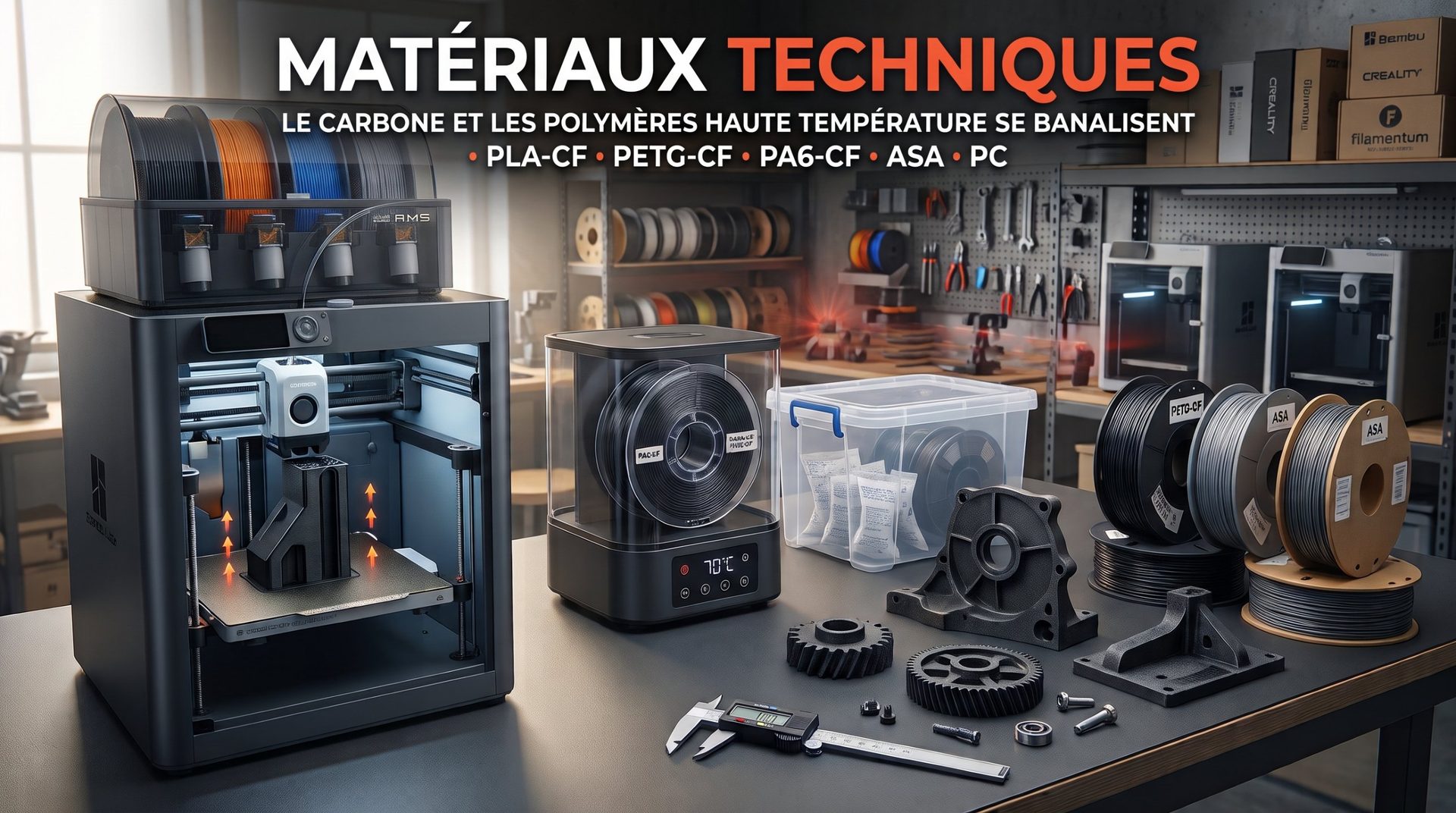
| Composites (CF/GF) | Loaded with carbon fiber (more rigid) or fiberglass (more insulating). | Competition parts, drone frames, tooling. |
✅ Advantages and Disadvantages
The Strengths
-
Impact and fatigue resistance: Unlike PLA which breaks cleanly, Nylon deforms slightly before rupture.
-
Low coefficient of friction: Ideal for moving parts (gears, bearings).
-
Chemical resistance: Withstands oils, greases, and hydrocarbons very well.
-
Post-processing: Parts can be easily dyed with textile dyes thanks to their porosity.
The Challenges
-
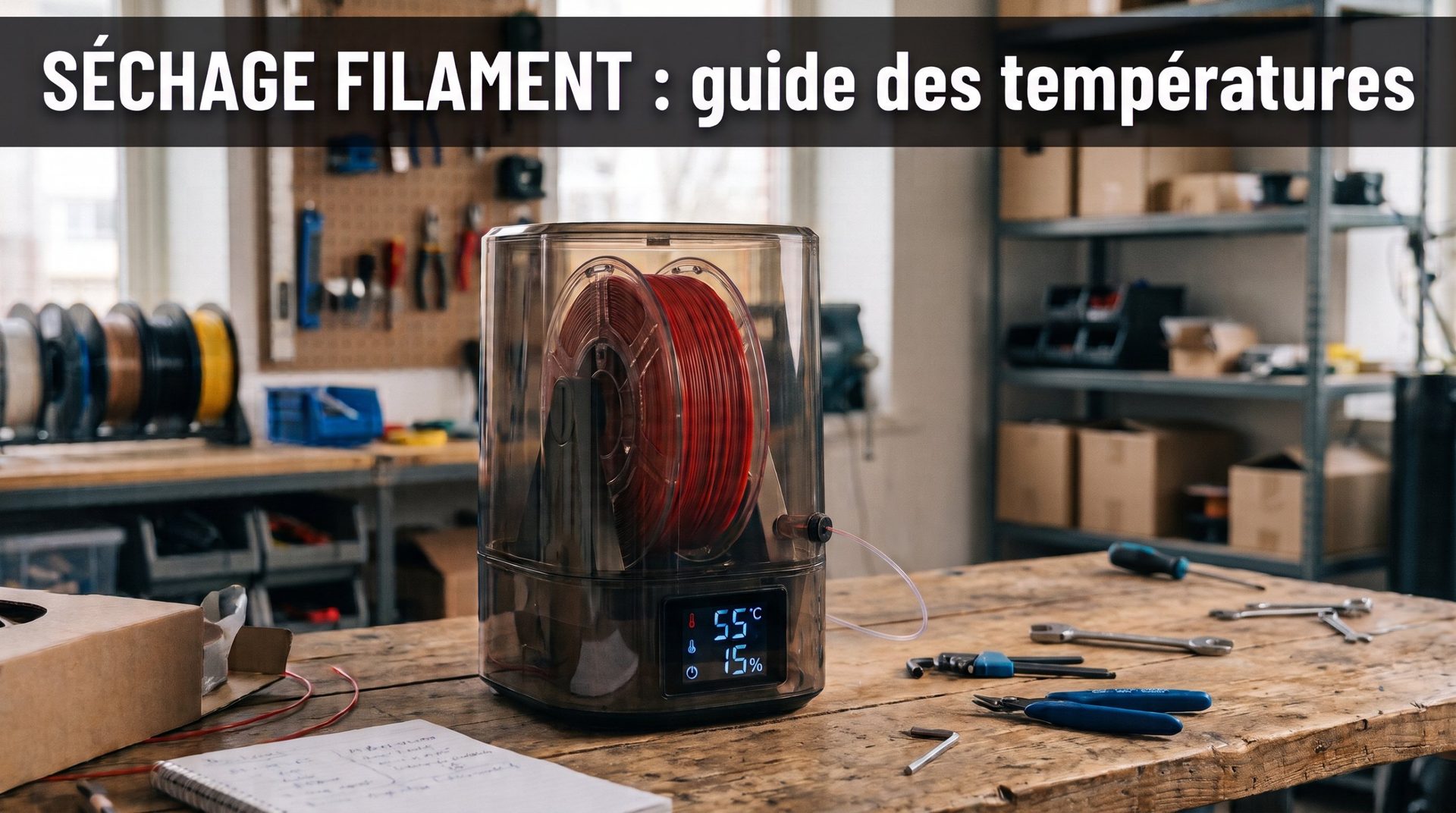
Hygroscopicity (Moisture): Nylon absorbs moisture from the air. Damp filament will create bubbles and surface defects. Prior drying (4–8 hours at 70°C) is essential.
-
Warping (Shrinkage): Nylon tends to lift off the build plate as it cools.
-
High temperature: Requires a nozzle between 240°C and 270°C.
✅ Technical Guide: How to Succeed with Your Print
To print Nylon, a standard "out-of-the-box" configuration rarely suffices. Here are the prerequisites:
Machine Configuration
-
All-Metal Extruder: Essential to withstand temperatures > 240°C without degrading the internal PTFE tube.
-
Heated Bed: Between 70°C and 100°C. The use of specific adhesive (such as Magigoo PA or UHU stick) is highly recommended.
-
Closed Enclosure: Crucial to maintain stable ambient temperature and limit warping.
Slicing Parameters (Slicer)
-
Speed: Moderate (30 to 50 mm/s).
-
Cooling Fan: Disabled or very low (0–10%) to ensure excellent layer adhesion.
-
Brim: Use a wide brim to keep the corners of the part on the build plate.
✅ Nylon Printing Technologies
While FDM (filament) is the most accessible, Nylon is also the king material in other processes:
-
SLS (Selective Laser Sintering): Uses powder. Allows complex geometries without supports and nearly isotropic parts.
-
MJF (Multi Jet Fusion): HP's very fast technology, ideal for small industrial production runs with superior surface finish.
Note: If you're just starting out, begin with PA12 or a carbon-filled Nylon (PA-CF). Carbon fibers drastically reduce warping, making printing much more stable.
✅ Quick Comparison Table
| Model | Multi-Color System | Max Speed | Build Volume | Main Advantage |
| Anycubic Kobra X | ACE 2 (External/Combo) | 600 mm/s | 260 x 260 x 260 mm | Filament savings (-81%) |
| Co Print Quadro | 4 Independent Heads | 500 mm/s | ~260 x 260 x 260 mm | Zero waste (no purge) |
| Creality Sparkx i7 | CFS (Combo) | 500 mm/s | 260 x 260 x 255 mm | AI and ease of use |
| Snapmaker U1 | 4 Interchangeable Heads | 500 mm/s | 270 x 270 x 270 mm | Pro precision and CoreXY |
✅ Why Can't They Be Interchanged?
It is impossible to use 2.85 mm in a machine designed for 1.75 mm (the filament simply won't fit). Conversely, putting 1.75 mm in a 2.85 mm head will cause massive leaks and complete loss of pressure control, as the filament will "float" in the nozzle.
The choice between 1.75 mm and 2.85 mm is no longer really a matter of debate, but a question of application and equipment.
For the vast majority of users, the 1.75 mm standard is the reasonable choice. Its market dominance guarantees you an almost infinite choice of materials, competitive prices, and compatibility with the latest technological innovations, such as automatic color-changing systems. It's the diameter of versatility and domestic precision.
2.85 mm, meanwhile, remains a specialized choice. It retains full relevance for professionals equipped with specific machine parks (such as Ultimaker) or those who exclusively print highly flexible technical materials at high speed. It's the diameter of industrial reliability and consistent throughput.
In conclusion, 3D printing with Nylon represents the transition from simple visual prototyping to manufacturing real industrial components. Although it is more technically demanding than PLA, requiring strict moisture management and a stable thermal enclosure, its mechanical properties are unmatched for parts subject to high stress.
Whether for the flexibility of a prosthetic, the durability of a gear, or the lightness of a drone chassis, Nylon remains the standard of excellence for any engineer or maker seeking to push the limits of additive manufacturing. Mastering this material means unlocking the true potential of your 3D printer.
Still hesitant? Our filament comparator guides you in just a few clicks.