The World of 3D Filaments: Choosing the Right Filament for Your 3D Printing

FDM 3D printing (Fused Deposition Modeling) is fascinating, but its true magic lies in the filament you choose. This "thread" of plastic or composite is the equivalent of ink for a traditional printer: it's the raw material that brings your digital models to life. Understanding the properties of different filament types is crucial to successful prints, whether for a simple prototype, a functional part, or a work of art.
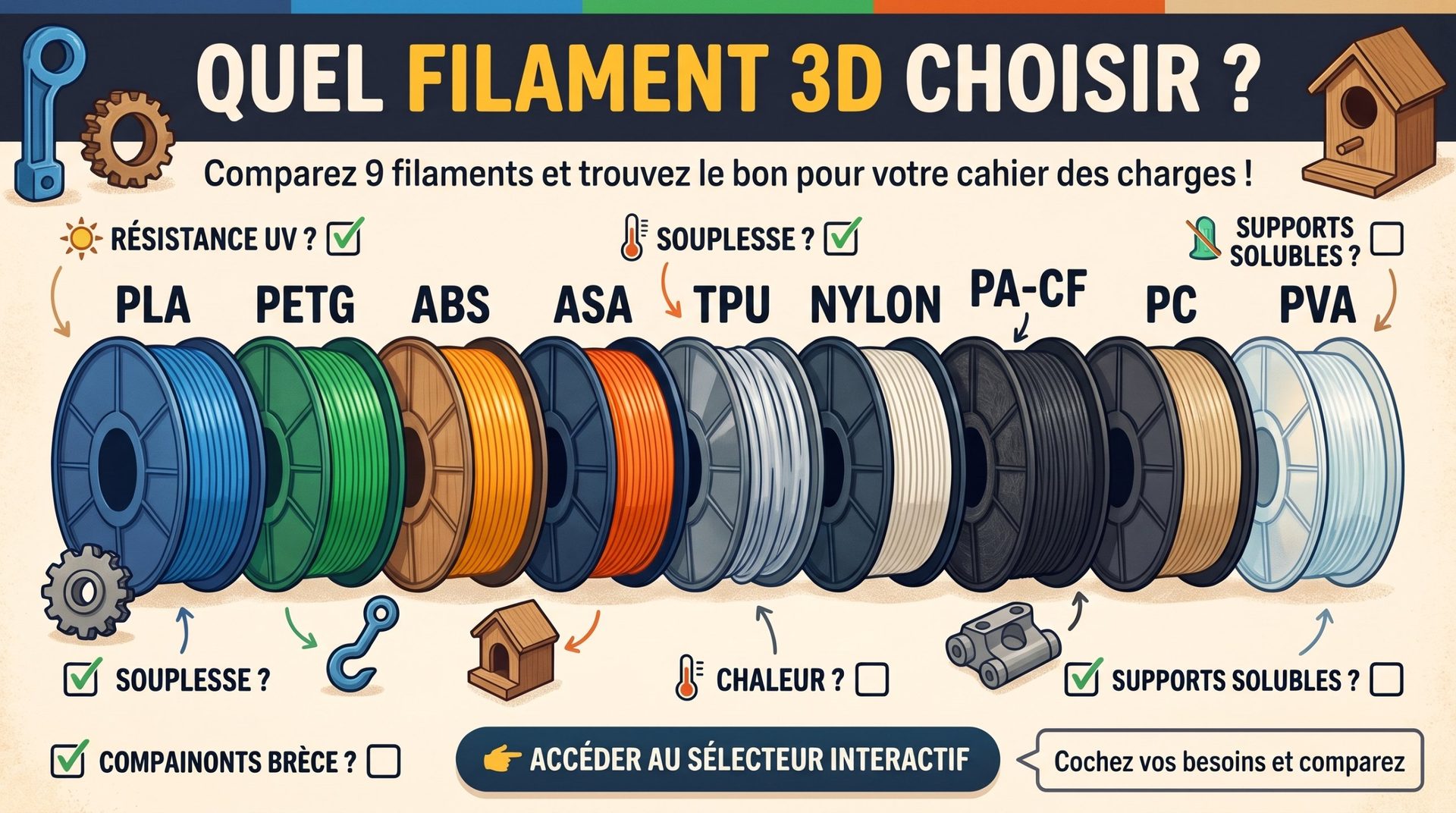
The filament market is vast and constantly evolving. Here's an overview of the most common and specialized types, with their advantages, disadvantages, and applications.
➧ The Essentials: The Basic Trio of 3D Filaments
These filaments are the most popular and accessible for beginners, but also for many common applications.
PLA (Polylactic Acid)
- Properties: Extremely easy to print, biodegradable (under industrial composting conditions), low odor and fume emissions, minimal warping. Available in countless colors, including glossy, matte, transparent, or even glitter finishes.
- Uses: Perfect for beginners, rapid prototyping, decorative objects, figurines, toys, architectural models, and any part that doesn't require high heat resistance or impact strength.
- Considerations: Relatively brittle and low heat resistance (softens around 60°C).
ABS (Acrylonitrile Butadiene Styrene)
- Properties: Robust, impact and heat resistant (up to 90°C), slightly flexible. Can be post-processed (sanded, painted, acetone smoothed).
- Uses: Mechanical parts, electronics enclosures, functional parts requiring durability and thermal resistance, replacement parts.
- Considerations: More difficult to print than PLA, prone to warping and bed adhesion issues without a heated build plate (often 90–110°C) and ideally an enclosed chamber. It releases characteristic odors and VOCs (Volatile Organic Compounds) during printing, requiring good ventilation.
PETG (Polyethylene Terephthalate Glycol)
- Properties: Often considered the "best of both worlds" between PLA and ABS. It's durable, impact and heat resistant (up to 70°C), more flexible than PLA, and offers excellent layer adhesion for strong parts. Some grades are certified for food contact.
- Uses: Functional parts, food containers (with precautions), moisture-resistant objects, demanding prototypes, outdoor parts (good UV and moisture resistance).
- Considerations: More prone to stringing than PLA, and can adhere very strongly to the build plate.
➧ Flexible Filaments:
These filaments are designed to produce objects that can bend, stretch, or compress.
TPU (Thermoplastic Polyurethane)
- Properties: Highly elastic, flexible (rubber-like), abrasion resistant, resistant to oils and impacts. Its hardness varies (indicated by a Shore A number, e.g., 95A).
- Uses: Phone cases, gaskets, drone or robot tires, impact-absorbing parts, shoe soles.
- Considerations: More difficult to print due to its flexibility, often requiring a direct drive extruder and very slow print speed to prevent jamming.
➧ Technical and Specialized Filaments:
These materials offer advanced properties for industrial or demanding applications.
Nylon (Polyamide)
- Properties: Extremely robust, high wear, abrasion, impact, heat, and chemical resistance. Offers low friction.
- Uses: Gears, hinges, mechanical parts under high stress, automotive components.
- Considerations: Extremely hygroscopic (absorbs moisture from air very quickly), must be dried before and during printing. Requires a heated build plate and often an enclosed chamber.
PC (Polycarbonate)
- Properties: Exceptionally impact resistant (used for bulletproof windows), very rigid, excellent heat resistance (up to 130°C).
- Uses: Technical parts under extreme stress, lighting components, robust electronics enclosures.
- Considerations: Very difficult to print, requiring very high extrusion and build plate temperatures, and a heated enclosure to prevent warping and ensure layer adhesion.
HIPS (High Impact Polystyrene) and PVA (Polyvinyl Alcohol)
- Properties (both): Primarily used as soluble support materials. HIPS is soluble in D-Limonene (often used with ABS), and PVA is soluble in water (ideal with PLA or PETG).
- Uses: Enable printing of complex geometries with large overhangs or internal cavities without leaving support traces.
- Considerations: PVA is very moisture-sensitive and must be stored in a hermetic environment with desiccant. HIPS requires a specific solvent.
➧ Composite Filaments:
These filaments are base polymers (PLA, ABS, PETG, Nylon…) with added fillers to modify their properties.
Carbon Fiber, Fiberglass, or Aramid (Kevlar) Filled Filaments
- Properties: Significantly increase rigidity, tensile strength, light weight, and dimensional stability.
- Uses: Structural parts, drones, automotive or aerospace components, tools, fixtures.
- Considerations: Very abrasive to printer nozzles; require hardened steel or ruby nozzles to prevent rapid wear. Can be more difficult to print and are more expensive.
Filled Filaments (Wood, Metal, Ceramic)
- Properties: Give a more authentic look and feel (wood, stone, metal). "Wood" filaments can often be sanded and stained. "Metal" filaments contain metal powder and can be polished for a shiny effect.
- Uses: Decorative objects, models, costume jewelry, sculptures.
- Considerations: More brittle than pure PLA. The filler particles can also be abrasive to the nozzle.
➧ Choosing the Right Filament for Your 3D Print:
Choosing the right filament is just as important as the 3D model itself. It depends on several factors:
- The final use of the part: Does it need to be rigid, flexible, heat resistant, impact resistant, waterproof?
- Your 3D printer: Is it equipped with a heated build plate, enclosure, direct drive extruder, suitable nozzles?
- Your experience level: Technical filaments require more skill.
- Your budget: Prices vary considerably from one type to another.
The 3D filament market is constantly innovating, with regular new materials featuring increasingly specific properties (conductive, phosphorescent, flame-resistant, etc.). Feel free to experiment and consult manufacturer datasheets to discover the perfect filament for each of your projects.

(Source: PRUSA)
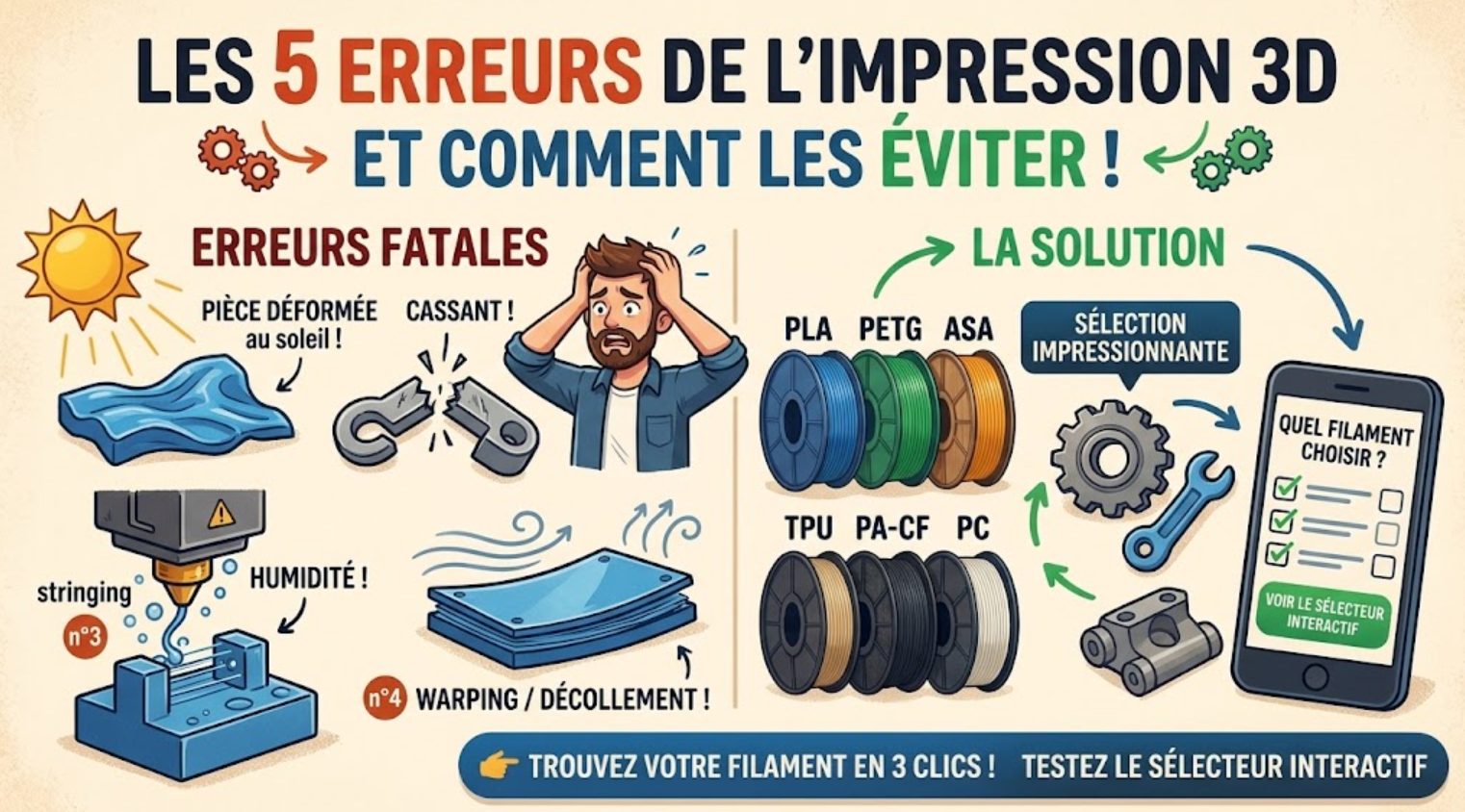
Strength, heat, flexibility: check your needs in our interactive selector.