Which 3D Filament Should You Choose? The Practical Guide to PLA, PETG, ABS, ASA, TPU & Nylon
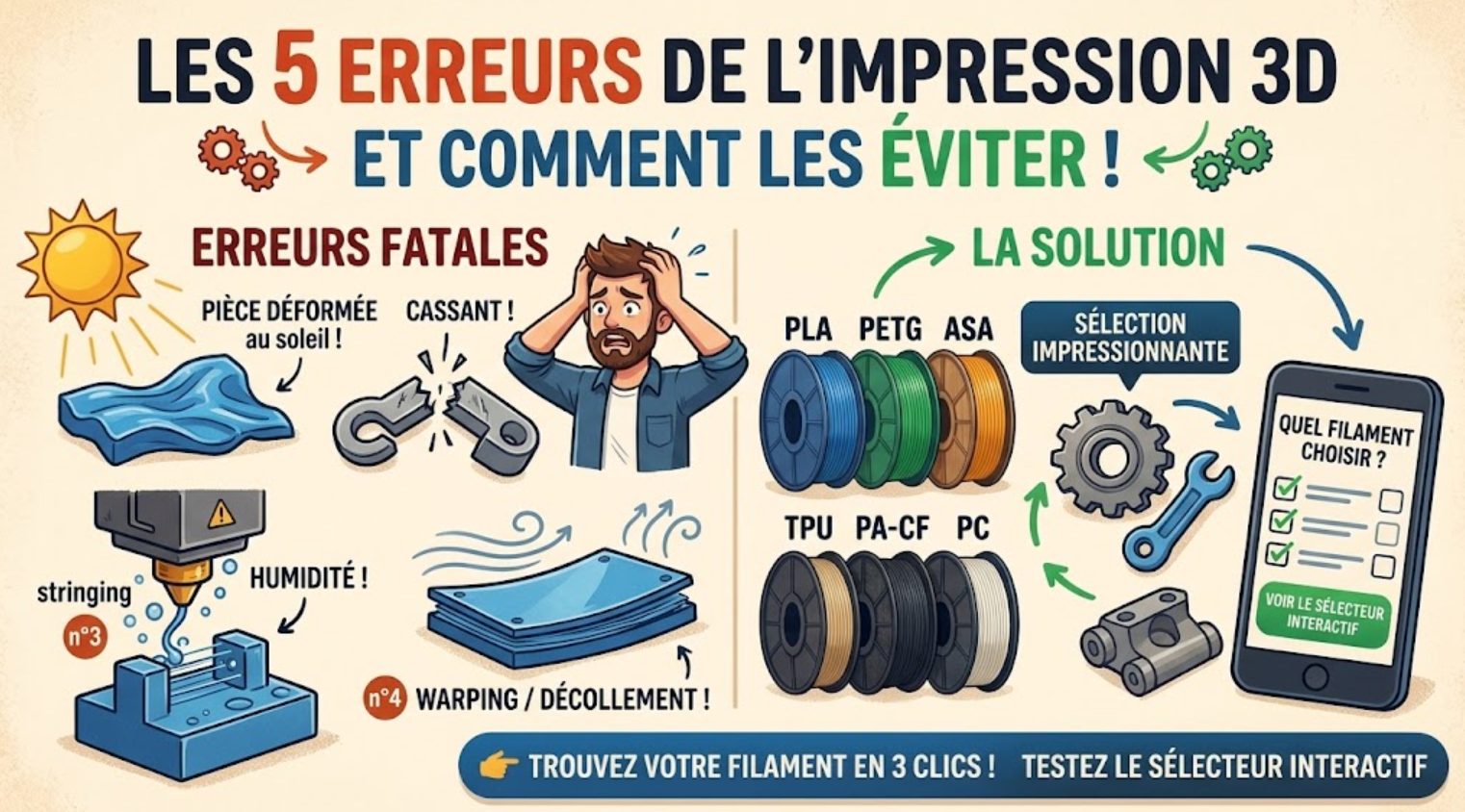
Your choice of filament determines the success of your 3D print. The wrong material often leads to disappointment: a decorative piece that melts on a car's rear window, a workshop hook that snaps under load, or a gear that wears prematurely.
To choose the right material without getting lost in technical datasheets, simply start by understanding the real constraints your part will face.
1. The key criteria to make the right choice
Before you fire up your slicer, ask yourself four questions:
- Environment of use: will the part stay indoors, or outside in rain and sunlight?
- Temperature: will it be exposed to heat (car interior, electronics enclosure, proximity to an engine)?
- Mechanical stress: does it need to flex without breaking, resist impacts, absorb vibrations, or withstand friction?
- Your printer's capabilities: do you have an open frame machine, or a closed chamber with a nozzle that can reach 280 °C or higher?
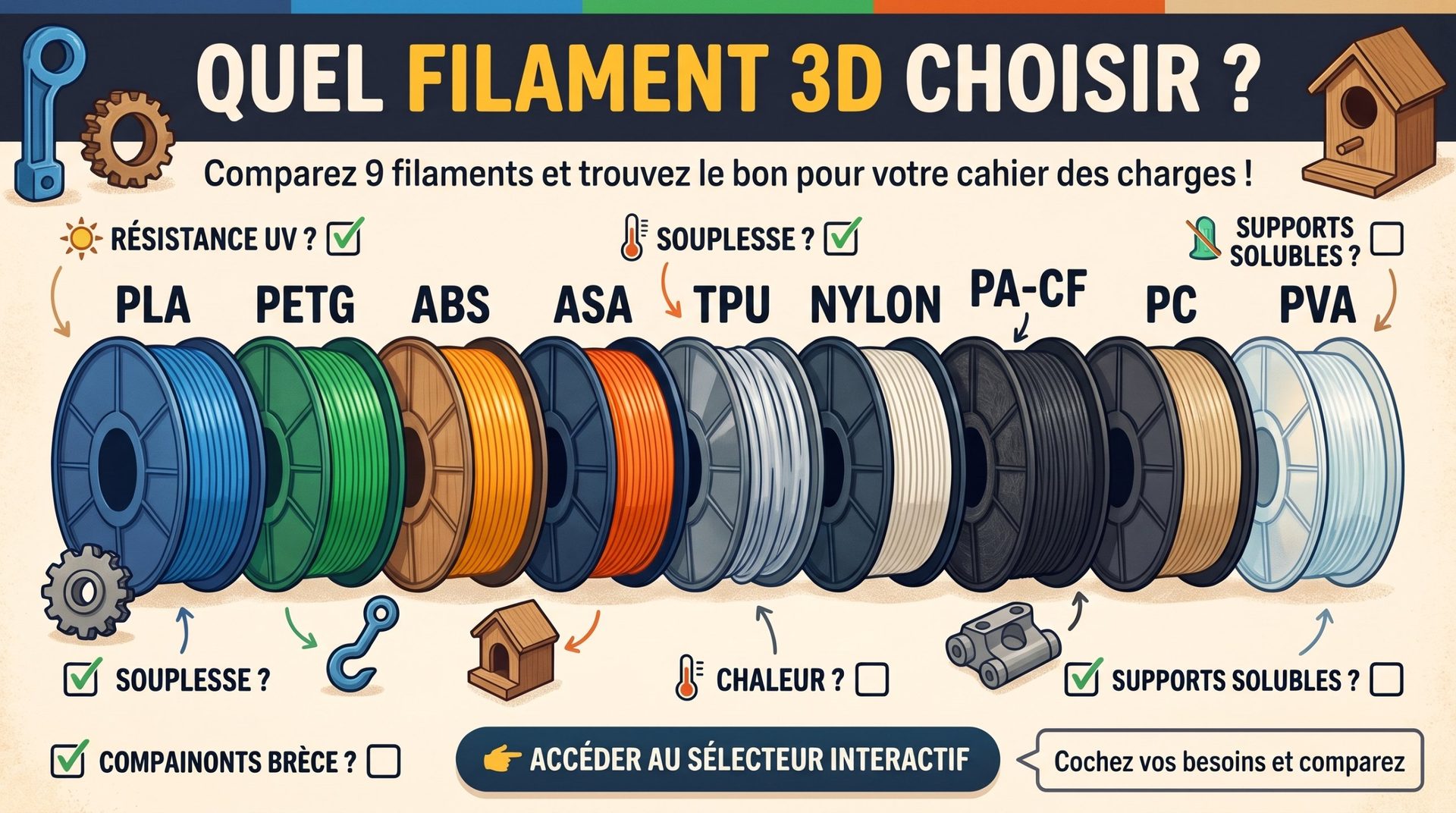
2. Overview of the 9 essential filaments
Common filaments, easy to print
- PLA: the king of prototyping and decoration. It prints on all machines, with no odor. However, it softens at just 50–60 °C and degrades in sunlight.
- PETG: the ideal compromise. More resistant to impacts and water than PLA, it holds up to around 70 °C. It's the workhorse for everyday functional parts (detailed comparison: PLA or PETG).
Technical polymers, often requiring a closed chamber
- ABS: rigid and economical, ideal for indoor mechanical parts exposed to heat (80–90 °C). It fears drafts (warping) and smells during printing.
- ASA: the modern alternative to ABS. Same mechanical properties, but native UV and weather resistance. It's the go-to for gardens, marine use, or automotive: ASA for outdoor use.
- Polycarbonate (PC): pure thermal and impact resistance, holding up beyond 110 °C. It demands very high extrusion temperatures and a well-heated chamber.
Specialty and advanced materials
- TPU: the flexible champion. Nearly unbreakable and abrasion-resistant, it's used for gaskets, cases, miniature tires, or engine mounts.
- Nylon (PA): excellent friction resistance and some mechanical flexibility. Perfect for gears or hinges, but very sensitive to moisture.
- Nylon PA-CF (carbon-fiber reinforced): the stiffness and strength-to-weight champion. The fibers limit warping and deliver a stunning matte finish, but require a hardened steel nozzle.
- PVA: a water-soluble support filament. Used in dual extrusion or multi-material systems, it lets you print complex suspended shapes, then dissolves in a simple warm water bath.

3. Quick comparison table
| Filament | Rigidity | UV / Weather Resistance | Thermal Resistance | Print Difficulty |
|---|---|---|---|---|
| PLA | Medium / brittle | Poor | Poor (~50 °C) | Very easy |
| PETG | High | Medium | Medium (~75 °C) | Easy |
| ABS | High | Poor | Good (~90 °C) | Medium (chamber required) |
| ASA | High | Excellent | Good (~95 °C) | Medium (chamber required) |
| TPU | Flexible | Good | Medium (~60 °C) | Medium (direct drive recommended) |
| Nylon | High (tough) | Medium | Very good (~100 °C) | Difficult (dryer required) |
| PA-CF | Extreme | Good | Excellent (> 120 °C) | Medium to difficult (reinforced nozzle) |
| PC | Extreme | Medium | Maximum (> 115 °C) | Difficult (high temperature) |
| PVA | N/A (support) | N/A | Poor | Moisture sensitive |
Indicative values: they vary by brand and formulation. Always refer to the temperatures listed on your spool.
Find the ideal filament in 3 clicks with our selector
You have a specific project in mind but unsure which material to order? Check what your part needs (UV resistance, flexibility, heat, food contact, ease of print, soluble supports): our selector compares 12 filaments, including PLA-CF, HIPS, and PVB, and instantly guides you to the best choice for your specifications, complete with print settings for each.