What Filament to Choose for Strong 3D Printed Parts?
Choosing the right filament for 3D printing isn't just about picking "the hardest" one. Strength is a nuanced concept that depends on your application: do you need a part to resist violent impact, support heavy weight without bending, or withstand the heat of a motor?
Here's a guide to navigate the polymer jungle.

✅ The Champions of Mechanical Strength
PLA (Polylactic Acid)
-
Strength: High rigidity, but very brittle under impact.
-
Ideal for: Parts that must not deform under static load.
-
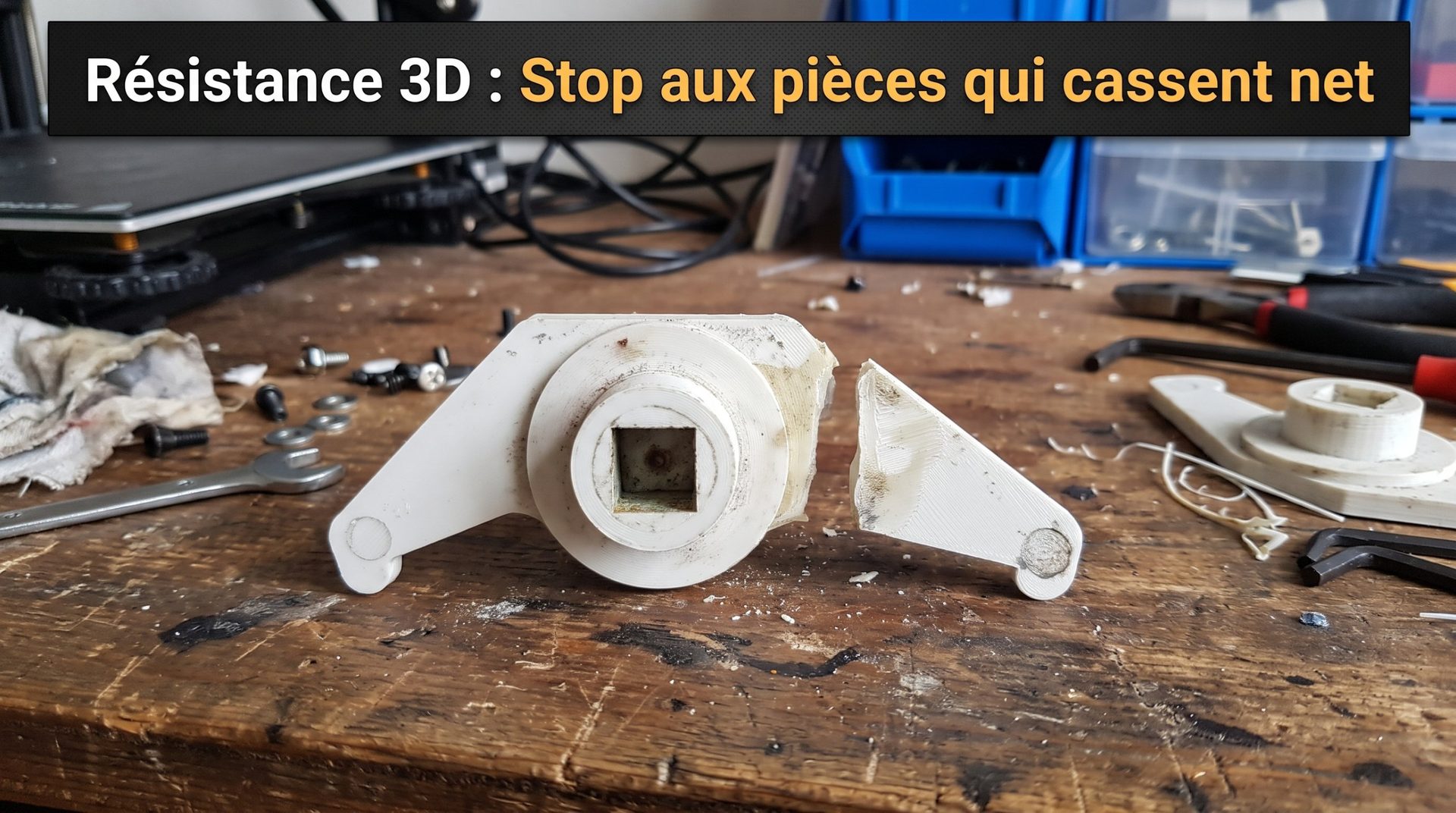
Weakness: It snaps cleanly like glass and softens starting at 55°C.
PETG (Polyethylene Terephthalate Glycol-Modified)
-
Strength: The "sweet spot". It's more flexible than PLA, allowing it to absorb impacts without breaking.
-
Ideal for: Standard mechanical parts, camera mounts, or workshop tools.
-
Advantage: Excellent layer adhesion, preventing part delamination.
ABS (Acrylonitrile Butadiene Styrene)
-
Strength: Good impact and abrasion resistance.
-
Ideal for: Parts exposed to heat (up to 90–100°C) or requiring post-processing (sanding, acetone smoothing).
-
Requirement: Needs an enclosed printer to avoid warping.
✅ The "Indestructible" Materials (Engineering)
For extreme needs, you step into technical materials.
Nylon (PA)
The king of toughness. It's extremely resistant to wear and chemicals. It almost never breaks; it deforms before rupturing.
-
Note: Very sensitive to moisture; it must be dried before printing.
Polycarbonate (PC)
One of the strongest materials available in consumer 3D printing. It offers very high thermal resistance and massive structural strength.
Reinforced Filaments (Carbon / Fiberglass)
Some filaments (often Nylon or PETG) are doped with carbon fiber.
-
Effect: This makes the part extremely rigid and lightweight.
-
Caution: These filaments are abrasive and require a hardened steel nozzle.
✅ Comparative Properties Table
| Material | Rigidity | Impact Resistance | Heat Resistance | Printing Difficulty |
| PLA | ★★★★★ | ★☆☆☆☆ | ★☆☆☆☆ | Easy |
| PETG | ★★★☆☆ | ★★★★☆ | ★★★☆☆ | Medium |
| ABS | ★★★☆☆ | ★★★★☆ | ★★★★☆ | Difficult |
| Nylon | ★★☆☆☆ | ★★★★★ | ★★★★☆ | Difficult |
| PC | ★★★★☆ | ★★★★★ | ★★★★★ | Very Difficult |
✅ The Secret to Strength: Print Settings
Material is only part of the equation. For truly robust parts, monitor these three parameters:
-
Infill Density: 40% to 60% is often enough. Beyond that, the strength gain is marginal compared to plastic consumption. Use a Gyroid pattern for uniform resistance in all directions.
-
Wall Count (Perimeter): This is the most critical factor. Adding 2 or 3 extra walls is often more effective than increasing infill.
-
Layer Adhesion: Print slightly hotter than usual to "weld" the layers together.
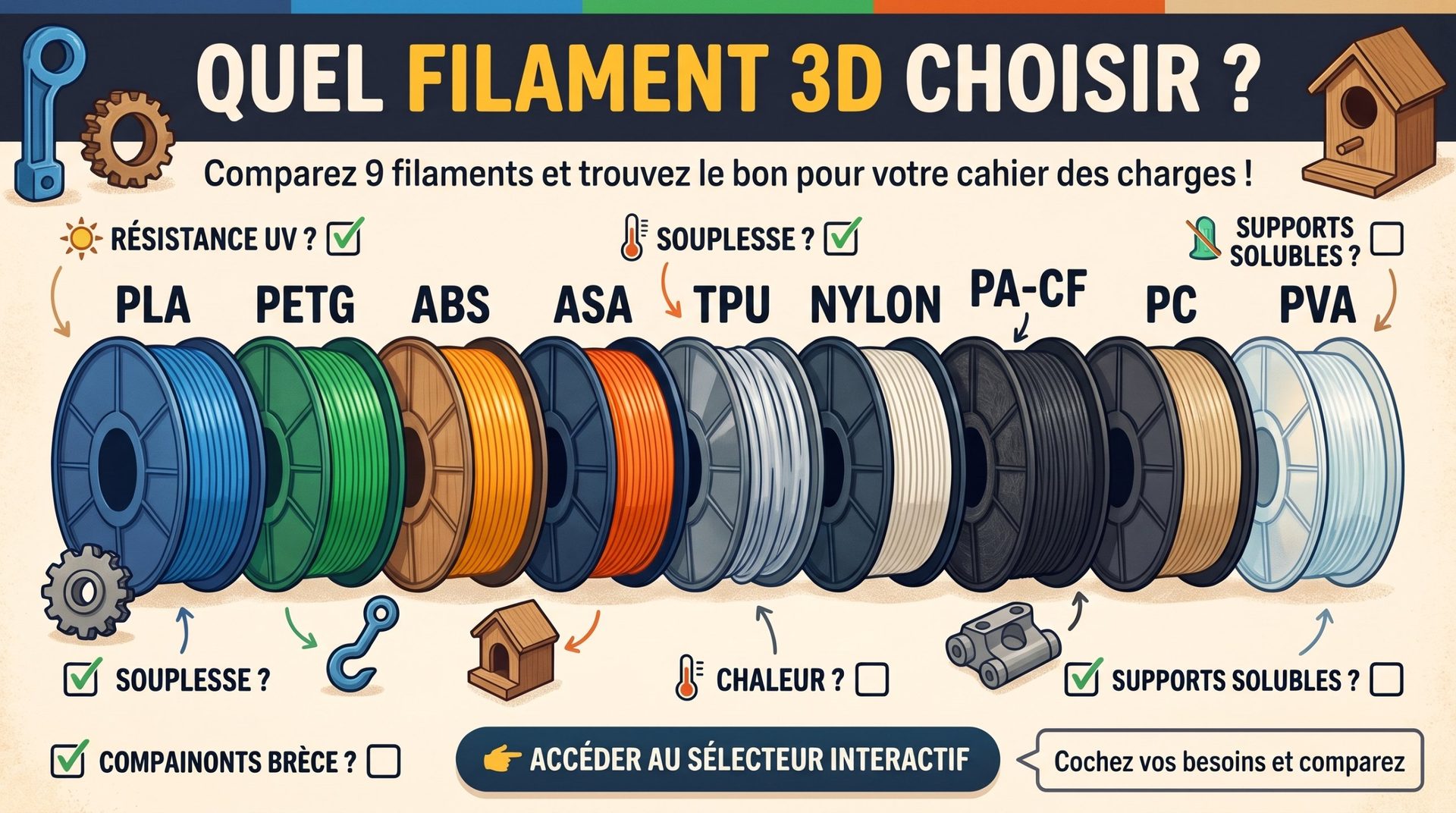
Strength, heat resistance, flexibility: check your needs in our interactive selector.