5 Fatal Mistakes Ruining Your 3D Prints (and How the Right Filament Solves 80% of the Problem)
Every maker has experienced this frustration: launch a 14-hour print, go to bed confident, and wake up to find an informless spaghetti nest or a warped part peeling off the build plate.
On 3D printing forums and groups, 9 beginners out of 10 immediately blame bed leveling, print speed, or belt tension. Yet in the vast majority of cases, the culprit isn't mechanical: it's a mismatch between the material chosen and the part being made.
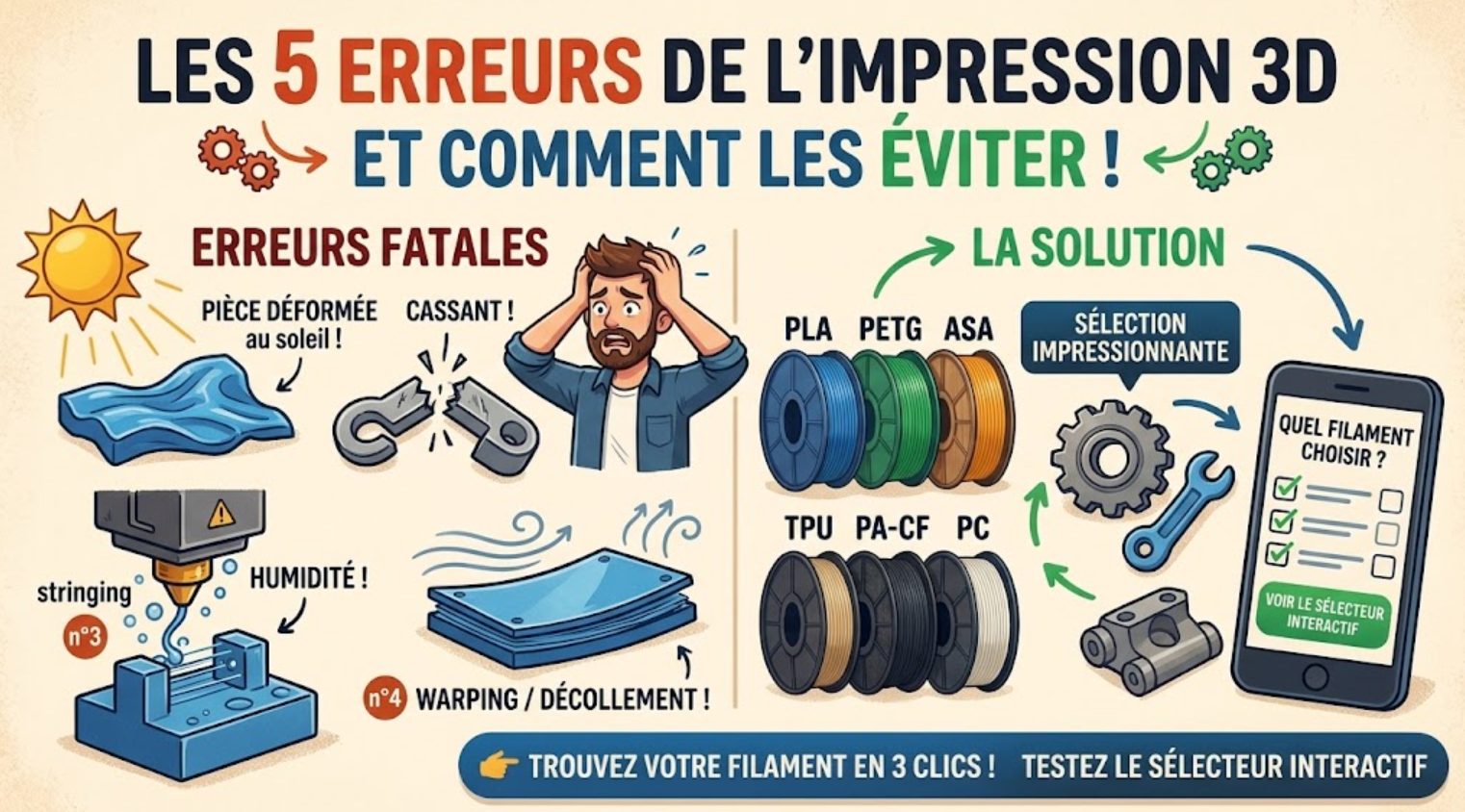
Here are the 5 most common mistakes, and the keys to never waste filament again.
Mistake #1: Using PLA for a part exposed to sunlight or in a car
PLA is fantastic: it's odorless, prints easily, and delivers beautiful finishes. But its glass transition temperature sits around 55-60 °C.
- The classic scenario: you print a phone mount for your dashboard or a hook for the garden. As soon as summer heat arrives, the part softens and sags under its own weight.
- The solution: for outdoor use and moderate heat, PETG or especially ASA, naturally resistant to UV and weathering, are essential.
Mistake #2: Chasing absolute rigidity instead of toughness
People often think a solid part must be perfectly rigid. That's wrong: a part that's too rigid is often brittle.
- The problem: a clip or hinge printed in standard PLA or resin snaps clean on the first bend.
- The solution: for parts subject to repeated impacts or vibrations, an engineering filament like Nylon (PA) or TPU (by adjusting infill) absorbs mechanical energy without breaking.
Mistake #3: Neglecting the moisture absorption of engineering filaments
You just bought a spool of Nylon or PVA for your soluble supports, and your prints have a spongy appearance, full of bubbles and stringing?
- Nylon and PVA are extremely hygroscopic: they absorb air moisture within just a few hours.
- The solution: these materials require an active filament dryer or a sealed dry box with fresh desiccant, like the AMS (see how to dry your filament).
Mistake #4: Printing ABS in a living space without an enclosure
ABS offers excellent mechanical and thermal resistance, but it has two major drawbacks:
- It releases volatile organic compounds (VOCs) and unpleasant odors during extrusion.
- It undergoes significant thermal shrinkage (warping) at the slightest air draft.
- The solution: reserve ABS for enclosed, ventilated, and filtered machines, or replace it with reinforced PETG or ASA.
Mistake #5: Picking the wrong material for a complex, expensive project
Nothing is more frustrating than printing a technical 400-gram part in polycarbonate or nylon carbon (PA-CF) only to realize afterward that the material doesn't suit the chemical or thermal environment of your project.
- The solution: before launching an expensive part, list its real constraints (heat, UV, impacts, humidity, food contact) and do a small test print in your chosen material.
Have a project in mind? Find the right material in 3 clicks
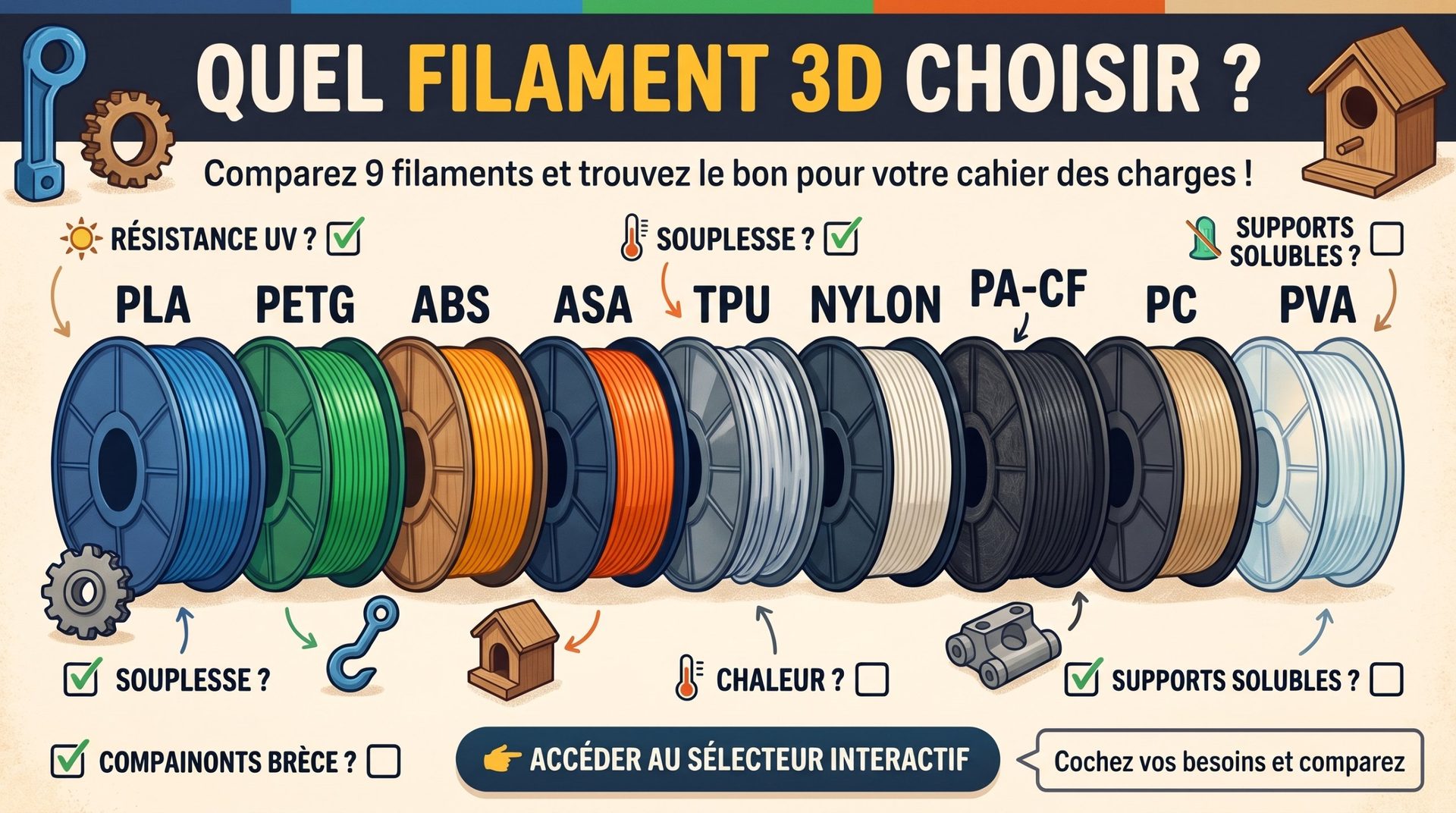
Stop guessing with your settings and filament budget. Check what your part needs: our selector compares 12 filaments (PLA, PLA-CF, PETG, ABS, HIPS, ASA, TPU, Nylon, Nylon PA-CF, polycarbonate, PVB, and PVA) and immediately points you to the right filament for your requirements.