Multi-Axis 3D Printing: When Additive Manufacturing Breaks Its Limits

Since its inception in the 1980s, 3D printing has profoundly transformed the way we design and manufacture objects. For decades, confined to three axes of movement — X, Y, and Z — this technology seemed to have reached its structural limits. Then came multi-axis 3D printing, an evolution that pushes the boundaries of what's possible and opens unprecedented possibilities for industry, medicine, aerospace, and countless other fields.
But what exactly is multi-axis printing? And why does it represent such a major turning point? Let's explore this together.

✅ The Limitations of Traditional 3D Printing (3 Axes)
To understand the value of multi-axis printing, you first need to grasp the constraints of traditional systems.
Standard FDM (Fused Deposition Modeling) deposits material layer by layer, from bottom to top. This approach poses several problems:
- Overhangs: Any geometry that "sticks out" into empty space must be supported by temporary structures, which are often difficult to remove and cause surface defects.
- Mechanical anisotropy: Layer-by-layer printed parts are more fragile in the Z direction, since bonds between layers are weaker than the material itself.
- Surface resolution: The "staircase effect" remains an aesthetic and functional challenge on curved surfaces.
- Complex geometries: Certain shapes are simply impossible to print without excessive supports.
Multi-axis 3D printing solves much of these limitations by adding extra degrees of freedom to the print head or build platform.
✅ What is Multi-Axis 3D Printing?
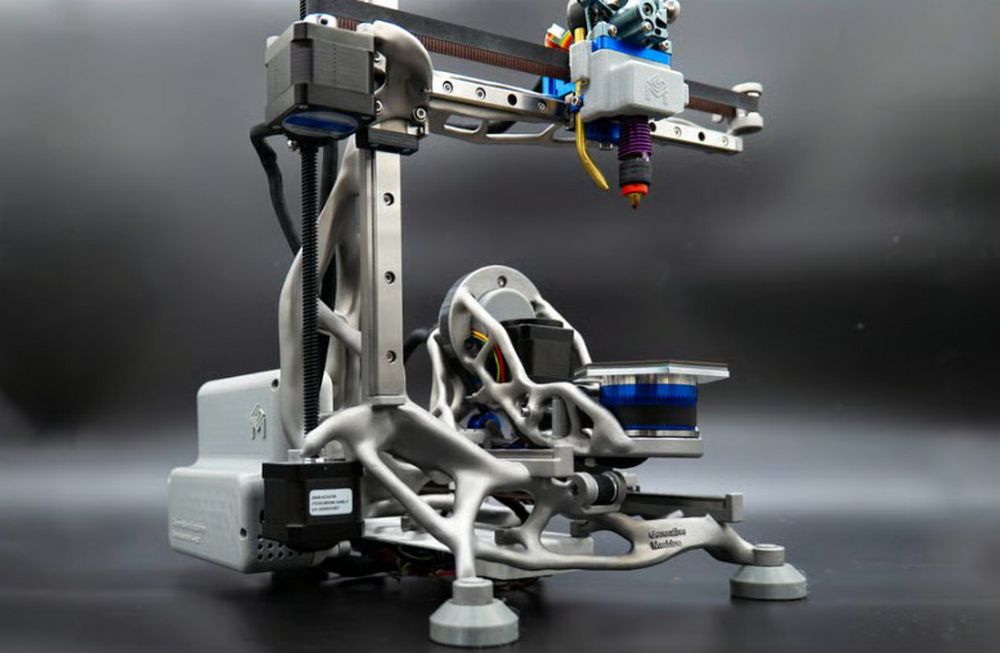
We talk about 4, 5, 6-axis, or even more printing when the print head or build plate can move and/or rotate in additional directions.
4 and 5-Axis Systems
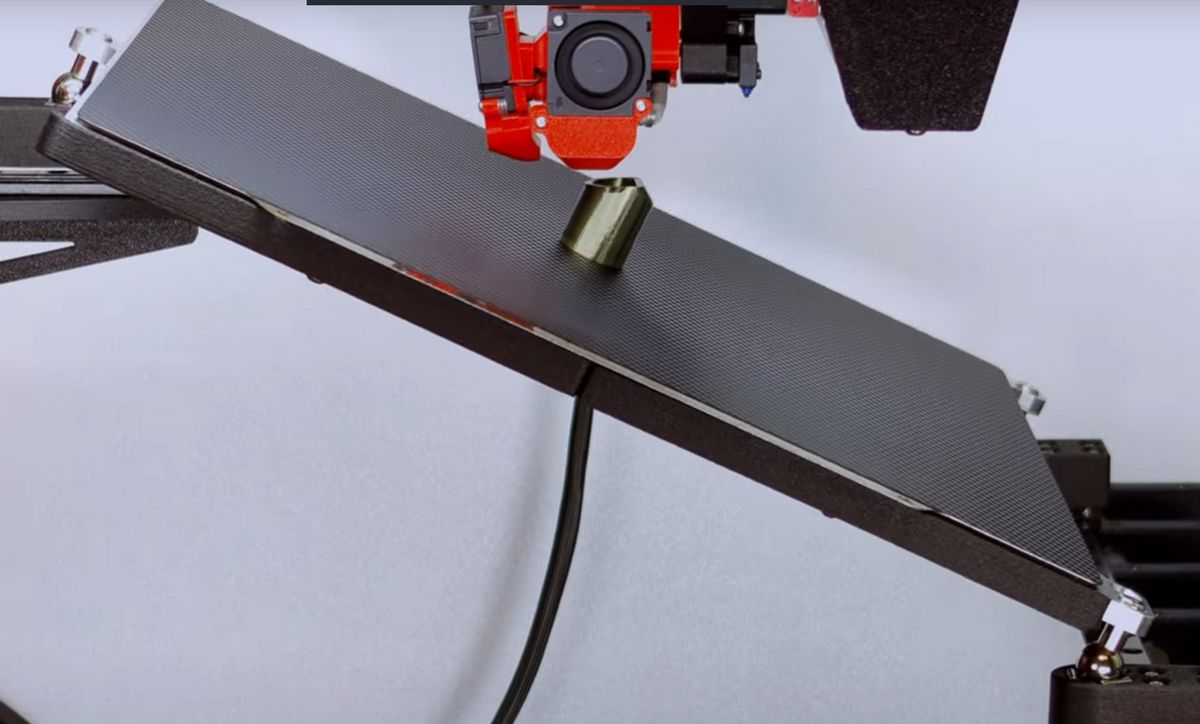
A 4-axis system adds rotation around one axis (often to rotate the part during printing). A 5-axis system adds an additional tilt, allowing the nozzle to deposit material at different angles.
Result: the head can approach a surface at any angle, which makes it possible to:
- Print without supports on complex geometries
- Deposit material in the direction of mechanical stresses (structural reinforcement)
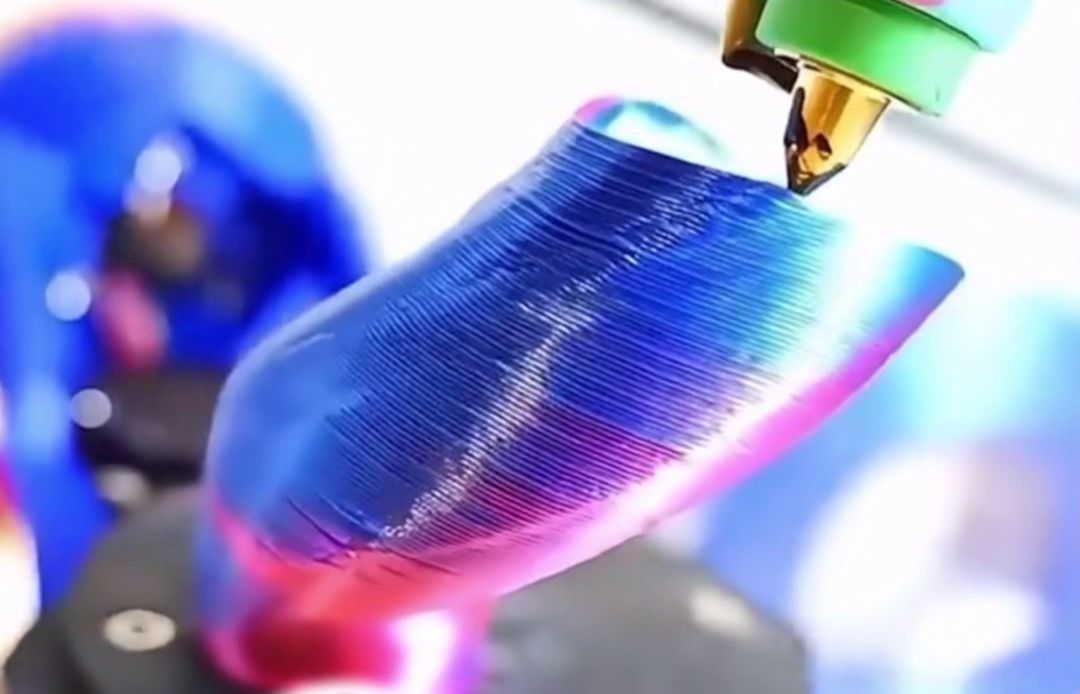
- Achieve smooth surfaces on curved parts
6-Axis and Robotic Systems
6-axis robotic arm printers take this a step further. Inspired by industrial welding and painting robots, these systems offer nearly complete freedom of movement. The nozzle can move through space in a completely fluid way, following complex trajectories impossible for a traditional gantry.
Companies like Stratasys, Markforged, and startups like Meltio and MX3D (famous for their steel bridge printed by robot in Amsterdam) are actively exploring these architectures.
✅ Concrete Advantages of Multi-Axis
1. Near-Total Support Elimination
This is the most immediate advantage. By tilting the nozzle or the part, you can print overhangs without generating temporary support structures. This reduces:
- Material waste
- Post-processing time
- Risk of part damage when removing supports
2. Mechanical Optimization
By orienting material deposition along stress lines (obtained through finite element analysis), you can create mechanically optimized parts. Fibers or layers follow the flow of forces, like in nature (think of bones or nutshells).
This is particularly powerful when combined with continuous fiber printing (carbon, glass, Kevlar), where fiber orientation is decisive for final performance.
3. Superior Surface Quality
Curved trajectories allow surfaces to be smoothed naturally, avoiding the "staircase effect" inherent to stacking horizontal layers. Parts are closer to the final CAD result, reducing post-processing needs (sanding, painting).
4. Previously Impossible Geometries
Some parts simply cannot be manufactured by a 3-axis machine without compromising their integrity. Multi-axis printing allows you to tackle organic shapes, complex lattice structures, or curved internal channels — particularly useful in aerospace or heat exchangers.
✅ Industrial Applications
Aerospace and Defense
The aerospace industry is one of the first to benefit from multi-axis printing. Manufacturing lightweight, durable, and complex-shaped parts — turbine blades, structural brackets, ducts — is greatly simplified. Reducing weight while maintaining structural strength is a paramount requirement in this sector.
Medical and Prosthetics
Custom-made bone implants and prosthetics directly benefit from the geometric freedom of multi-axis printing. Porous structures mimicking the architecture of cancellous bone, printed in titanium alloys or biocompatible polymers, promote better bone integration.
Energy and Industry
On-site repair of heavy equipment — turbines, casting parts — using multi-axis additive manufacturing robots is rapidly expanding. Rather than disassembling and replacing an expensive part, you can rebuild it in place.
Architecture and Construction
MX3D demonstrated that it was possible to print a pedestrian footbridge in steel on public land in Amsterdam using an articulated robot. Other projects are exploring concrete printing by multi-axis robotic arms for architectural structures impossible to form using traditional methods.
✅ Challenges to Overcome
As promising as it is, multi-axis 3D printing is not without obstacles.
Software complexity is the first barrier. Generating print trajectories in 5 or 6 axes requires slicing software far more sophisticated than 3-axis equivalents. Tools like Dyndrite, Siemens NX AM, and Aibuild are starting to address this need, but the learning curve remains steep.
Cost is the second obstacle. Multi-axis machines are significantly more expensive to purchase and maintain. Integration into an existing production chain requires substantial human and financial investment.
Calibration and repeatability also pose challenges. The more degrees of freedom a system has, the more complex it is to calibrate to ensure consistent precision.
Finally, certification in regulated sectors (aerospace, medical) takes time. Standards are evolving, but qualifying parts manufactured by these innovative processes remains a demanding undertaking.
✅ The Future of Multi-Axis
The outlook is exciting. Several trends are emerging for the coming years:
- Hybrid additive/subtractive manufacturing: machines that print and machine in the same cycle, guaranteeing tight tolerances on complex parts.
- In-situ printing: mobile robots capable of printing directly onto existing structures to repair or augment them.
- Artificial intelligence for slicing: algorithms capable of automatically generating optimal trajectories while accounting for mechanical, thermal, and geometric constraints simultaneously.
- Democratization: as costs drop and software simplifies, multi-axis will become accessible to SMEs and research laboratories.
✅ Conclusion
Multi-axis 3D printing is not a simple incremental improvement — it's a paradigm shift. By freeing the print head from the tyranny of horizontal layers, it opens a radically new design space. Parts become lighter, stronger, more precise, and their manufacture generates less waste.
We are still in the early stages of this revolution. But the signals are clear: in the factories, hospitals, construction sites, and laboratories of tomorrow, multi-axis machines will play a central role. For engineers, designers, and entrepreneurs, the time has come to familiarize yourselves with these technologies before they become indispensable.