3D Printing Evolution: How CoreXY Architecture Became the New Standard

For nearly a decade, the consumer and semi-professional 3D printing landscape has been dominated by an ultra-familiar silhouette: the classic "Cartesian" architecture (or Bed Slinger). On these machines, the print head moves left to right, while the heated build plate moves forward and backward to create the Y-axis.
But times are changing. Today, whether in prototyping workshops or among enthusiasts, one message rings loud and clear: CoreXY. Once reserved for experts, this kinematics system is now establishing itself as the market's inescapable standard, completely redefining the boundary between hobbyist and industrial-grade 3D printing.
✅ What is CoreXY Architecture?
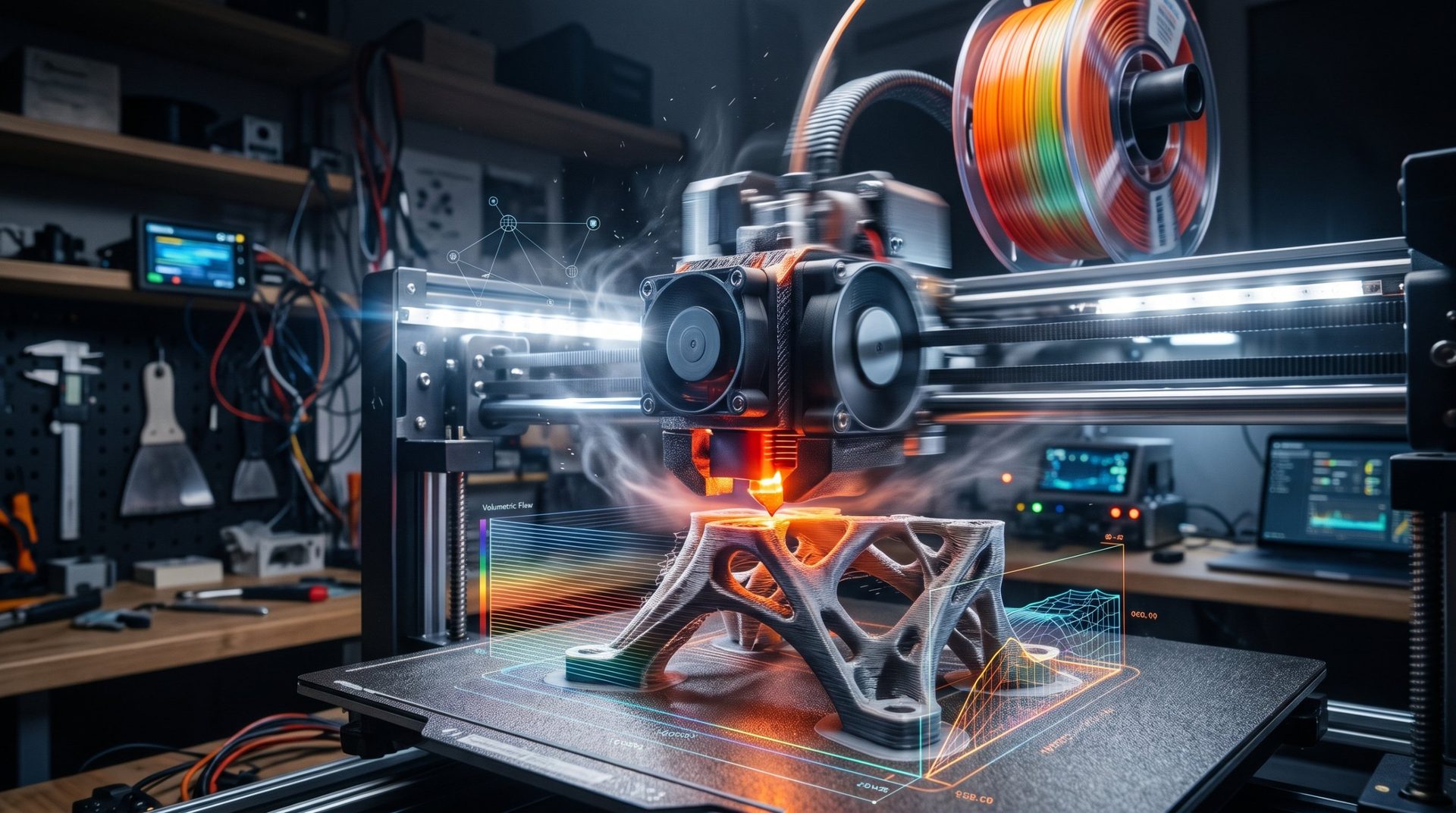
To understand its success, you first need to understand its mechanics. Unlike a classic Cartesian printer, a CoreXY printer uses a system of crossed belts and two fixed motors (typically located at the rear of the machine) to move the print head along both the X-axis (left/right) and Y-axis (front/back). The build plate, meanwhile, moves only vertically (Z-axis), descending as the object takes shape.
This rigid cubic structure offers a crucial advantage: it allows the machine to be hermetically sealed.
✅ The Pillars of Rapid Success
If CoreXY is relegating Bed Slingers to the background, it's because it solves the physical limitations inherent to the older generation through three massive advantages.
1. Pure Speed Without Quality Loss
On a classic printer, the build plate supports the weight of the piece. As the object grows larger, the mass in motion creates inertia and vibrations, causing ghosting (surface undulations). With CoreXY, the print head is ultra-lightweight and the motors are fixed. Less moving mass means you can push accelerations (often beyond $10,000 \text{ mm/s}^2$) and reach speeds of 500 to 600 mm/s without sacrificing precision.
2. Unmatched Print Consistency
The fact that the build plate only moves on the Z-axis changes everything. The piece remains perfectly still throughout the entire print. There's no risk of a tall, thin part peeling off due to sudden build plate movement.
3. The Thermal Revolution: Active Heated Chamber
This is where CoreXY architecture reveals its greatest modern advantage. Its native cubic structure has enabled the widespread introduction of active heated chambers (maintained between 60 and 65°C).
Previously, most enclosed printers relied only on passive heat from the build plate. Now, a dedicated heating system actively controls the ambient air temperature. This innovation finally allows printing of ultra-resistant technical polymers like PA-CF (Nylon carbon fiber-reinforced) or PC (Polycarbonate) without any risk of warping (part lifting or deformation due to thermal shock).
✅ The Era of "Industrial Democratization"
This technological leap marks a historic turning point. What was still yesterday an exclusive privilege of industrial machines costing tens of thousands of euros is now accessible to advanced makers, SMEs, and laboratories for a fraction of that price.
For years, CoreXY remained the domain of complex Open Source projects requiring custom builds (like the Voron Design project). The real turning point came when manufacturers industrialized this turnkey concept. The arrival of brands like Bambulab (with its X1 series), followed by replicas from giants like Creality (K1, K2) or Qidi Tech, now puts professional-grade performance in the hands of everyone.
✅ Industrial Applications
Aerospace and Defense
The aerospace industry is one of the first to benefit from multi-axis technology. Manufacturing lightweight, resistant parts with complex shapes — turbine blades, structural supports, ducts — is greatly simplified. Reducing weight while maintaining structural resistance is a critical requirement in this sector.
Medical and Prosthetics
Custom bone implants and prosthetics directly benefit from the geometric freedom of multi-axis printing. Porous structures mimicking spongy bone architecture, printed in titanium alloys or biocompatible polymers, promote better osseointegration.
Energy and Industry
On-site repair of heavy equipment — turbines, foundry parts — using multi-axis additive manufacturing robots is rapidly expanding. Rather than dismantling and replacing an expensive part, you can rebuild it in place.
Architecture and Construction
MX3D demonstrated that it was possible to 3D print a steel pedestrian bridge in public space in Amsterdam using an articulated robot. Other projects are exploring concrete printing by multi-axis robotic arms for architectural structures impossible to form using traditional methods.
✅ Conclusion: The New 3D Printing Standard
While classic Cartesian printers (Bed Slingers) retain utility in the ultra-budget segment (under €200), they have definitively lost the performance battle.
For anyone seeking productivity, speed, and especially the ability to produce functional, technical parts, the question is settled. CoreXY architecture, combined with active thermal control, has established itself as the new industry standard.