What Is a 5-Axis 3D Printer? How It Works, Advantages, Applications
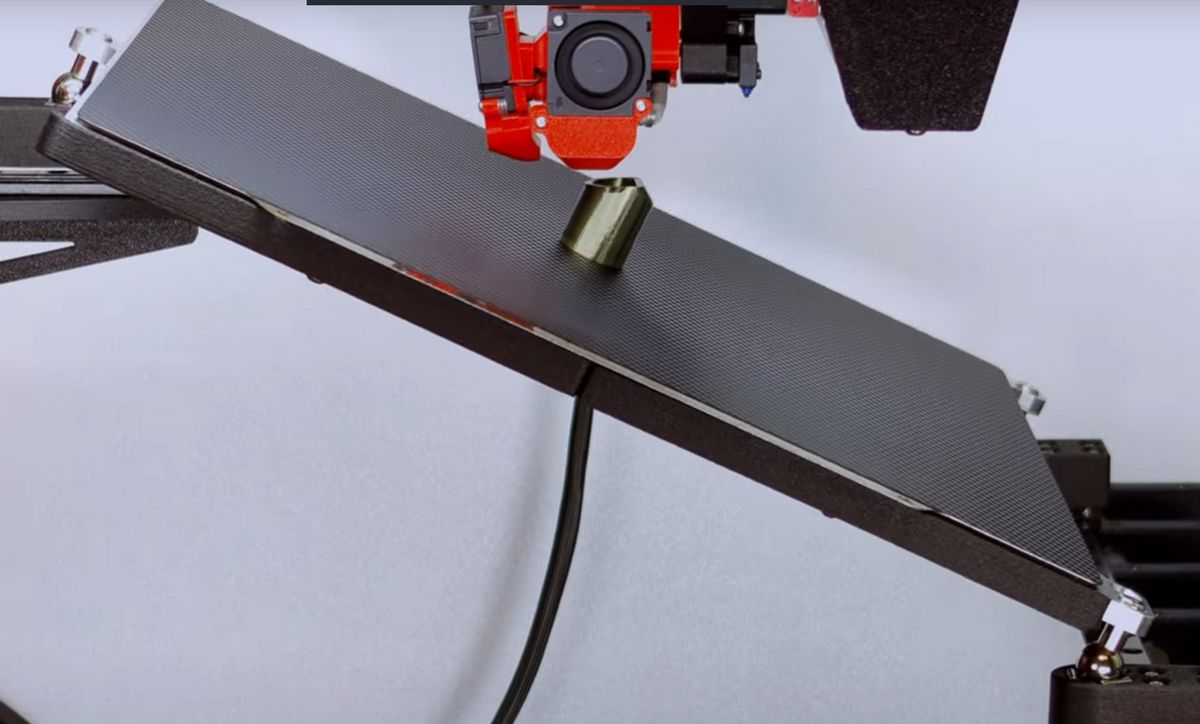
Traditional 3D printing, with its three axes (X, Y, Z), has revolutionized the way we design and produce objects. However, this "layer-by-layer" manufacturing method has inherent limitations, particularly the need for supports on overhangs and anisotropy in parts (unequal strength depending on direction). This is where the 5-axis 3D printer comes in—a cutting-edge technology that promises to free additive manufacturing from its most fundamental constraints, opening the door to more complex geometries, more robust parts, and more efficient processes.
What Is a 5-Axis 3D Printer?
(Image and Video Source: @multipoleguy via Youtube)

How a 5-axis printer works is fundamentally more complex than a 3-axis machine, mainly at the software level:
- 3D Modeling: The process always starts with a 3D model designed in CAD software.
- Advanced Slicing Software (Slicer): This is the heart of 5-axis innovation. A traditional slicer can't handle rotational movements. 5-axis printers require specialized CAM software (Computer-Aided Manufacturing) or slicers capable of:
- Analyzing the part's geometry to identify critical zones (overhangs, shallow angles).
- Determining the optimal orientation of the nozzle and/or the part for each printing segment.
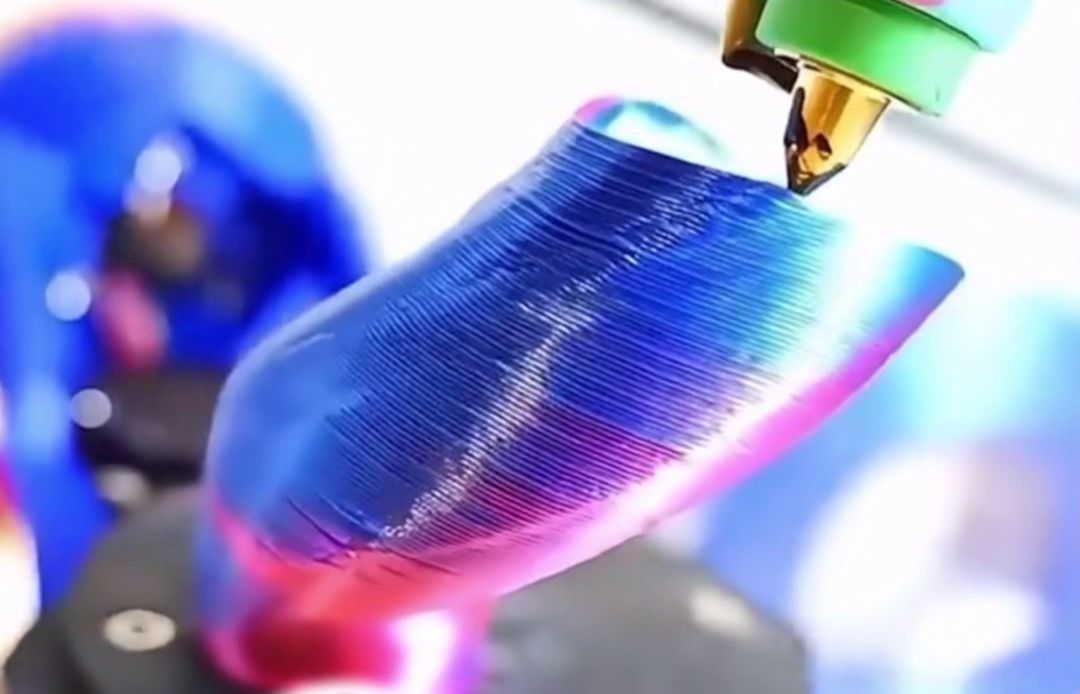
- Generating a complex toolpath that uses all 5 axes to deposit material non-planar, following the object's curves rather than stacking perfectly horizontal layers.
- Printing Process: The printer executes commands from the G-code generated by the slicer/CAM, tilting and rotating the nozzle or build plate as needed to construct the part optimally.
How Does 5-Axis 3D Printing Work?
The 3MF format was developed by the 3MF Consortium (including giants like Microsoft, HP, Autodesk, Dassault Systèmes, etc.) to address STL's shortcomings and provide a more complete and reliable solution for modern additive manufacturing.
How It Works:
- 3MF is an XML-based format that brings together all relevant information in a single compressed file (.3mf). It's like a ZIP file containing all necessary data.
- It describes the object's geometry, but much more than that.
Advantages (compared to STL):
- Rich Integrated Information:
- Color and Texture: 3MF can include color information (per vertex, per face) and textures (standard, PBR - Physically Based Rendering), enabling photorealistic prints.
- Multiple Materials: It can define and assign different materials to different model parts in a single file, essential for multi-material printers.
- Units of Measurement: Units are explicitly defined in the file, eliminating scaling issues.
- Support Information: Can include data on generated supports or other printing-specific instructions.
- Metadata: Allows integrating information about the author, license, model properties, etc.
- Reliable and Improved Geometry:
- Designed to ensure a "watertight" and error-free mesh, significantly reducing common STL problems (holes, inverted normals).
- Can represent volumetric information (not just the surface) and even complex geometries (like implicit shapes) more efficiently.
- One File, Everything Included: Instead of having an STL file for geometry, image files for textures, and notes for materials, 3MF contains all this data in one package. This simplifies project management, sharing, and reduces errors.
- Open and Extensible: The format is open and can be extended for future features or industry-specific needs (for example, extensions for slice cutting, build material management, etc.).
Revolutionary Advantages of 5-Axis 3D Printing
Adding these two extra axes unlocks capabilities that were previously major limitations for 3D printing:
- Drastic Reduction or Complete Elimination of Supports: This is the most significant advantage. By tilting the part, overhangs can be printed at an optimal angle, requiring little to no support structures. This reduces material waste, post-processing time, and improves surface aesthetics.
- Improved Mechanical Properties (Isotropy): Parts printed in 3 axes are typically anisotropic, meaning they're weaker between layers. By printing along curved contours or crossing extrusion paths with adjacent layers thanks to 5-axis movements, inter-layer adhesion improves. The final parts are then stronger in all directions, approaching the properties of molded or machined parts.
- Better Surface Quality: By printing directly on curved surfaces, the characteristic "stair-stepping" effect from layers is greatly reduced, giving parts a smoother, more aesthetic finish.
- Direct Printing on Existing Components: The ability to orient the nozzle allows printing directly onto parts or already-existing surfaces, opening the door to repairing damaged parts or adding features to prefabricated objects.
- Increased Design Freedom: Designers are no longer constrained by overhang limits or layer orientation, enabling the creation of even more complex and optimized geometries.
Challenges and Obstacles to Adoption
Despite its undeniable advantages, 5-axis 3D printing faces several challenges:
- Software Complexity: Developing high-performance slicers/CAM capable of efficiently handling 5 axes is the main hurdle. The software must generate collision-free trajectories and optimize printing angles.
- High Cost: 5-axis printers are complex machines, making them much more expensive than their 3-axis counterparts.
- Operational and Calibration Complexity: Setting up and maintaining a 5-axis printer is more demanding, requiring advanced technical skills.
- Reduced Build Volume: The movement of the bed or head can sometimes reduce the usable build volume for certain designs.
Potential and Current Applications
5-axis 3D printing is currently an active research and development field, but it's beginning to find promising applications in demanding sectors:
- Aerospace and Space: For lightweight, ultra-optimized parts requiring maximum structural integrity and defect-free performance.
- Medical: Manufacturing implants, prosthetics, or orthoses with complex shapes and isotropic strength crucial for performance and safety.
- Tool and Mold Fabrication: Creating molds and tools with superior detail and surface finish, without the need for intensive post-processing.
- R&D and Advanced Prototypes: Pushing the limits of product design and testing new manufacturing approaches.
- Repair and Customization: Adding material or precisely repairing existing parts with robustness.
The 5-axis 3D printer represents a major advancement that transcends the fundamental limitations of traditional 3D printing. By enabling parts to be manufactured without supports, with improved strength and better surface finish, it opens the door to high-value industrial applications. While the technology is still costly and software continues to evolve, the potential of 5-axis additive manufacturing is immense. It brings us closer to true "three-dimensional manufacturing freedom," where geometric constraints fade in favor of innovation and efficiency.