🧠 AI and 3D Printing: Toward Autonomous and Optimized Manufacturing

Updated November 18, 2026
Artificial intelligence (AI) is no longer just making marginal improvements to 3D printing—it's involved at nearly every step, from design to the finished part. What once required craftsmanship and endless trial-and-error is becoming a more reliable, faster, and more cost-effective production process.
Here's how AI is changing the game in additive manufacturing, and where its limits still lie.

✅ Parameter and Slicing Optimization
Finding the right settings (temperature, speed, flow rate, retraction) for each filament and geometry used to require long rounds of testing.
Today, slicers offer ready-to-use profiles and increasingly advanced automatic features: part orientation, tree supports, adaptive infill, alerts on thin walls or overhangs. Recent printers calibrate flow rate, vibrations (input shaping) and pressure compensation on their own. Some research tools go further and adjust parameters layer by layer using models trained on thousands of prints, but these remain rare for hobbyists.
✅ Generative Design
This is one of the most spectacular contributions. Instead of drawing the part, the engineer specifies constraints (loads, mounting points, material) and the software explores many variants to propose the lightest and strongest geometry. The result is lattices and organic shapes that would be difficult to manufacture any other way, but ideal for 3D printing: lightweight parts for aerospace, sports, or even the printers themselves.
✅ Quality Control and Real-Time Monitoring
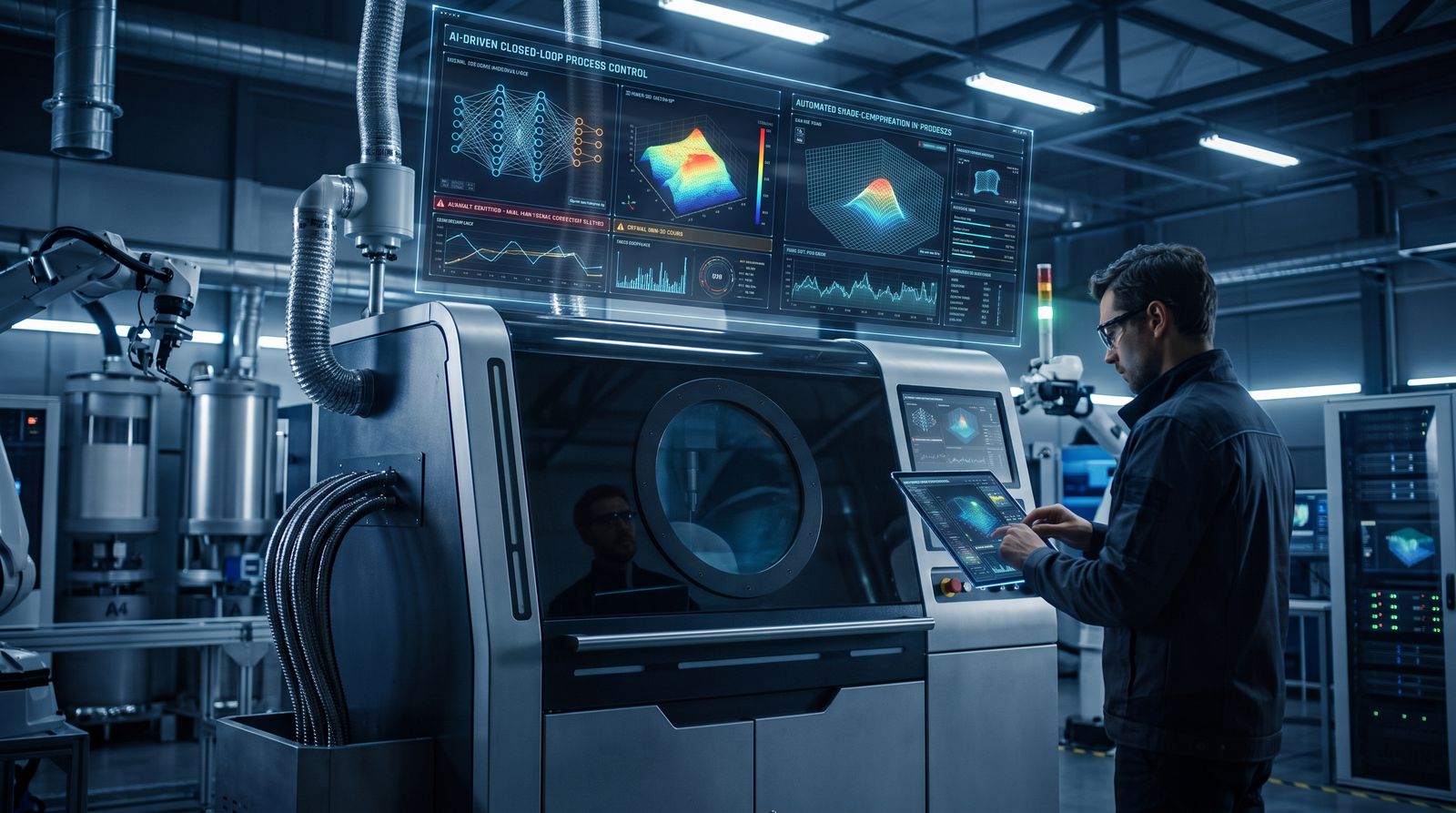
With cameras and sensors, AI monitors the print layer by layer. It spots common problems: lifted objects, corner warping, "spaghetti" jams or a clogged nozzle, and pauses the print before wasting filament. The most advanced systems, especially industrial ones or those from research, go further: they adjust flow, temperature, or speed in real-time. We detail these advances in from simple alerts to real-time auto-correction.
✅ Automation and Predictive Maintenance
In print farms, AI helps distribute jobs across machines and minimize downtime. By analyzing printer data (vibrations, heating cycles, motor temperatures), it's also starting to predict belt wear or heater cartridge failure before it breaks: that's predictive maintenance.
In short, AI makes 3D printing more reliable and more accessible, and closes the gap between prototype and small-batch production. That said, it doesn't replace maker expertise: material choice, design suited to the application, and dimension verification remain essential. For the full picture, step by step, read AI at every stage of 3D printing.