3D Printing and AI: From Simple Alerts to Real-Time Auto-Correction
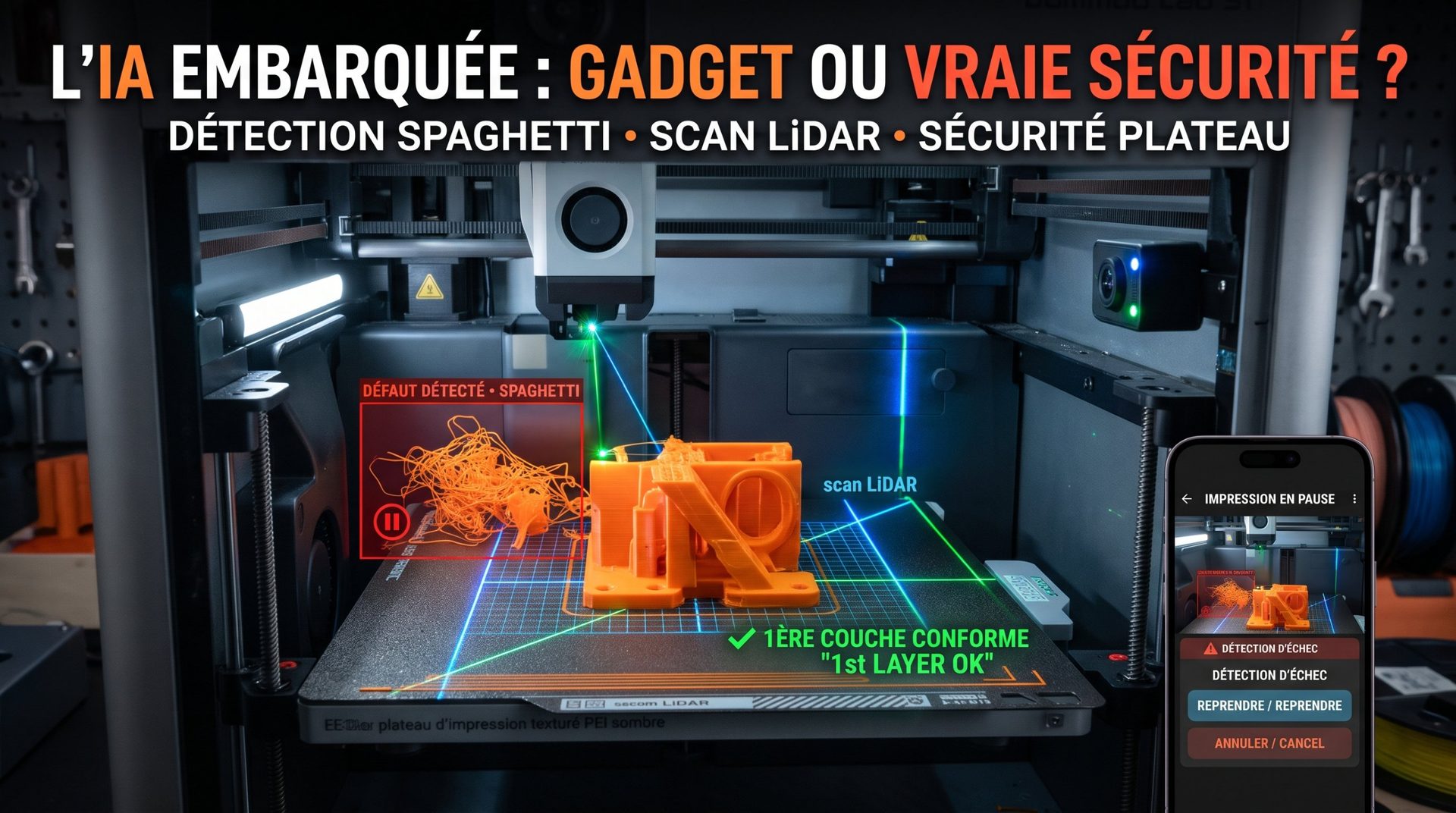
For a long time, artificial intelligence built into 3D printers amounted to a passive sentinel function. A camera trained on the build plate would detect the appearance of a filament blob (the infamous "spaghetti nest") or sudden detachment, then stop the print to minimize damage. Useful, certainly, but the part was already ruined and the filament irretrievably wasted.
Today, a silent revolution is unfolding: the shift from failure detection to closed-loop control via neural vision. AI no longer just spots errors—it corrects them in real time.
1. Computer Vision to Micron Precision
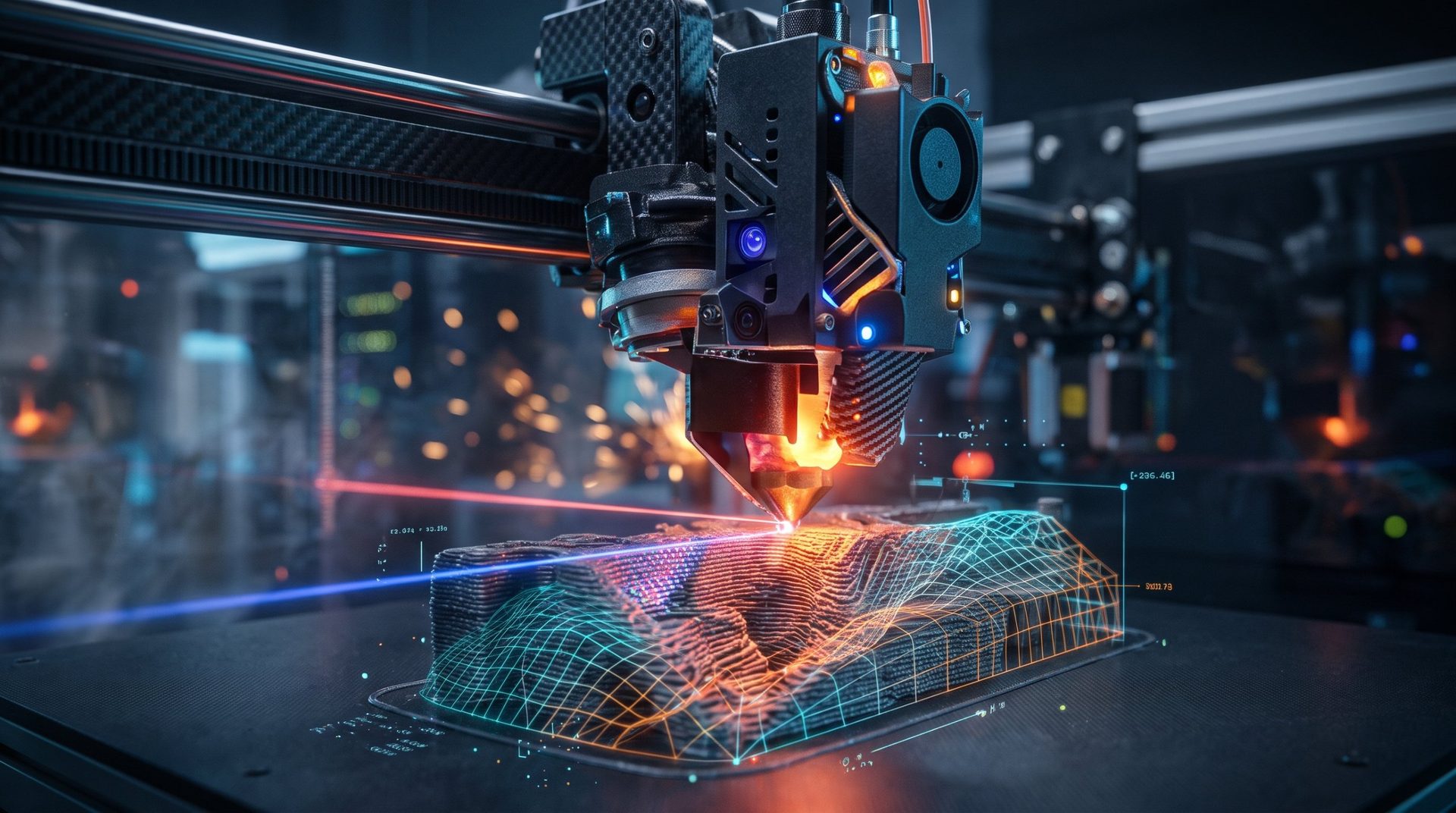
At the heart of this technology, high-speed cameras and laser sensors continuously analyze the strand of material laid down by the nozzle. Thanks to deep learning models trained on millions of extrusion layers:
- Early anomaly detection: the system immediately catches even a tiny under-extrusion, the start of curling on a corner, or an adhesion instability—long before they become critical.
- Dimensional mapping: each printed layer is compared in real time to the theoretical CAD model sliced by the slicer.
2. Dynamic Parameter Adjustment During Print
The real breakthrough lies in the algorithm's ability to react without stopping the cycle:
- Flow rate regulation (dynamic flow rate): if the camera detects a shortage of material or a change in filament diameter, the extrusion flow is compensated on the fly.
- Thermal and kinematic adaptation: the printer can instantly adjust the hotend temperature by a few degrees, or reduce acceleration on a delicate section to give the polymer time to stabilize.
- Compensation on the next layer: in case of a slight dip in one pass, the system automatically recalculates layer height and the next pass trajectory to fill the gap, with no extra thickness.
This logic of autonomy is the same one driving the emergence of autonomous 3D printing farms.
3. Critical Impact on Technical Materials
While this technology is a game changer for simple PLA, it becomes essential as soon as you work with technical polymers:
- Nylon PA-CF and polycarbonate: expensive materials where each failed print weighs heavily on the shop budget.
- TPU and elastomers: notoriously known for their unpredictable viscoelastic behavior and flow variations depending on humidity.
To compare these materials, try our filament selector.
By transforming printers into autonomous cells capable of learning and adapting to the vagaries of material, AI removes the last barrier to additive manufacturing: outcome uncertainty.