
🧠 AI Becomes Your True 3D Printer Copilot

Say goodbye to the days of watching your machine like a hawk. In 2026, AI is moving into our workshops to transform 3D printing into a seamless, predictive experience that's finally accessible to everyone.

✅ The End of Failed Prints
We've all been there: pulling a tangled blob of plastic after 12 hours of printing. Thanks to computer vision, AI now analyzes the video stream in real time.
-
Predictive detection: It spots even the slightest bed adhesion loss or layer shift before the error becomes critical.
-
Auto-correction: The most advanced models, like those in the Bambu Lab X2D range, dynamically adjust parameters (speed, temperature) to save the ongoing print.
✅ Predictive Maintenance: It Talks to You
Your printer no longer breaks down—it warns you. By analyzing micro-vibrations in the motors and belt tension, AI detects wear before it becomes critical. That's your guarantee of a fully operational machine fleet, whether you're a maker or a factory.
✅ Intelligent Slicing
Converting a 3D file to a print (the slicing process) used to be an expert's job. Today, Deep Learning algorithms take over:
-
Optimal orientation: AI calculates the perfect angle to guarantee the best finish while minimizing supports.
-
Adaptive density: It automatically reinforces weak points in your object without wasting material where it's not needed.
✅ No More Waste: AI vs. the Purge Tower
The biggest flaw in traditional multi-color printing is the plastic waste (the purge tower) needed to clean the nozzle between colors. AI brings two game-changing solutions:
-
Internal purge (Infill Purging): AI calculates exactly how much residual color can be "hidden" inside the object (in the infill) to clean the nozzle without wasting a gram of filament on the outside.
-
Path optimization: It reorganizes the print order of parts to minimize filament changes, cutting print time by up to 40%.
✅ Smart Color Mapping (Assisted Colorization)
No more spending hours selecting each face of your 3D model to assign colors.
-
Shape recognition: AI analyzes your file (a character, logo, or architectural model) and automatically suggests a cohesive color palette.
-
Intelligent segmentation: It knows how to distinguish "skin," "clothing," or "windows" on a model and applies colors logically in one click.
The union of artificial intelligence and 3D printing marks the end of one era—that of sometimes frustrating technical craftsmanship—and the beginning of an era of smart, frictionless production.
In 2026, the 3D printer is no longer a simple machine that follows orders; it has become an autonomous system capable of seeing, understanding, correcting its own mistakes, and even optimizing our designs beyond our human abilities.
Key Takeaways:
-
Accessibility: AI removes technical barriers (slicing, modeling) so everyone can create.
-
Reliability: With an integrated copilot, failure rates approach zero, making the technology viable for heavy industry and home hobbyists alike.
-
Sustainability: Fewer failed prints and optimized designs mean less wasted plastic.
In short, if the 3D printer is the arm of creation, artificial intelligence is now its brain. This synergy does more than manufacture objects: it redefines the limits of our imagination. The future isn't just printed in three dimensions—it's printed with intelligence.
Read also
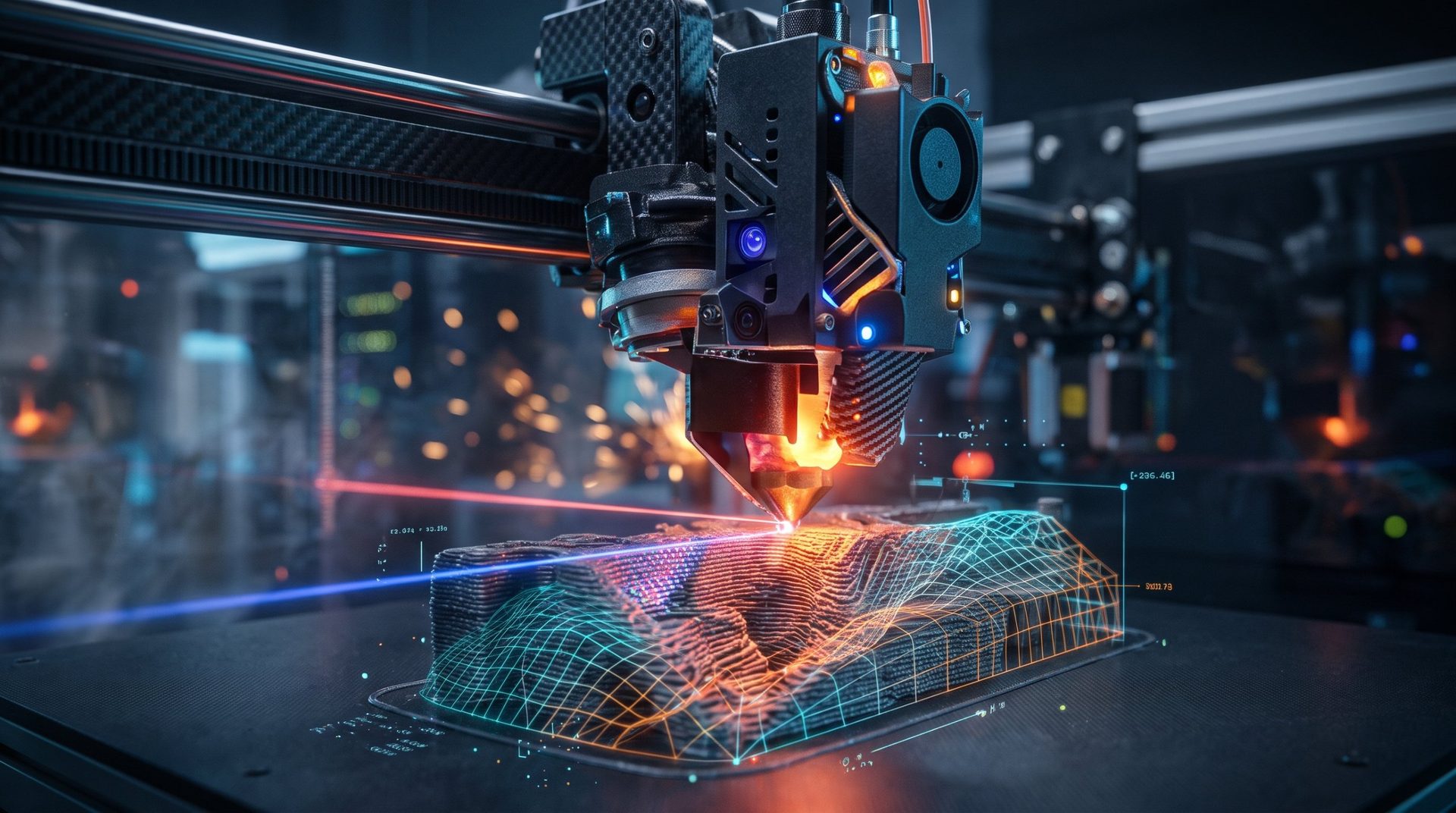 3D Printing and AI: From Simple Alerts to Real-Time Auto-Correction
 The 3D Printer of the Future: What Features Should We Expect?
 🤖 3D Printing in the Age of Industry 4.0: Automation and Artificial Intelligence
 3D Printing and Artificial Intelligence: The Marriage Revolutionizing Additive Manufacturing