AI at Every Stage of 3D Printing: From Machine Design to Final Part
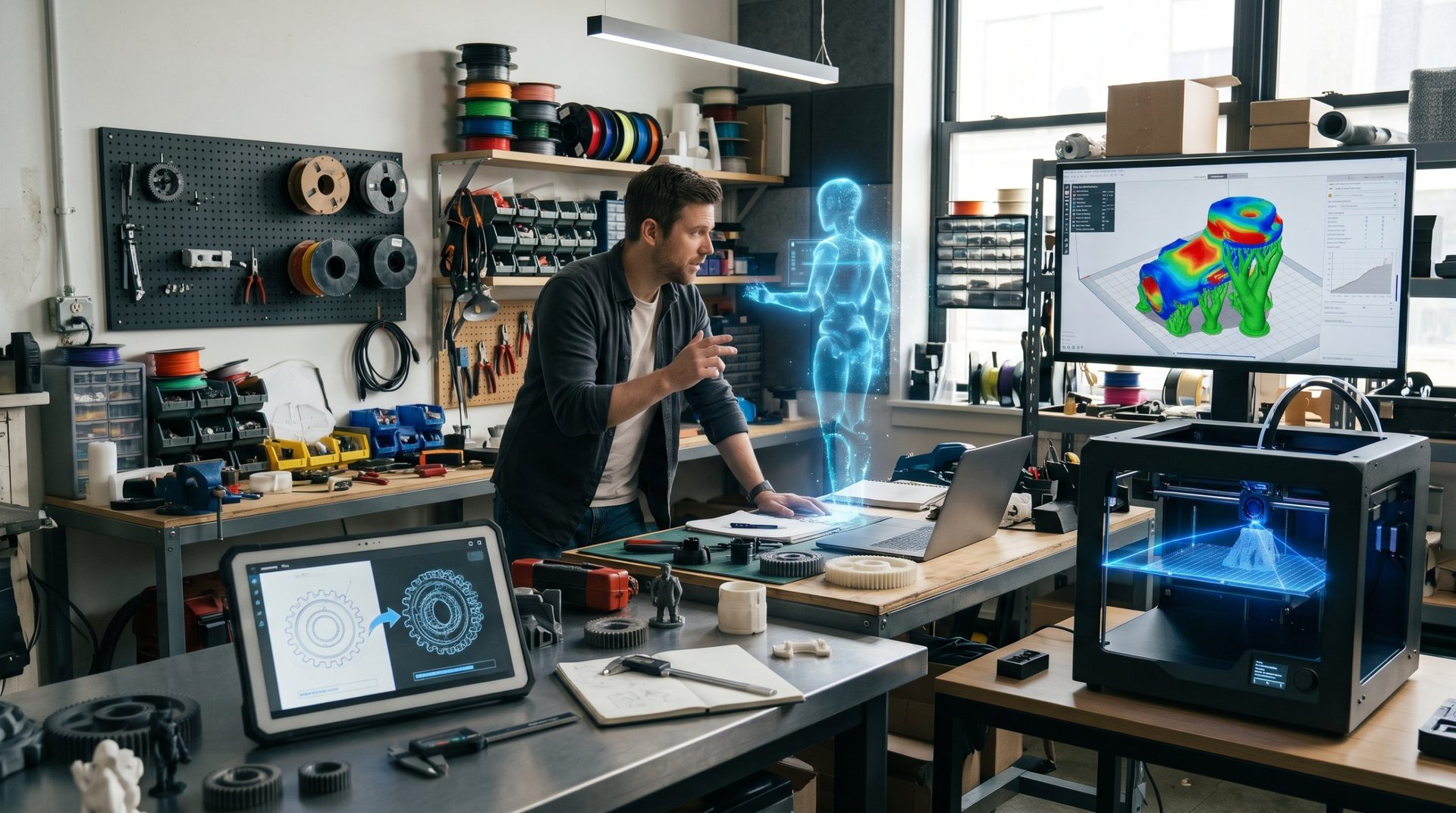
For a long time, artificial intelligence in 3D printing boiled down to a camera capable of detecting a messy blob of filament (the famous "spaghetti detection"). Today, it's stepping in at every stage of additive manufacturing: from the design of the printer itself to object modeling, file preparation, and print monitoring.
Here's how AI and intelligent algorithms are concretely transforming each of the 4 major stages of 3D printing.
1. Designing and tuning the printer itself
Before printing a single object, digital tools help engineers and DIY machine designers (like the Voron community) create lighter, stiffer, and faster printers:
- Generative design of structural parts: you specify the constraints (attachment points, forces, maximum weight) and the software proposes optimized organic shapes—for example, for an X-axis carriage or a print head mount. Less mass in motion means more speed and acceleration without ghosting artifacts.
- Thermal and airflow simulation: used to optimize ventilation ducts and heatsinks around high-temperature nozzles (up to 350 °C on some machines), so filament cools evenly right at the exit.
- Auto-calibration: on recent machines, automated routines measure resonances (input shaping), pressure compensation at the nozzle (pressure advance), and build plate flatness. These are mostly measurement algorithms rather than AI in the strict sense, but the result is clear: the machine configures itself right out of the box.
2. Modeling: from text or sketch to printable file
This is where the technical barrier has dropped the most. You no longer need to spend months in CAD software to create your own models:
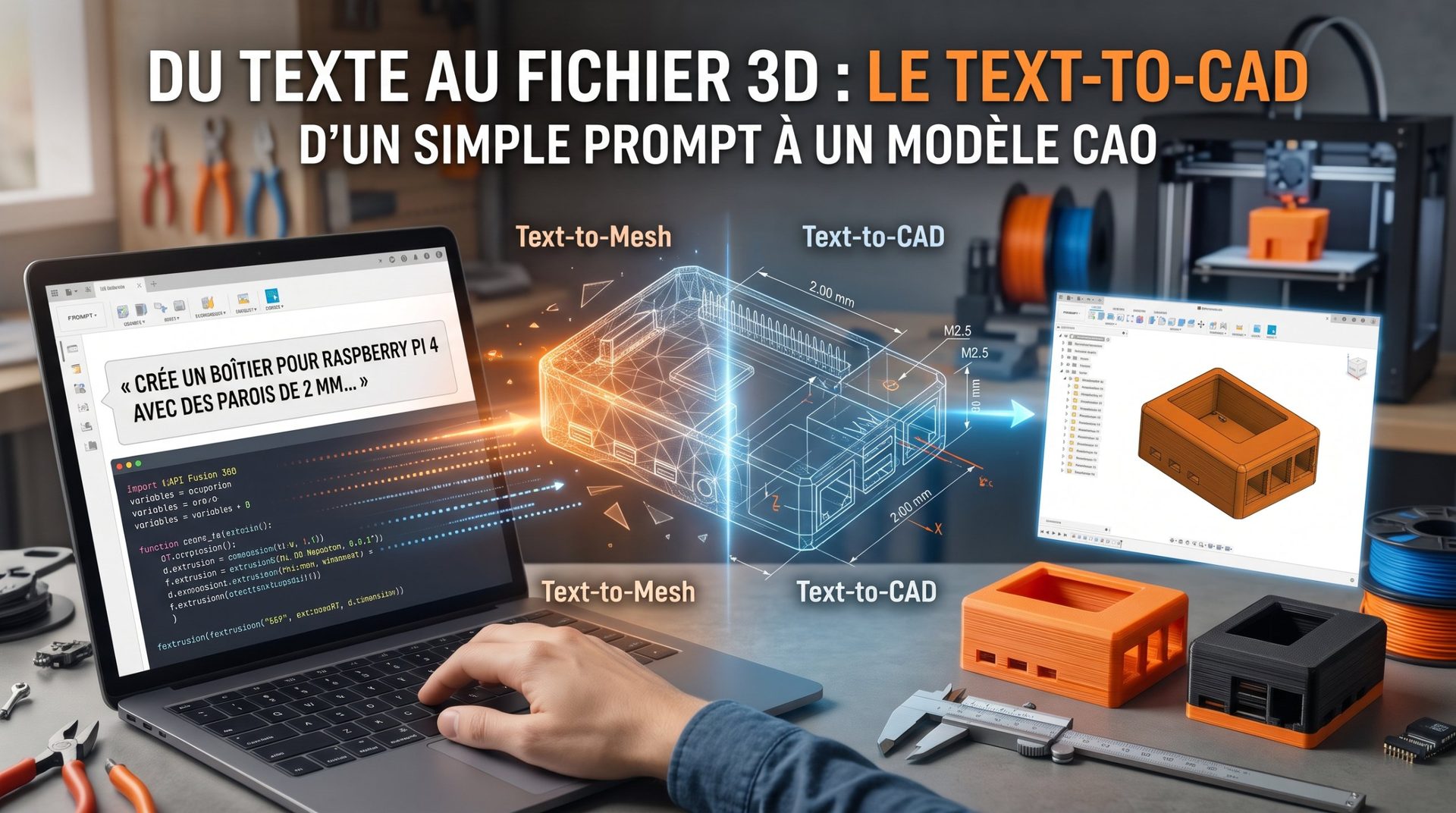
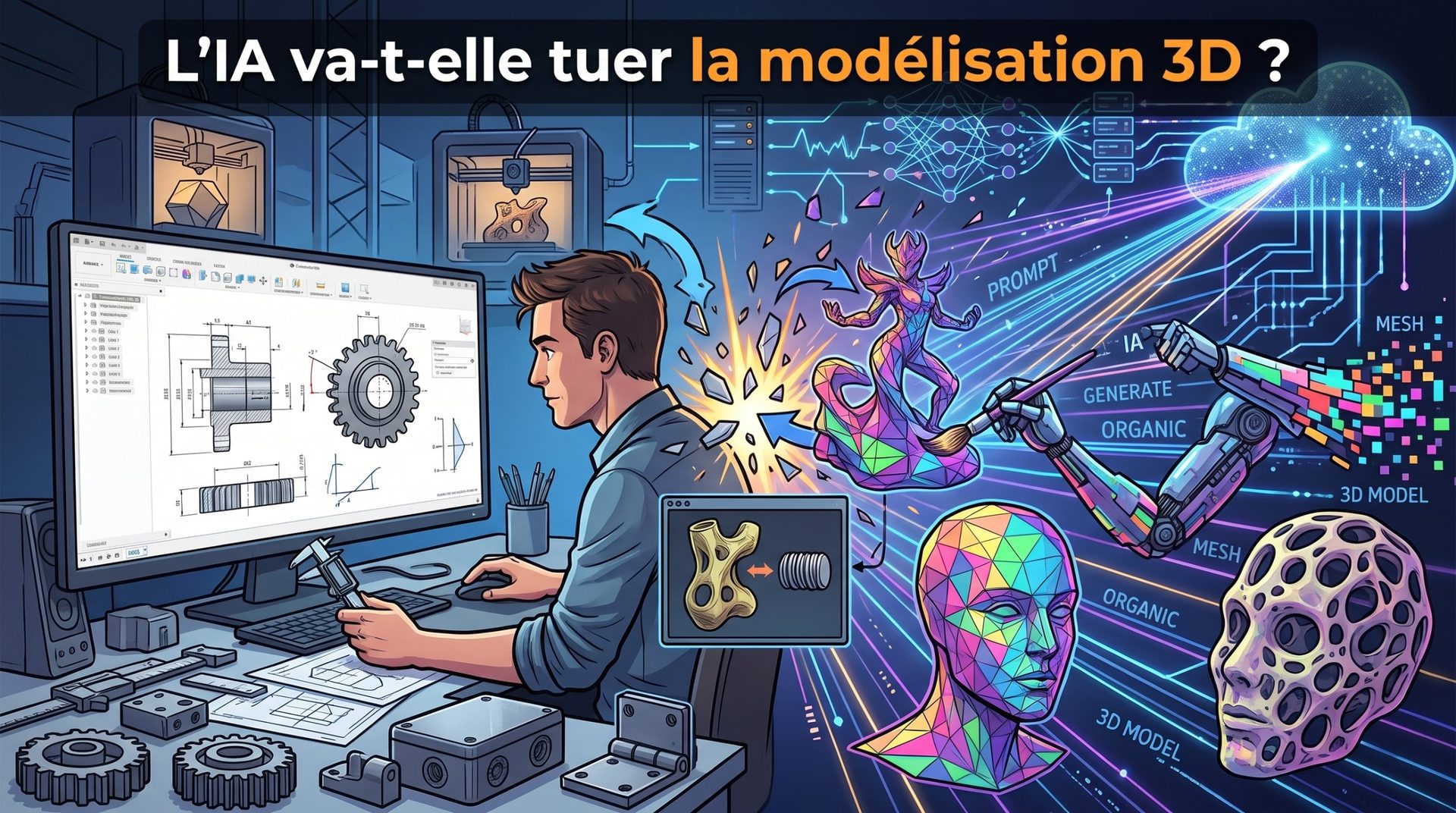
- Text-to-3D and Image-to-3D: generators like Tripo AI, Meshy, or tools built into manufacturer platforms create figurines, busts, and decorative objects in under a minute from a description, photo, or sketch.
- Text-to-CAD parametric: for technical parts, a new generation of tools produces editable models (in STEP format) with dimensions and holes. They're still limited to simple parts, and dimensions always need verification.
- Physics-aware AI: research projects like MIT's MechStyle presented in early 2026 couple shape generation and mechanical simulation to customize an object (hook, bracket, accessory) without making it too fragile. This is still in the lab stage.
- Automatic mesh repair: slicers and online services fill holes, fix non-manifold edges, and slice models that are too large for the build plate.
3. Slicing the file: a smarter slicer
Once the model is ready, the slicer transforms the virtual volume into print paths. Its automated functions are increasingly sophisticated:
- Automatic orientation: the software looks for the angle that reduces supports and improves surface finish. Thinking about strength (layers are the weak point of a part) is generally still up to the maker.
- Targeted supports and infill: tree supports, adaptive infill, or lightning infill: material goes where it's needed, not uniformly everywhere.
- Pre-print alerts: thin walls, overhangs without support, or floating parts are flagged before you start printing.
To find out which software offers what, check our best slicers comparison.
4. Printing and real-time monitoring
During printing, AI acts like an attentive operator, day and night:
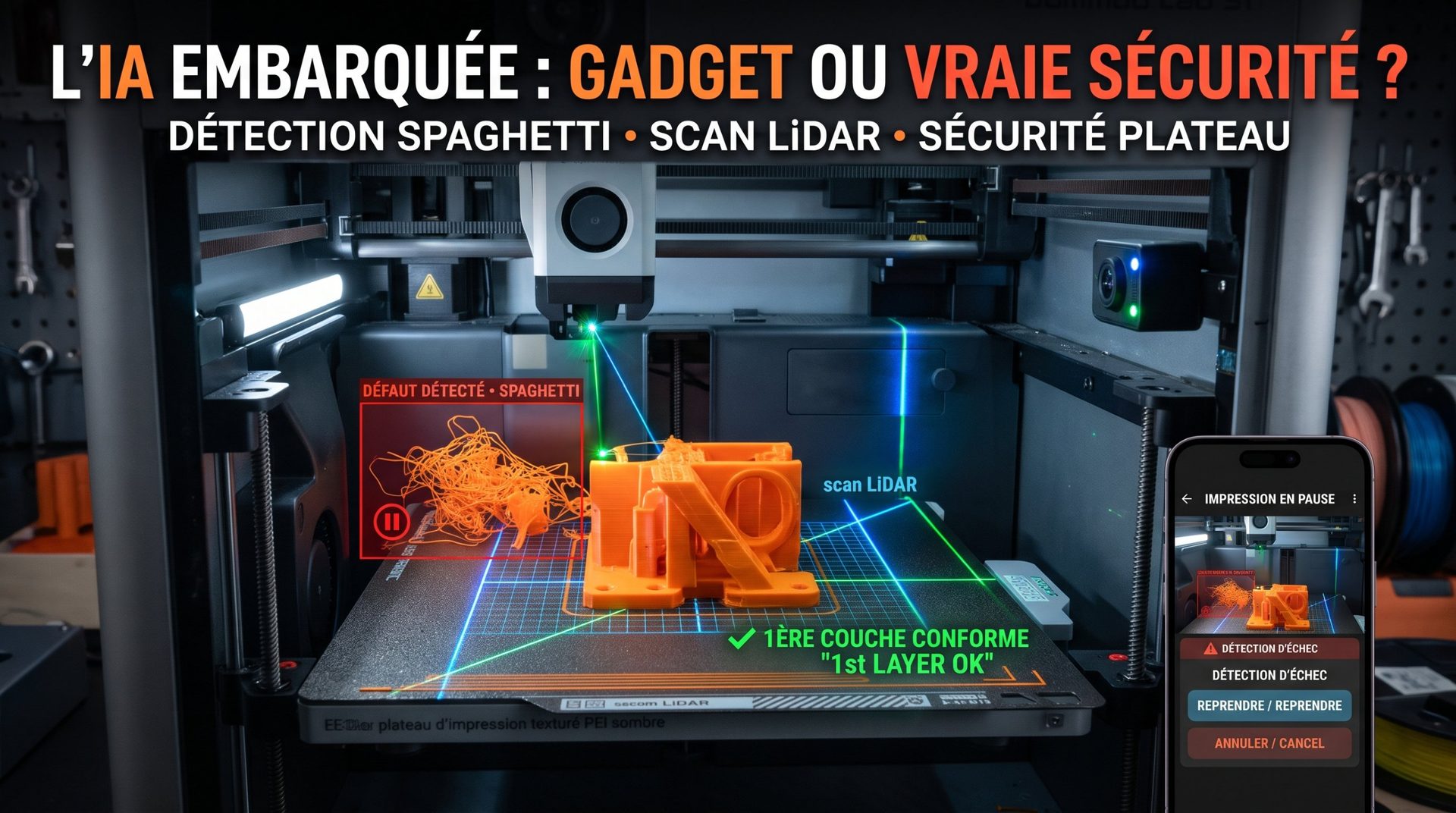
- First layer inspection: some machines scan it with a Lidar sensor or camera, adjust flow rate, and alert if the deposit isn't correct.
- Incident detection: cameras and algorithms spot spaghetti, a detached object, filament tangles, or clogged nozzles, and pause printing before wasting filament. We cover these systems in detail in embedded AI: gimmick or real safety?
- Predictive maintenance: in print farms, vibration and heating cycle analysis is starting to be used to anticipate belt, bearing, or heating cartridge wear before failure.
In short: the complete chain assisted by AI
| Stage | Role of AI and algorithms | Real benefit for the maker |
|---|---|---|
| 1. Machine | Generative design, auto-calibration | Faster machines, ready to use |
| 2. Modeling | Text/Image-to-3D, Text-to-CAD, mesh repair | Create parts without mastering full CAD |
| 3. Slicing | Orientation, targeted supports, alerts | Less filament wasted, stronger parts |
| 4. Printing | Computer vision, first layer control, pause | Far fewer failures, even on long prints |
AI doesn't replace expertise: it eliminates most tedious adjustments and avoidable failures. Choosing the right material, designing the part for its intended use, and verifying dimensions remain the maker's responsibility.