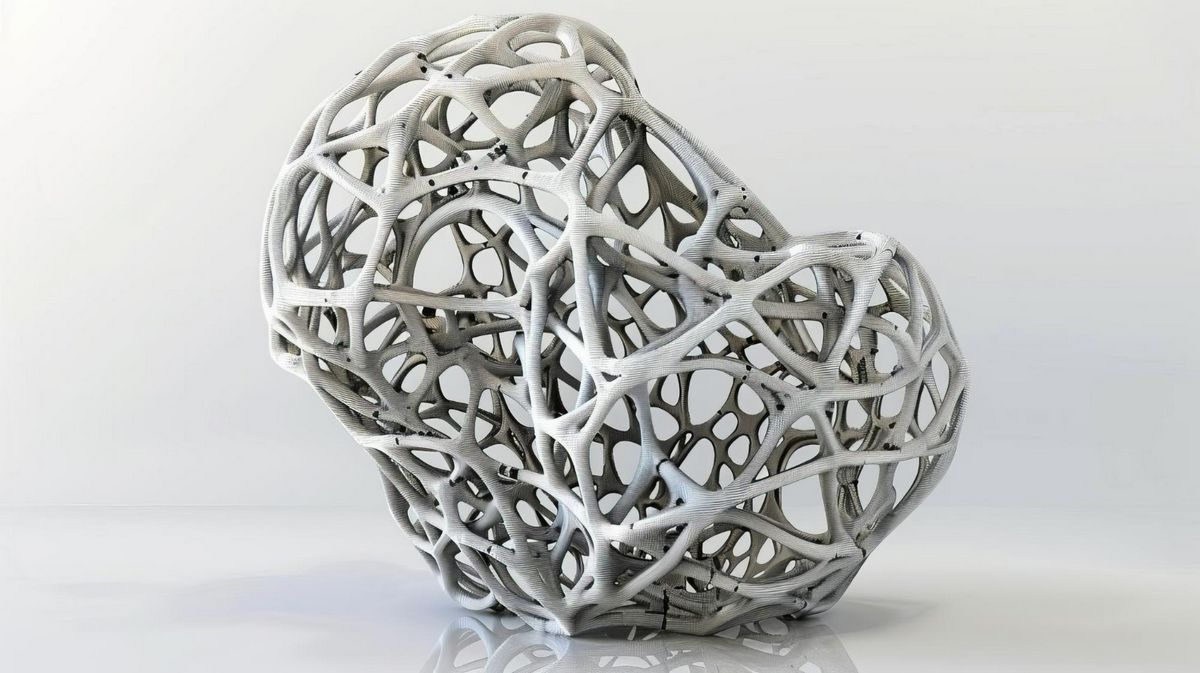
What Is Direct Ink Writing (DIW)?

Direct Ink Writing (DIW), sometimes called Robocasting, is an additive manufacturing (3D printing) technique that stands out for its use of highly viscous pastes or inks (hence the term "Ink") extruded with precise control. It's essentially an advanced form of material extrusion, but specifically designed for substances that aren't conventional thermoplastics.
DIW is particularly used in research environments for the fabrication of functional materials and advanced engineering, where compatibility with unconventional materials is essential.

How It Works: Paste Extrusion Principle
The Direct Ink Writing process is based on precise mechanical extrusion of material through a nozzle, but the nature of the material used is key:
- Viscous Ink: DIW uses "inks" that are actually pastes loaded with particles (ceramics, metals, polymers, hydrogels, or even biological substances) that have one essential property: thixotropy.
- Thixotropy: This is the ability of a material to become liquid under stress (when extruded from the nozzle) and quickly regain its rigidity or shape after the stress stops (once deposited on the build plate). This property allows printed layers to hold their shape without sagging or requiring complex supports.
- Precise Deposition: The printer follows the 3D file's path and deposits material line by line, layer by layer. The pasty nature of the ink often makes it possible to create structures with better aspect ratios and more complex geometries than conventional FDM extrusion.
- Consolidation (Hardening): After deposition, the object must be consolidated. For advanced materials:
- Ceramic or metal pastes often require post-processing thermal treatment (sintering) to harden the final part.
- Polymers or bioinks can be hardened in situ through UV crosslinking, rapid chemical reaction between two components, or solvent evaporation.
Unique Advantages of DIW
Direct Ink Writing excels where FDM (fused filament) and SLA (liquid resin) techniques reach their limits:
- Material Diversity: This is the main strength. DIW is compatible with an almost unlimited range of materials, including ceramics, metals (as particle-loaded formulations), hydrogels, and nanostructured composite materials.
- High-Solids Content: The technique allows printing pastes containing up to 90% by volume of solid particles, ensuring the final piece has the properties of the base material (ceramic or metal).
- Resolution and Precision: Precise control of ink pressure and flow rate makes it possible to create microstructures and highly detailed objects for applications in microelectronics or tissue engineering.
- Multi-Material: DIW is the method of choice for fabricating structures that integrate multiple different materials within the same part.
Applications of Direct Ink Writing
DIW is not mainstream consumer technology; it's fundamental in cutting-edge research and industry:
- Electronics: 3D printing of conductive circuits, sensors, electrodes, or integrated electronic components.
- Biomedical and Bio-printing: Use of cell-laden hydrogels (bioinks) to create support structures (scaffolds) for tissue engineering or organ prototypes.
- Advanced Materials: Fabrication of ceramic or metal parts with complex internal geometries (porous, cellular structures) for heat exchangers, catalysts, or lightweight materials.
- 4D Printing: DIW is often used to print smart polymers (hydrogels, shape-memory polymers) that change shape or function when exposed to external stimuli (heat, water, light).
Direct Ink Writing is therefore a bridge between the laboratory and cutting-edge functional material manufacturing, dramatically expanding 3D printing's possibilities beyond conventional polymers.