Recreate the Wind-Up Toy Car of Our Childhood with 3D Printing
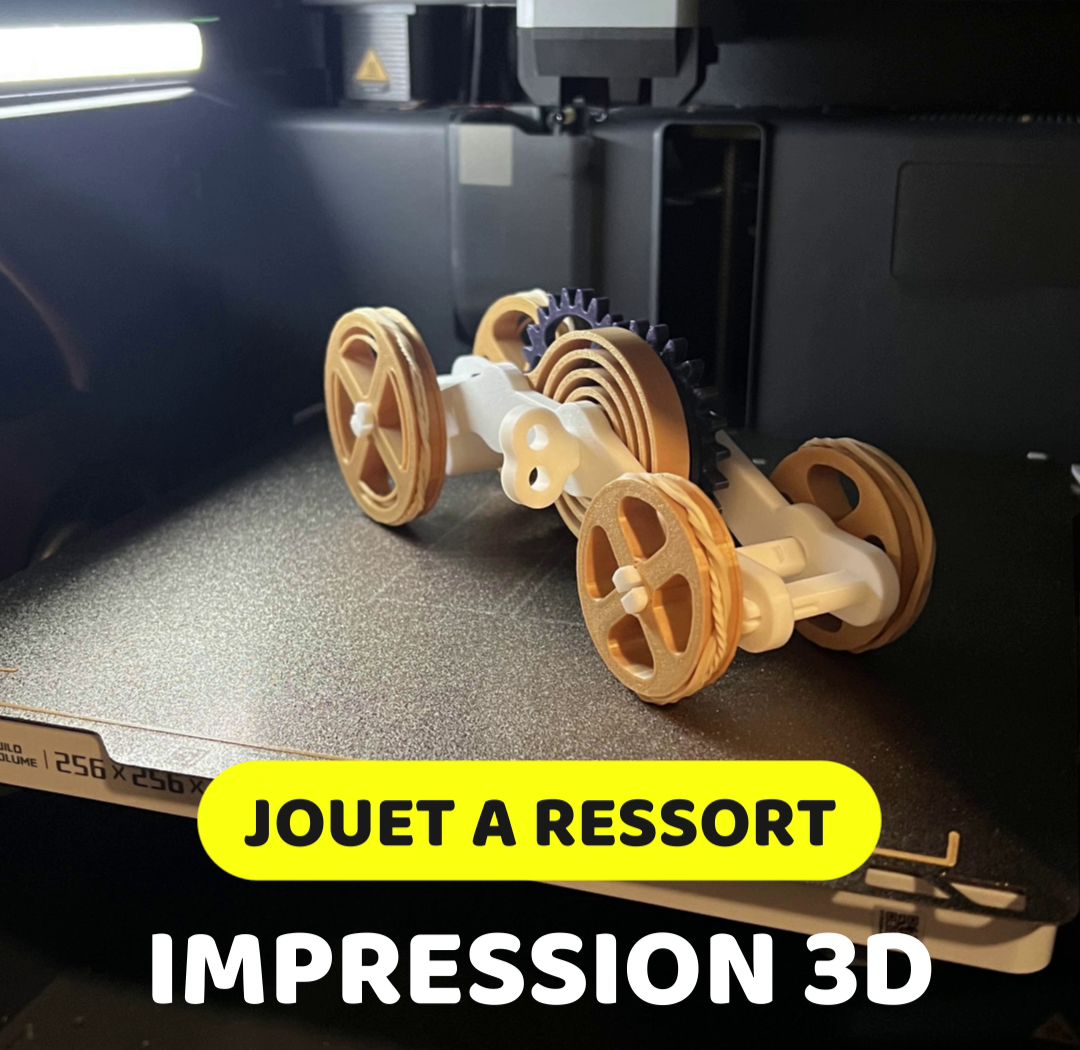
The charm of wind-up toys from our childhood lay in a brilliantly simple mechanism: a key, a turn of the wrist, and the object came to life thanks to energy stored in a simple helical spring. Today, 3D printing makes it possible to reproduce not only the chassis, but also to integrate or simulate this mechanical heart, bringing the classic wind-up car back to life.

(Image Source and 3D File: Nebula via MakerWorld)
The Challenge of Integrating the Spring Mechanism
Moving this simple toy into the world of 3D printing presents a fascinating engineering challenge: how do you integrate the motor without relying on commercial parts?
A. Integrating an External Spring
For maximum power, many 3D-printed models are designed to accommodate a motor spring (often salvaged from an old toy or purchased commercially). The role of 3D printing is then to provide the perfect housing and optimized transmission gears to transfer this power to the wheels.
B. The 3D-Printed Spring (Simulated)
This is the most purely "maker" solution. Instead of a metal spring, the system often uses the inherent elasticity of a rigid filament (such as PLA) modeled in the form of a flexible torsion band.
- Principle: A thin band is printed and connected between two axes. As the key is turned, the band twists or stretches, storing energy. When the key is released, the band unwinds and spins the wheels.
- Advantage: The toy is entirely 3D-printed, with no external parts.
- Drawback: These printed springs are less powerful and less durable than their metal equivalents, but they're perfect for demonstration and educational models.
The Precision of Printed Gears
The success of any wind-up car relies on the smoothness of its transmission.
- Gear Ratio: 3D designers must create gear trains with the right reduction ratio to convert the spring's rotational speed into maximum travel distance. This is the essence of CAD design applied to mechanics.
- Micro-Tolerances: The weak link in such a mechanism is often the clearance (the space) between gear teeth. If it's too tight (), the parts fuse together. If it's too loose (), the mechanism is noisy and inefficient. Modern 3D printing allows you to target the ideal tolerance () for smooth operation.
An Educational and Reverse-Engineering Tool
3D printing these toys goes beyond nostalgia. It's an excellent way to do reverse engineering on classic objects.
By printing the parts in transparent material (with transparent PETG or PLA), you can see the internal mechanics in action: the spring twists, the gears mesh, and energy flows to the wheels. It's a tangible and visual introduction to the principles of potential energy and mechanical transmission for makers of all ages.
Thanks to additive manufacturing, the simple wind-up car of our childhood has become an accessible, customizable, and highly rewarding engineering project.