3D Printed RC Lunar Rover
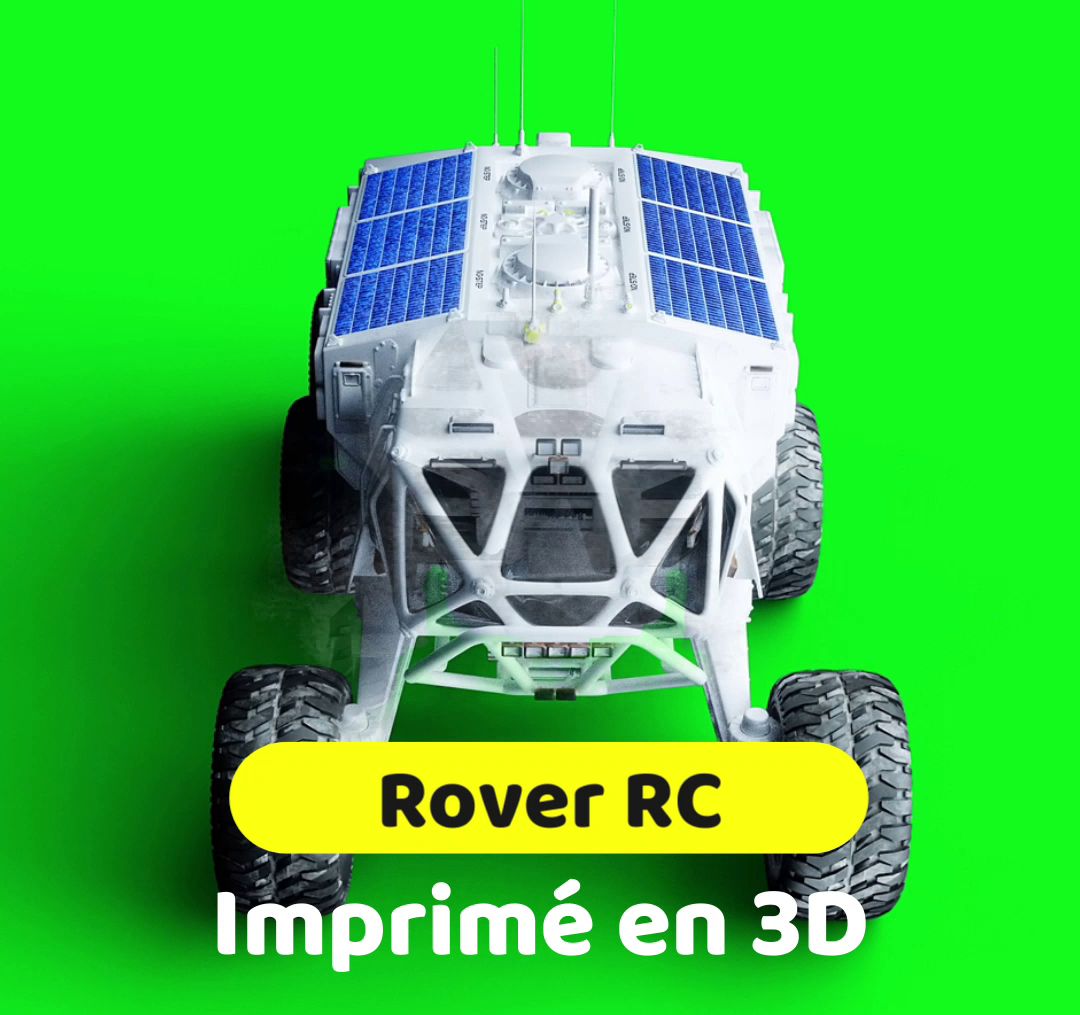
Building a remote-controlled (RC) rover is the perfect intersection of robotics, electronics, and mechanical engineering. Thanks to 3D printing, what was once limited to engineering labs is now within reach of any maker. 3D printing lets you design and manufacture complex systems (chassis, gears, suspensions) that form the rover's core.

1. 3D Printing for Robotics
Using 3D printing for robotics offers critical advantages that traditional manufacturing methods like machining simply can't match.
- Total Customization: Every bracket, motor housing, and battery compartment can be perfectly tailored to the exact dimensions of your electronics (Arduino, Raspberry Pi, drivers, etc.).
- Rapid Prototyping: Robotics is an iterative process. You can print and test a new suspension arm in hours, modify it, and print again the same day, speeding up development.
- Lightweight & Optimized: 3D printing lets you optimize structures to minimize weight while maintaining strength. Organic shapes and complex internal structures (like infill) can be tuned for maximum performance.
2. Design: Critical Mechanical Systems
A successful 3D printed RC rover depends on solid mechanical design.
Chassis and Suspension
Your rover needs a rigid chassis to protect electronics and good suspension to navigate varied terrain.
- Rocker-Bogie: Inspired by NASA rovers, this passive suspension system can be entirely 3D printed. It keeps wheels in contact with uneven ground, testing your printer's joint precision.
- Wheels: They must be lightweight and tough. Usually the rim is 3D printed, with a rubber tire or TPU (flexible filament) added for traction.
Drive Train and Gears
Transmitting motor power to wheels is a potential weak point. Gears and speed reducers must be printed with tight tolerances (often 0.1 mm clearance) to avoid excessive friction or gear slip.
3. Electronics and Integration
A rover is only as good as how well its parts work together. 3D printing makes this easier.
- Control Board: Choosing a microcontroller (usually Raspberry Pi or Arduino) determines your rover's architecture. The printed chassis must include specific mounting points for these boards.
- Power Management: Battery mounts and cable routing need to be safe and accessible. 3D printing lets you create cable conduits and clips built into the chassis for a clean, professional result.
- Sensors: For an autonomous rover, 3D printing is key for mounting cameras, ultrasonic sensors, or lidars with proper calibration.
4. Recommended Materials and Challenges

The main challenge is ensuring long-term reliability. A rover that works in the lab must handle real-world stress. Choosing carbon-fiber reinforced (CF) filament for high-load parts (gears) can greatly boost strength and lifespan.
Building a 3D printed RC rover is demanding, but success proves you can transform a complex digital idea into a functional, autonomous electromechanical system.