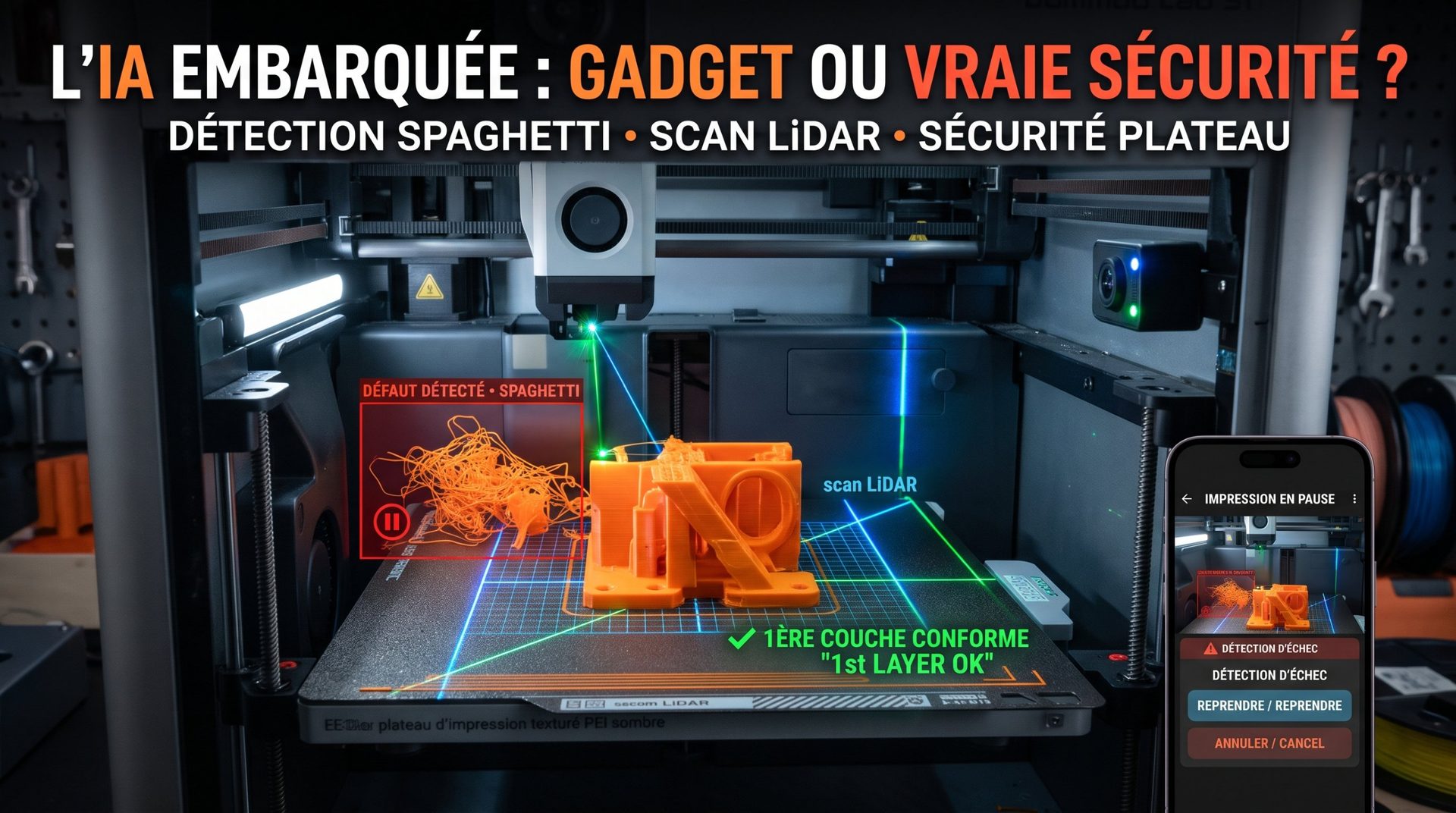
Understanding the LiDAR Sensor in Bambu Lab 3D Printers

Updated November 16, 2026: the X1 series, the only model equipped with LiDAR, is no longer produced as of March 31, 2026 (support guaranteed until 2031). It has been replaced by the X2D. The principle remains useful for understanding automatic calibration; for current models, check their technical specifications.
The LiDAR (Light Detection and Ranging) sensor in Bambu Lab 3D printers, primarily found on the X1-Carbon series, is a high-precision laser scanner that acts as the machine's "eye". It automates adjustments that previously had to be made manually by the user.
Here's how it works and what it brings to your prints in practice:
✅ How LiDAR Works: The Technical Principle
The module, called Micro LiDAR, projects laser beams (often two red/infrared lasers) onto the surface of the build plate. By measuring the time it takes for light to return to the sensor and the angle of reflection, the printer can map the surface with precision down to the micrometer (approximately 7 microns).
✅ The Three Major Functions of LiDAR
LiDAR comes into play at critical moments in the printing process:
-
Flow Calibration : Before starting the object, the printer traces test lines on the build plate. The LiDAR "scans" these lines to analyze their width and regularity. The algorithm then automatically adjusts the pressure and amount of plastic extruded so that the layers are perfectly uniform.
-
First Layer Inspection: This is one of the most critical steps. Once the first layer is laid down, the LiDAR scans over it. If it detects poor adhesion, a hole, or an irregularity, the printer pauses the job and alerts you on your phone. This prevents wasting filament on a print doomed to fail.
-
Automatic Bed Leveling (Auto-Leveling): While the printer also uses force sensors under the build plate, the LiDAR adds a layer of redundancy. It verifies the nozzle height relative to the bed to ensure the distance is absolutely perfect across the entire surface.
✅ LiDAR Advantages and Limitations
| Advantages | Limitations |
| Time Savings: No need for manual flow calibration tests. | Build Plate Compatibility: It performs poorly on highly textured plates (textured PEI) because the laser "gets lost" in the texture. |
| Reliability: Significantly reduces the risk of "spaghetti" (print failures). | Exclusivity: Limited to the X1 series (not present on P1P, P1S, or A1). |
| Quality: Smoother surface finish thanks to optimized extrusion flow. | Sensitivity: The lens must be cleaned regularly to stay accurate. |
✅ The Winning Duo: LiDAR and Artificial Intelligence
LiDAR doesn't just "see"—it's the optical nerve of a far more complex system. The raw data captured by the laser is instantly processed by an embedded Artificial Intelligence algorithm.
Here's how this partnership transforms your printing experience:
-
Real-Time Comparison: The AI compares the point cloud generated by the laser scan with the theoretical digital model (the G-code file). It verifies that what's being deposited on the bed matches, down to the micrometer, what the printer is supposed to produce.
-
Predictive Anomaly Detection: This system is capable of identifying defects invisible to the naked eye, such as slight under-extrusion or the beginning of delamination. Instead of waiting for the part to detach completely, the AI anticipates failure.
-
The End of the "Spaghetti Monster": If a significant deviation is detected, the printer doesn't just keep going into thin air. It makes an autonomous decision: pause the print and send a priority notification to your smartphone via the Bambu Handy app.
-
Learning and Adjustment: More than just a check, this LiDAR/AI partnership allows the machine to dynamically adjust its parameters (such as nozzle pressure) to compensate for small variations in filament as printing proceeds.
In summary: Where a standard printer advances "blind", the Bambu Lab X1 uses this technology to move from mechanical execution to adaptive manufacturing.