AI in 3D Printers: Marketing Gimmick or Real Safety?
In just two years, the specs of consumer 3D printers have changed dramatically. After the race for speed and CoreXY kinematics, manufacturers like Bambu Lab, Creality, and Anycubic are pushing a new buzzword: onboard artificial intelligence.
Smart cameras, LiDAR sensors, nozzle pressure sensors… We're promised machines that can monitor their build plate on their own. But what's really happening in the workshop? A genuine safety guardian or just a sales pitch? Detailed analysis.
1. Spaghetti Detection: Your Anti-Waste Insurance
This is the most hyped feature. Every maker has lived that moment: start a 14-hour print, head to work, and come back to find a massive tangle of filament—the infamous "spaghetti mess"—with half a spool wasted. Worst case, the nozzle gets trapped in a block of melted plastic.
How does it work?
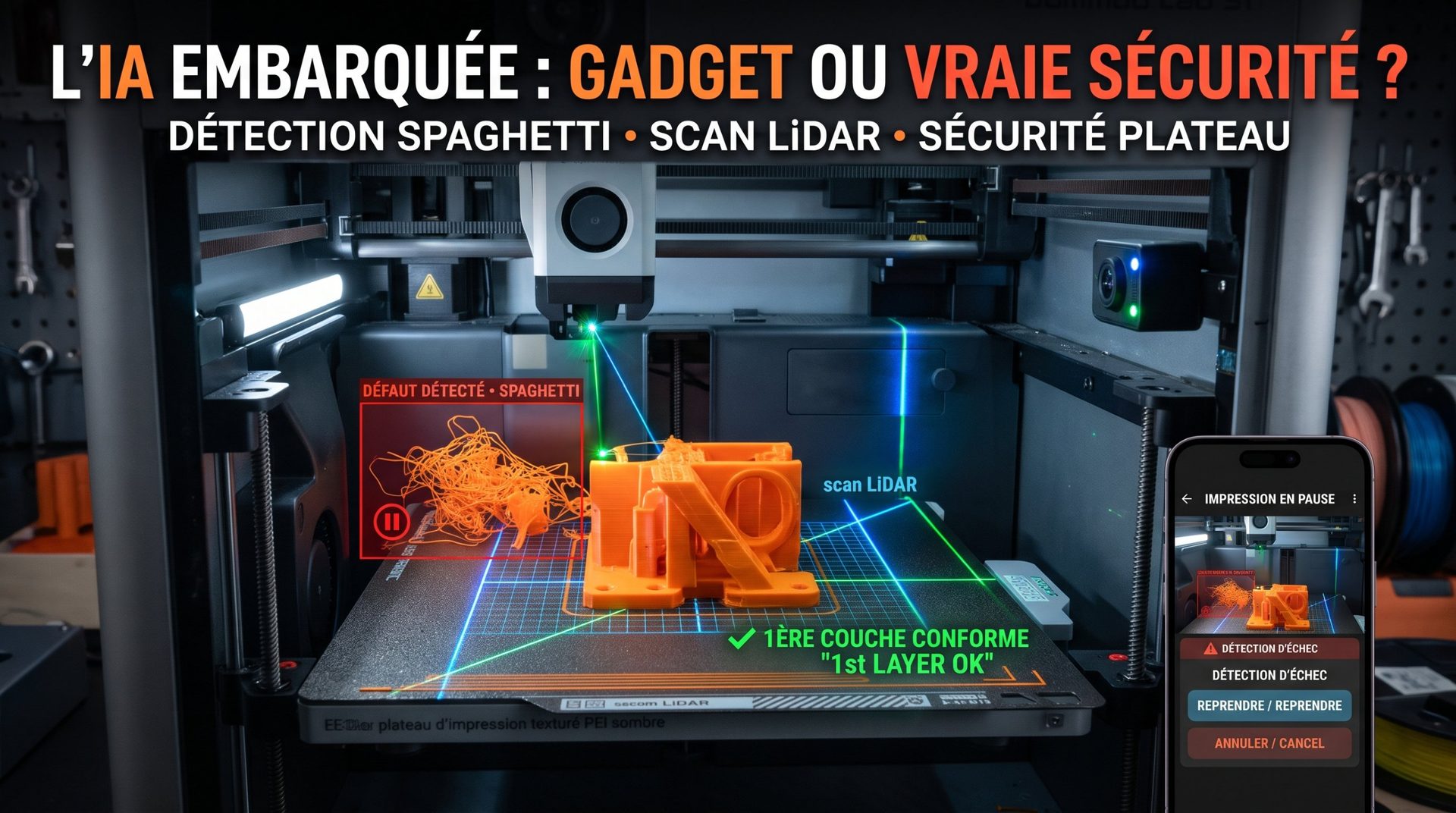
The internal camera regularly analyzes the build plate image using a computer vision model trained on thousands of successful and failed print photos. As soon as it spots a messy tangle of filament:
- the printer pauses the print;
- the print head moves away from the part;
- a notification reaches your smartphone (Bambu Handy, Creality Cloud, etc.) with a photo, so you can decide to resume or cancel.
Real-world reliability
When a part clearly lifts off the plate, detection typically kicks in within minutes—enough to avoid wasting an entire spool and protect the print head. Some newer machines also monitor plastic buildup around the nozzle to prevent jams or collisions.
2. First-Layer Control: LiDAR and Cameras
The first layer sets the stage for most of your print's success. Poor adhesion or flow in the opening minutes usually means the rest is doomed.
- LiDAR, popularized by the Bambu Lab X1-Carbon: a laser sensor scans the first laid lines and measures their height and consistency. It also auto-calibrates flow and pressure advance compensation. For the full picture, check out our article on the LiDAR sensor in Bambu Lab 3D printers.
- Cameras and pressure sensors: other machines rely on the camera or a nozzle-mounted sensor to adjust the initial nozzle-to-plate gap and spot anomalies.
If an anomaly is detected, the machine can stop before wasting filament for nothing.
3. Forgotten Object Detection: Protecting Your Mechanics
A spatula left on the plate, a pair of tweezers accidentally placed there, or a previous part still stuck: a collision between nozzle and plate can bend a nozzle, scratch a build surface, or throw the machine out of alignment.
On the latest models (like Bambu Lab's H2 series), AI steps in before startup:
- the camera captures images of the plate at different heights;
- it spots anything protruding from the surface;
- if something's in the way, the machine refuses to start and alerts you.
It also verifies that the right plate is installed and correctly positioned.
4. The Verdict: Foolproof Revolution or False-Alert Festival?
Progress is real, but these systems still have growing pains.
| Feature | Reliability | Common Issues |
|---|---|---|
| Spaghetti detection | Good | False alerts or misses with black or very dark filaments, and on highly perforated parts (tree supports, lattice structures). |
| First-layer control | Fair | Less accurate on some textured or glossy build plates that interfere with measurement. |
| Forgotten object detection | Good | Blind spots on the plate, very flat objects sometimes missed, sensitivity to lighting. |
Key limitations to know
- False alerts: watching a 20-hour print pause at 3 a.m. because a thin support was mistaken for spaghetti is one of the most common user frustrations. Sensitivity is usually adjustable in settings.
- Cleanliness and lighting: a camera lens fouled by ABS or PETG fumes, or poor lighting placement, is enough to fool detection.
- Price: these cameras, sensors, and dedicated processors bump up the machine's cost compared to an equivalent model without these features.
Conclusion: Gimmick or Real Safety?
Onboard AI is not just a marketing gimmick. For print farms, professionals, and makers running long unattended prints, it already saves countless spools and hardware failures.
It doesn't replace a well-leveled, isopropyl-alcohol-cleaned plate or a properly dialed slicer profile, but it acts like a genuine safety belt. Not yet 100% reliable, it's becoming an important factor in choosing a new printer—our 2026 buying guide helps you sort it out. And if a defect still sneaks through, our visual defect diagnosis shows you which settings to tweak.