Bambu Lab X2D
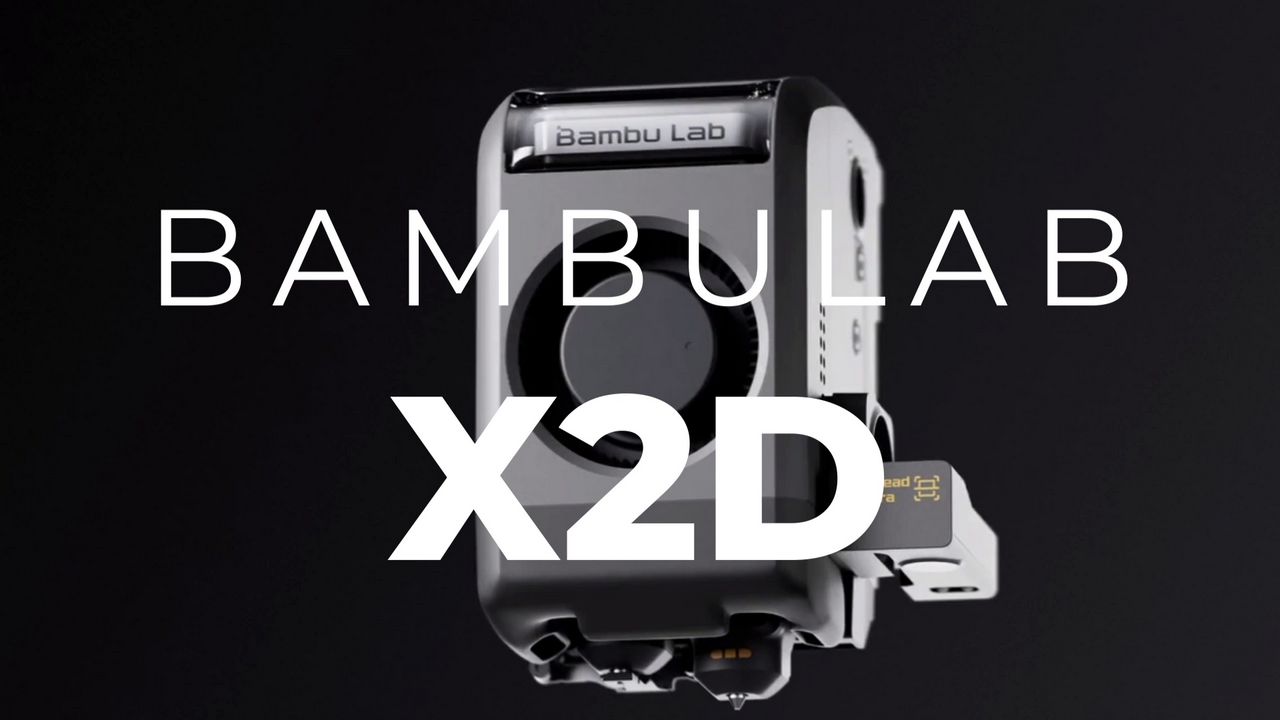
The Bambu Lab X2D is at the center of all the buzz right now, as it was just officially launched (as of April 14, 2026).
It succeeds the legendary X1-Carbon by pushing the limits of automation and speed for consumers and professionals alike. Here's what you need to know about this new standard-setter.

✅ Price and Versions (Official 2026 Pricing)
The X2D's positioning is much more aggressive than anticipated. It's replacing the X1 lineup (now end-of-life) at a very competitive price:
-
Bambu Lab X2D (Standalone): $629
-
Bambu Lab X2D Combo (with AMS 2 Pro): $849
✅ X2D's True Innovations
The X2D isn't just an incremental update—it brings dual extrusion to the mainstream consumer market:
-
Dual-Nozzle System (Dual Nozzle): It has two independent nozzles. This lets you print soluble supports or transition materials with zero purge waste (goodbye massive "purge towers").
-
Actively Heated Chamber: The chamber now reaches 65°C (instead of 55°C), making it perfect for printing technical materials like ABS, ASA, or Nylon without warping.
-
Speed and Precision: It maintains a top speed of 600 mm/s but uses new closed-loop servo motors (PMSM) sampled at 20 kHz, virtually eliminating vibration and layer shifts.
✅ Speed Reaches a New Level
The X2D isn't just a cosmetic refresh. It's been completely redesigned to optimize CoreXY kinematics:
-
Acceleration: It now reaches 30,000 mm/s², up from 20,000 on the X1C.
-
Print Speed: Volumetric flow has been increased thanks to a new high-power hotend, allowing perfect quality even at 600 mm/s.
-
Motors: Upgraded to closed-loop motors to eliminate layer shift risk (layer shifts), even from impacts.
✅ The "Dual-Flow Chamber" System
One of the X2D's biggest upgrades is its thermal management system:
-
Chamber Preheating: Unlike the X1, which relied on the bed, the X2D has dedicated chamber heating (up to 55°C).
-
Advanced Filtration: A dual-circuit HEPA + activated carbon filtration system that recycles hot air to maintain temperature while eliminating 99.9% of VOCs (volatile organic compounds).
✅ "V3" Artificial Intelligence
The Micro-Lidar and camera have been replaced with a stereoscopic vision system:
-
Perfect Auto-Z Offset: No need to mess with first-layer height anymore—the system measures flatness at 5 micron resolution.
-
Predictive Spaghetti Detection: The AI can now anticipate print failure before it happens by analyzing abnormal nozzle vibrations.
-
Automatic Filament Calibration: It scans the filament surface to instantly adjust Flow Rate and Pressure Advance.
✅ The Dual-Nozzle System
The Dual-Nozzle system on the Bambu Lab X2D is arguably the most anticipated upgrade because it solves the biggest pain point of previous models (X1 and P1): filament waste and slow multi-material printing.
Here are the technical details of this system:
1. "IDEX-Lite" Architecture
Unlike a traditional IDEX machine where both heads move independently on the X-axis, the X2D uses an ultra-fast toggle mechanism built into a single printhead.
-
How it works: Two nozzles are mounted on a pivot mechanism. When one nozzle finishes its layer or section, the head shifts slightly to the side, a mechanism flips the active nozzle up and lowers the second nozzle into working position.
-
Swap time: Switching from one nozzle to the other takes less than 0.8 seconds, compared to 30–60 seconds for a filament change via a standard AMS.
2. No More "Purge Towers"
This is the economic breakthrough of this model. On an X1-Carbon with AMS, every color change requires purging all filament in the nozzle, creating the infamous "poop" (waste).
-
Zero transition waste: Since each nozzle has its own thermal path, there's no color mixing. Nozzle A prints the main plastic, nozzle B prints the support or second color.
-
Material savings: On complex prints, filament savings can reach 30% to 50% compared to a single-nozzle system.
3. Soluble Support and Technical Material Printing
The Dual-Nozzle opens the door to geometries that were impossible before:
-
Perfect support interfaces: You can use BVOH or PVA (water-soluble) in the second nozzle. Supports wash away completely with zero traces on the part, enabling flawless surface finishes under overhangs.
-
Material combinations: You can print a rigid part in PA-CF (Carbon Nylon) with flexible zones in TPU, or use a dedicated support material that won't stick to the main part (e.g., PETG interface for a PLA part).
With the X2D, Bambu Lab isn't just refreshing its lineup; the company is redefining what you should expect from a "prosumer" printer under $1,000.
By integrating native dual extrusion (Dual-Nozzle), the brand finally solves the biggest flaw of filament-switching systems: material waste and extended cycle times. Add a 65°C heated chamber and even smarter AI on top, and you get a machine capable of handling everything from colorful trinkets to complex mechanical Nylon parts without breaking a sweat.
It's a machine that seems designed by listening to every complaint about the X1-Carbon, then cutting its price in half.
So, will you take the plunge?
Whether you're a maker tired of watching your filament spool disappear as "purge waste" or a pro needing soluble supports for perfect mechanical parts, the X2D checks every box. At $629, the price argument doesn't hold up anymore against the performance on offer.
And you—is this dual-nozzle system finally the reason you'll click "Add to Cart"?