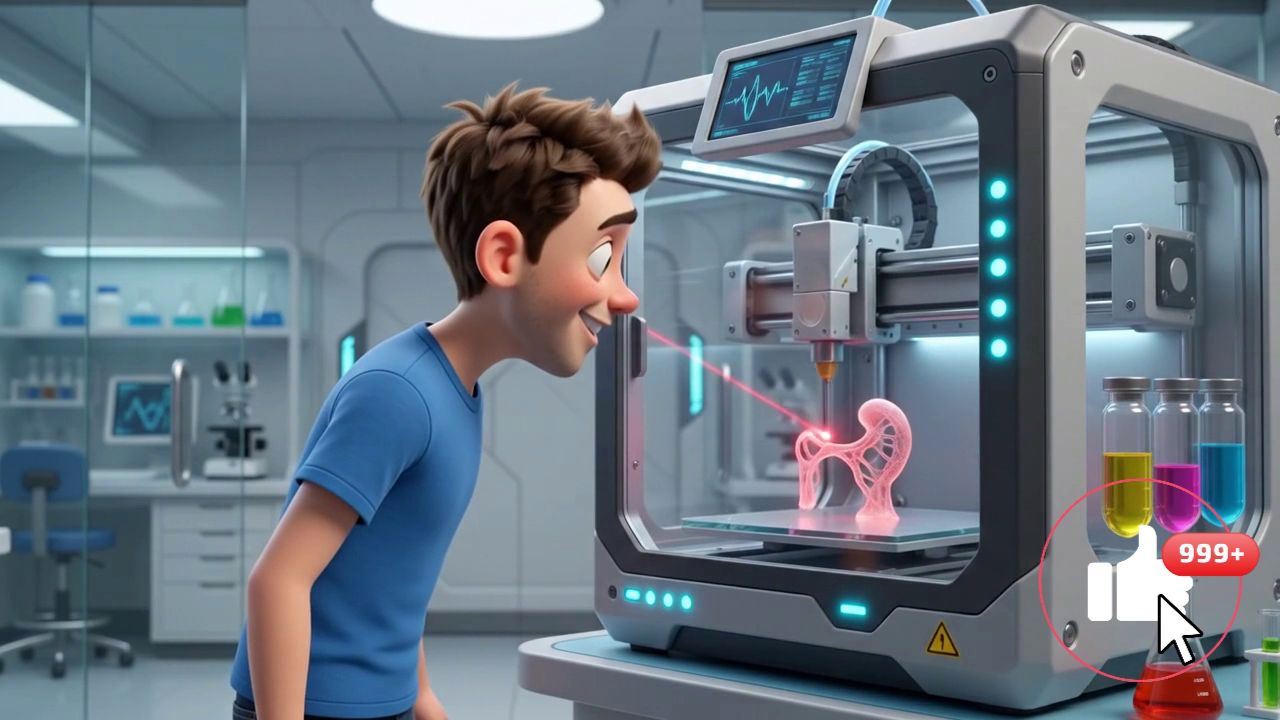
The Future of 3D Printing, a Revolution in Progress

3D printing is no longer science fiction. It has already transformed the way we design and manufacture, from simple hobby objects to industrial prototypes. But what we know today is merely the introduction to a much larger story. The future of 3D printing promises an even deeper revolution, touching every aspect of our daily lives, from healthcare to construction, and the way we consume.
Increasingly innovative materials

One of the greatest breakthroughs lies in materials. Plastics (PLA, PETG) are just the starting point.
- Metals and ceramics: Metal 3D printing technologies (SLM, DMLS) are becoming mainstream and enable the production of stronger, lighter, and more complex parts for aerospace, medical, and automotive industries. We're already printing parts in titanium, aluminum, and stainless steel.
- Biomaterials and bioprinting: The future of medicine will go through 3D printing. Bioprinting uses living cells to create tissues, blood vessels, and eventually entire organs, solving the donor shortage problem and reducing rejection risks.
- Composite and smart materials: New filaments capable of changing color, shape, or properties based on temperature or light will pave the way for interactive and dynamic objects with integrated sensors and electronics.
Applications that push the boundaries
The technology will no longer be limited to desktop objects, but will tackle projects at a much larger scale.
- Construction and housing: Giant 3D printers are already capable of building entire walls or even whole houses in concrete or rammed earth. This technique drastically reduces construction time, costs, and material waste.
- Healthcare and medicine: Beyond bioprinting, 3D printing allows for custom-made prosthetics, ultra-precise surgical guides, and personalized implants for each patient, improving treatment effectiveness.
- Food: Food 3D printing will allow for dishes with complex shapes and textures, from pastries to pasta, opening a new era of gastronomy and dietary customization.
Smarter and simpler technology
The 3D printing process itself will become more seamless, more automated, and more accessible to everyone.
- Automation and factories of the future: Autonomous "printer farms," managed by artificial intelligence, will produce objects in series without human intervention, from design to post-processing.
- Software and AI: Modeling software will become more intuitive. AI can automatically optimize a part's design to make it lighter or stronger, and even correct design errors before printing.
- On-demand production and mass customization: 3D printing will enable "mass customization." Every consumer will be able to order a fully personalized product (clothing, glasses, spare part) that will be manufactured locally and on demand.
In conclusion, the future of 3D printing won't just be an improvement of what we know today. It will mark a paradigm shift, taking us from a mass production economy to a local and personalized creation economy. 3D printing will no longer be a tool, but an invisible infrastructure that will allow all of us to become creators.