The Podium of the Fastest 3D Printers

Writing an article about the fastest 3D printer is a challenge because technology evolves at breakneck speed. What is "fastest" today could be surpassed tomorrow. However, it's possible to base this on current models that have redefined speed standards and explain the technologies that make this speed possible.

The Podium of the Fastest 3D Printers in 2025
Until recently, print speeds hovered around 50–80 mm/s. Today, high-end machines easily reach 500 mm/s and beyond without sacrificing quality.
- Bambu Lab H2D, X1-Carbon and P1S/P1P/P2S : Bambu Lab has truly revolutionized the market by democratizing ultra-fast 3D printing. Their models, like the X1-Carbon and P1S, are renowned for reaching speeds of up to 500 mm/s or more. They achieve this thanks to their CoreXY structure and vibration detection system (Input Shaping). The X1-Carbon also stands out for its multi-color filament management system (AMS), enabling complex and fast prints. The era of ultra-fast dual extrusion : The H2D represents a major breakthrough for Bambu Lab. This model integrates a dual extruder print head, allowing it to handle two filaments simultaneously. With speeds reaching up to 600 mm/s, it solves the problem of fast and efficient multi-color printing by drastically reducing filament waste during color changes. Its advanced optical measurement system ensures exceptional precision, making this machine a tool of choice for professionals. The Bambu Lab P2S positions itself as the worthy successor to the hugely popular P1P and P1S series, marking a fusion between the accessibility of the P line and the innovations of the X line. It aims to deliver an even smoother user experience, increased performance, and maximum reliability, particularly for multi-material and high-temperature printing.
- Anycubic Kobra S1 : Anycubic, a brand already recognized for its FDM and resin printers, has also entered the speed race with the Kobra S1. This printer stands out for its maximum print speed of 600 mm/s. It uses a CoreXY structure, like market leaders, and comes with an enclosed chamber for optimal thermal stability. The Kobra S1 is also renowned for its reliability and ease of use, making it an excellent choice for those who want fast printing without technical complications.
- Creality K1 and K2 : Creality has also embraced high-speed printing with its K series. The K1 is an FDM (Fused Deposition Modeling) printer capable of reaching 600 mm/s. The K2 model, meanwhile, promises the same speeds with a larger build volume and compatible multi-color system.
- FLSun : Known for its Delta-type 3D printers, FLSun has always been synonymous with speed. Their machines, like the FLSun V400 and the two new models in the S1 and T1 ranges, stand out for a mechanical structure that allows very fast print head movements. Some of their machines can even reach announced speeds of 1000 mm/s or more.
Key Technologies for Fast 3D Printing
The speed of a 3D printer depends on more than just a number on the spec sheet. Several technical elements work together to optimize print time :
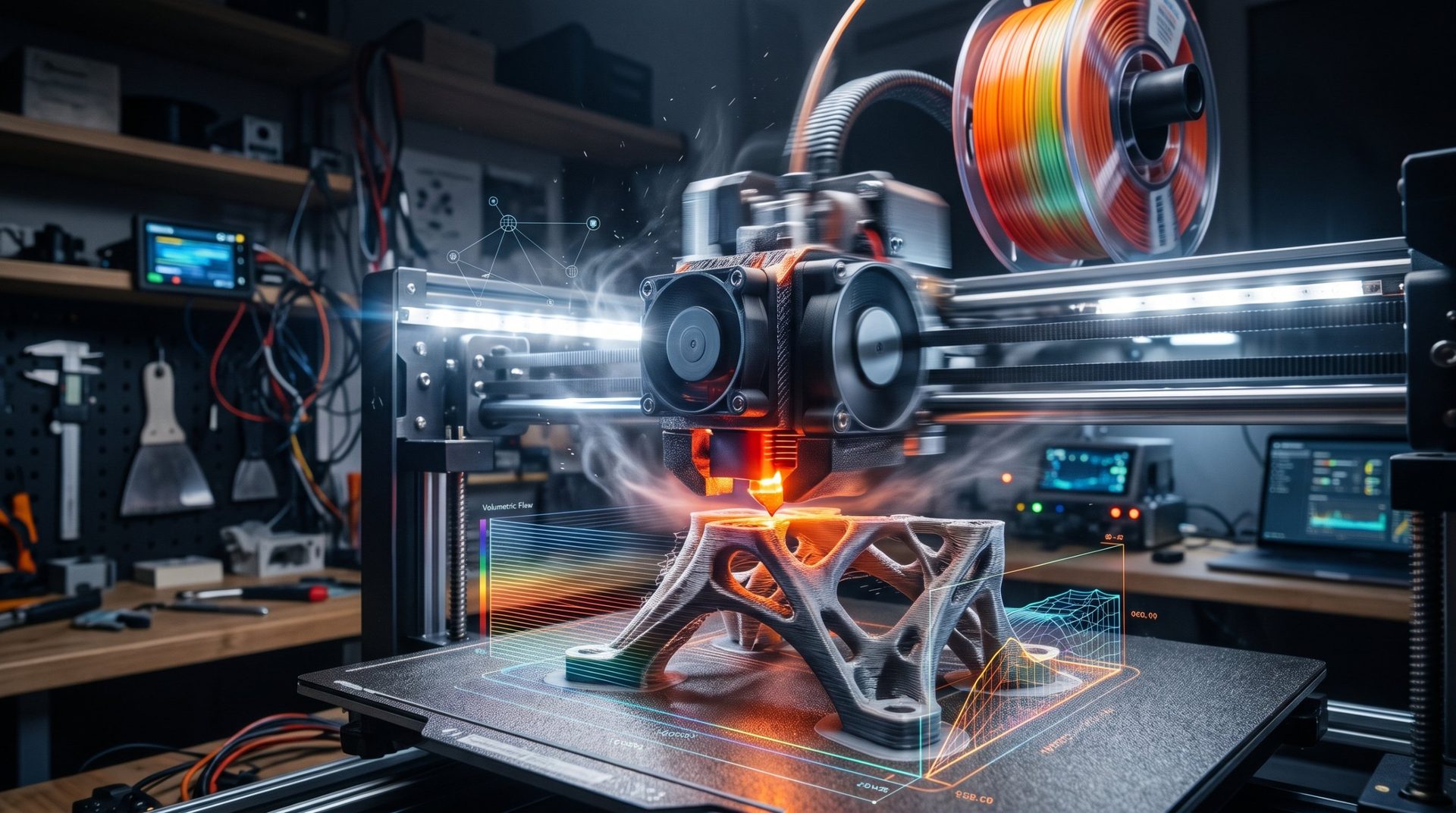
- CoreXY Structure : This is the most common mechanical configuration on fast machines. Unlike classical "Cartesian" printers, where the build plate moves back and forth (Y-axis), the CoreXY system moves the print head on the X and Y axes using belts and fixed motors. This reduces inertia and allows for faster, more precise movements.
- Direct Drive High-Flow Extruder : The extruder is the motor that pushes filament toward the nozzle. A Direct Drive extruder is mounted directly on the print head, ensuring better extrusion control, essential for fast retractions and direction changes. To support these speeds, you also need a nozzle and hotend capable of melting plastic more quickly.
- Optimized Firmware : Firmware is the software that controls the printer. Open-source solutions like Klipper or proprietary firmware from manufacturers like Bambu Lab use advanced algorithms. They anticipate movements, compensate for vibrations (via Input Shaping), and optimize flow so the machine can accelerate and decelerate without compromising quality.
- High-Speed Materials : Certain filaments, like high-speed PLA and PETG, are specifically designed to melt and cool quickly, which is crucial for maintaining quality at high speeds.
Choosing Speed: A Matter of Compromise
While ultra-fast printers are impressive, it's important to note that "speed" is a tradeoff. For highly detailed parts requiring extreme precision, it's often better to reduce speed to ensure the best possible surface quality.
In conclusion, the Bambu Lab X1-Carbon, Creality K1 Max, and Anycubic Kobra S1 are the go-to consumer references for speed. They've made fast printing accessible and reliable, transforming the landscape of additive manufacturing for hobbyists and professionals alike.