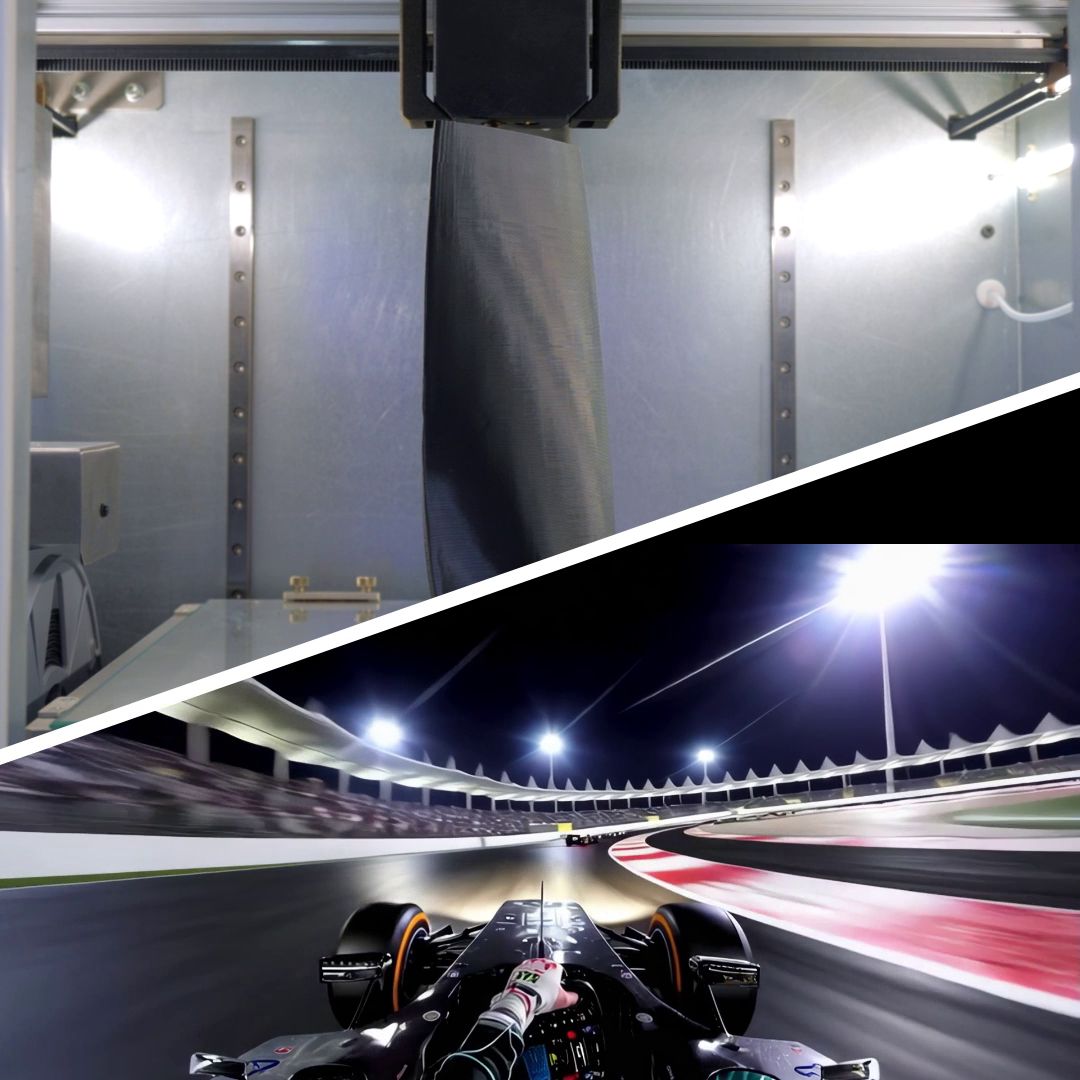
🏎 F1 and 3D Printing: The Race for Marginal Gains

In the Formula 1 paddock, where every thousandth of a second is worth millions, 3D printing (or additive manufacturing) is no longer a laboratory curiosity: it's the engineers' secret weapon. Today, a maintenance technician or trackside engineer does far more than change tires; they manage streams of digital parts ready to be materialized in just a few hours.

✅ Ultra-Fast Prototyping: From Screen to Wind Tunnel
F1 is a discipline of constant iteration. Between race weekends, teams like McLaren and Red Bull print hundreds of components for their wind tunnel scale models.
-
Speed: Where traditional machining took weeks, SLA (stereolithography) printing lets teams test a new front wing in under 48 hours.
-
Precision: High-resolution resins deliver surfaces so smooth they perfectly simulate airflow at 300 km/h.
✅ Final Parts "Printed" on the Race Car
It's not just about testing anymore; these parts race. Thanks to Metal Laser Sintering (DMLS), cars now carry functional 3D-printed components:
-
Titanium exhaust manifolds: Complex shapes impossible to cast that optimize gas flow.
-
Suspension brackets: Using aluminum or titanium, engineers create "organic" structures (generative design) that are both lighter and stiffer than conventional parts.
-
The Steering Wheel: Many internal steering wheel components, like ergonomic grips customized for each driver, come from 3D printing.
✅ Logistics and Responsiveness: The Factory in the Garage
Imagine a race weekend on the other side of the world. A part breaks during Friday practice. Instead of waiting for a private jet from the factory, teams now transport compact 3D printers directly in their trucks or paddock spaces.
-
Instant repair: Print fasteners, sensor mounts, or drilling guides on the spot.
-
Customization: Adjust brake cooling ducts based on the specific temperature of Singapore or Monza's track.
✅ The Future: 2026 and New Regulations
With new engine regulations arriving in 2026, the FIA increasingly permits components from additive manufacturing. The goal is twofold: reduce costs (less material waste) and foster technical innovation.
Did you know? A top team like Williams can produce over 2,000 3D-printed parts per month.