Dental 3D Printing
Dental 3D printing, also known as additive manufacturing, has radically transformed the daily workflow of dental practices and prosthetic laboratories. By moving from physical paste impressions to a 100% digital workflow, dentistry gains in precision, speed, and patient comfort.
Here's a complete overview of this technology.

✅ The Digital Workflow
3D printing doesn't work in isolation—it integrates into a precise digital chain:
-
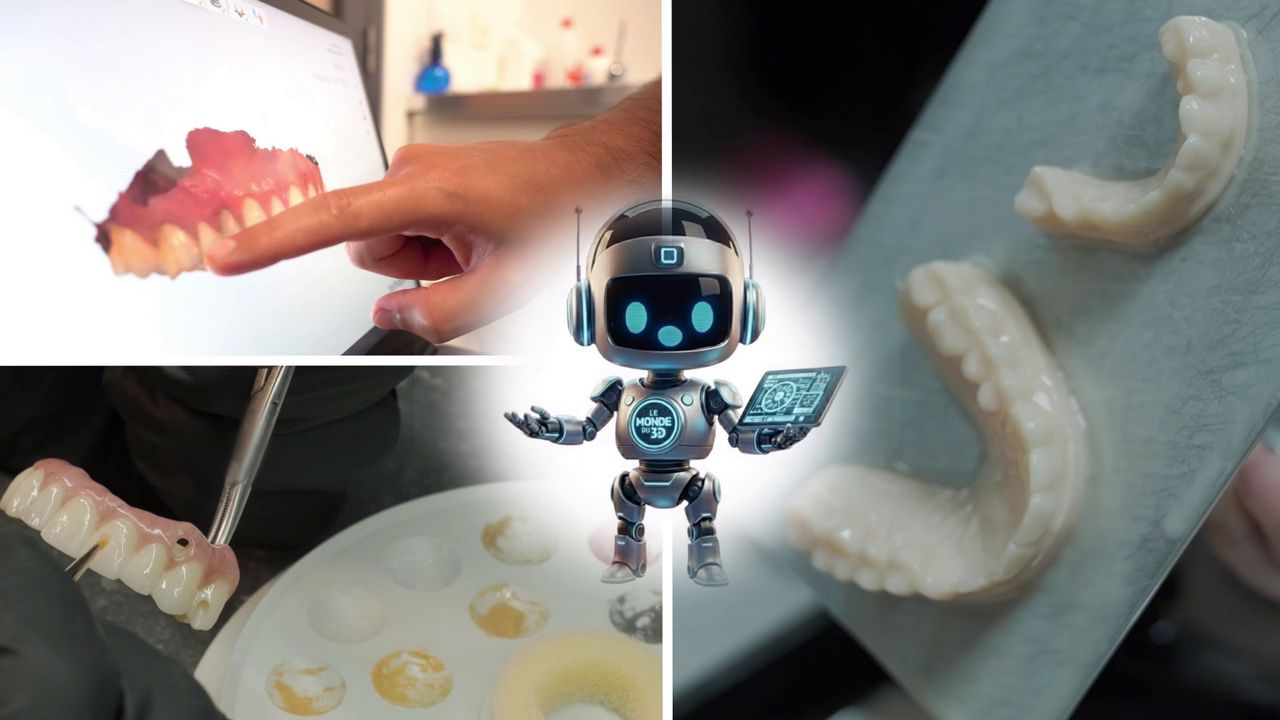
Intra-oral scanner: The dentist scans the patient's mouth to create a 3D file (often in .STL format).
-
Design (CAD): Using specialized software (such as Exocad or 3Shape) to model the crown, appliance, or surgical guide.
-
3D printing (CAM): The file is sent to the printer, which layers resin or metal.
-
Post-processing: Cleaning with isopropyl alcohol and final UV polymerization to solidify the material.
✅ Dominant Technologies
Not all 3D printers are equal. In dentistry, three main processes are used:
| Technology | Material Used | Typical Applications |
| SLA (Stereolithography) | Liquid resin (Laser) | High-precision models, temporary crowns. |
| DLP / LCD | Liquid resin (Projector/Screen) | Most widespread. Very fast, ideal for aligners and guides. |
| SLM (Laser Fusion) | Metal powder | Crown frameworks, bridges in chrome-cobalt or titanium. |
✅ Practical Applications in the Practice
3D printing allows production of a wide variety of medical devices:
-
Study models: To visualize the dentition and plan treatment.
-
Surgical guides: Ultra-precise "stencils" that show the surgeon exactly where to place an implant.
-
Orthodontic aligners: Printing successive models for thermoforming invisible trays.
-
Removable dentures: Printing denture bases with tinted biocompatible resins.
-
Crowns and bridges: Using hybrid ceramic resins for durable restorations.
✅ Benefits and Limitations
The benefits
-
Surgical precision: Reduced risk of human error during impression taking.
-
Time savings: A crown can sometimes be printed and placed the same day (chairside dentistry).
-
Cost savings: Reduced storage and transport costs for physical materials.
-
Patient comfort: No more choking sensation with traditional paste impressions.
The challenges
-
Initial investment: Cost of the machine, software, and staff training.
-
Regulation: Resins must be strictly certified (Class IIa or IIb) to remain in the mouth.
-
Maintenance: Requires regular calibration to guarantee micron-level precision.
✅ The Future: Multi-Material Printing
The next major step is simultaneous printing of multiple materials. Imagine printing a denture where the base is a soft pink resin and the teeth are an ultra-esthetic hard white resin, all in one go.
Dental 3D printing is no longer a futuristic technology, but an essential care standard in 2026. It represents the perfect convergence between precision engineering and oral health.
Key takeaways:
-
Democratization: Increased accessibility of printers (DLP/LCD) has allowed small practices to bring production in-house, reducing lead times from several days to just a few hours.
-
Mass customization: Every piece produced is unique and perfectly adapted to the patient's anatomy, significantly improving the success rate of complex treatments (implantology, orthodontics).
-
Toward sustainable dentistry: By minimizing material waste and eliminating logistics transport related to physical impressions, the digital workflow supports a more sustainable approach.
Progress now focuses on artificial intelligence, which automates CAD design to make 3D printing even smoother and more accessible to practitioners without modeling expertise.