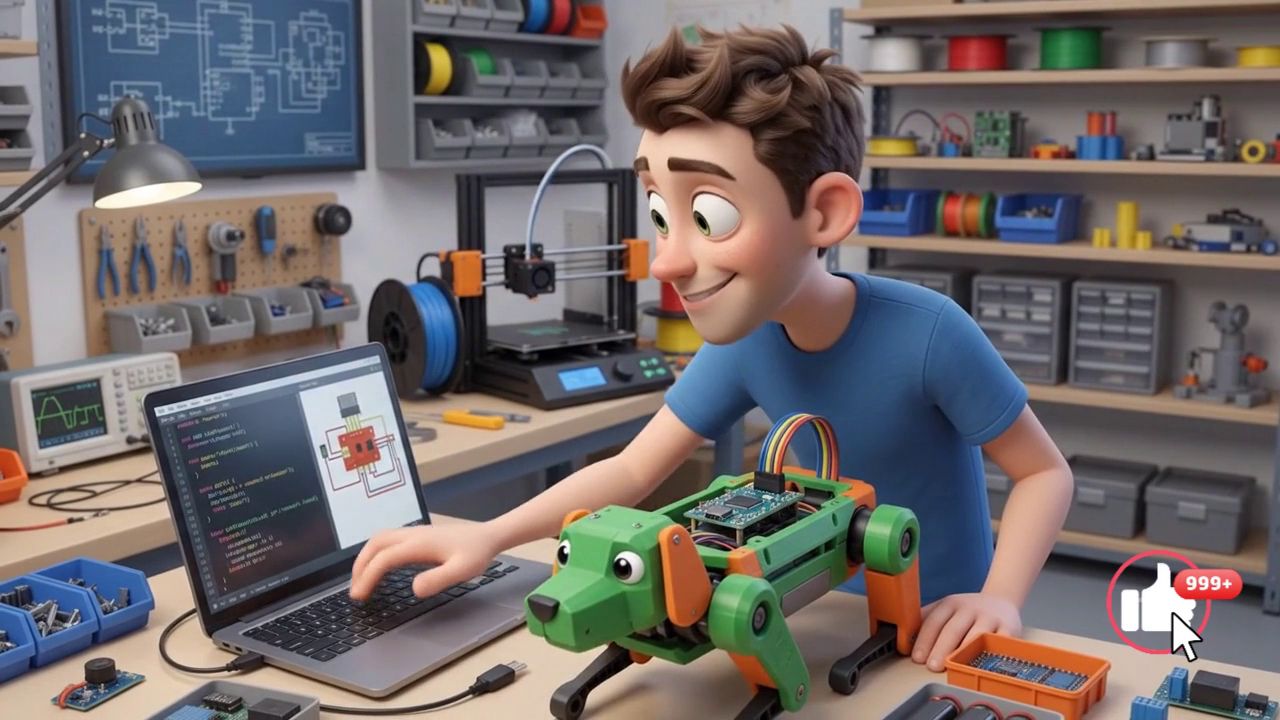
Create an Animatronic Mechanism with 3D Printing

Animatronics — those mechanisms capable of reproducing realistic movements in creatures, faces, or objects — were once reserved for film studios or theme parks with massive budgets. Today, thanks to 3D printing, these technologies are becoming increasingly accessible to makers, artists, engineers, and robotics enthusiasts. The combination of 3D modeling and electronics opens the door to creating custom animatronic systems at a fraction of the cost.

(Image Source and 3D File: PurpleShark via MakerWorld)
What is an Animatronic Mechanism?
An animatronic mechanism is an electromechanical device designed to simulate natural movements, often used to animate:
-
faces (facial expressions, eye movements, lip movement, etc.)
-
articulated limbs (arms, legs, fingers)
-
animals or fantastical creatures
These movements are made possible by servo motors, stepper motors, sensors, and are controlled via electronic boards (Arduino, Raspberry Pi, etc.).
The Impact of 3D Printing
1. Custom Part Fabrication
3D printing makes it easy to create personalized components:
-
Complex joints
-
Custom gears
-
Motor mounts
-
Lightweight yet sturdy structures
It effectively replaces traditional machining, especially for one-off or small-batch parts.
2. Cost Reduction
Fabricating animatronic parts by hand or via CNC machining can be expensive. 3D printing allows local production at low cost with common materials like PLA, ABS, or PETG.
3. Rapid Prototyping
A prototype can be designed, printed, tested, and modified in just a few hours. This encourages experimentation and innovation.
Example of a 3D Printed Animatronic Project
A Robotic Face
Goal: Reproduce human expressions (blinking, smiling, eye movement).
Key Steps:
-
3D Modeling (Fusion, Blender) of the face's mechanical parts: jaw, eyebrows, eyeballs, eyelids.
-
3D Printing of elements in PLA to test the mechanics.
-
Assembly of servo motors in the designated slots (controlled by Arduino).
-
Programming movements via Arduino or Python scripts (interactions, emotional sequences).
-
Adding a silicone skin for a more realistic appearance.
Typical Electronic Components
-
Servo Motors: precise, ideal for small movements (eyelids, lips)
-
DC Motors: for wider rotations (neck, arms)
-
Sensors: distance, sound, light, for automatic interactions
-
Control Boards: Arduino Uno, Mega, ESP32, etc.
Limitations and Challenges
-
Durability of Printed Parts: certain mechanical stresses require reinforced materials (nylon, carbon fiber).
-
Precision: the fit between moving parts must be millimeter-perfect.
-
Motor Heat: sometimes requires cooling or careful servo selection.
-
Programming: requires basic knowledge of electronics and coding.
Possible Applications
-
Film and special effects
-
Animated or interactive shows
-
Educational projects
-
Companion robots or mascots
-
Museums and exhibitions
3D printing has democratized animatronic creation, allowing anyone to design and manufacture complex mechanisms with minimal resources. By combining creativity, modeling, electronics, and mechanical engineering, it's now possible to bring inanimate objects to life, whether for entertainment, education, or art. The boundary between imagination and reality has never been thinner.