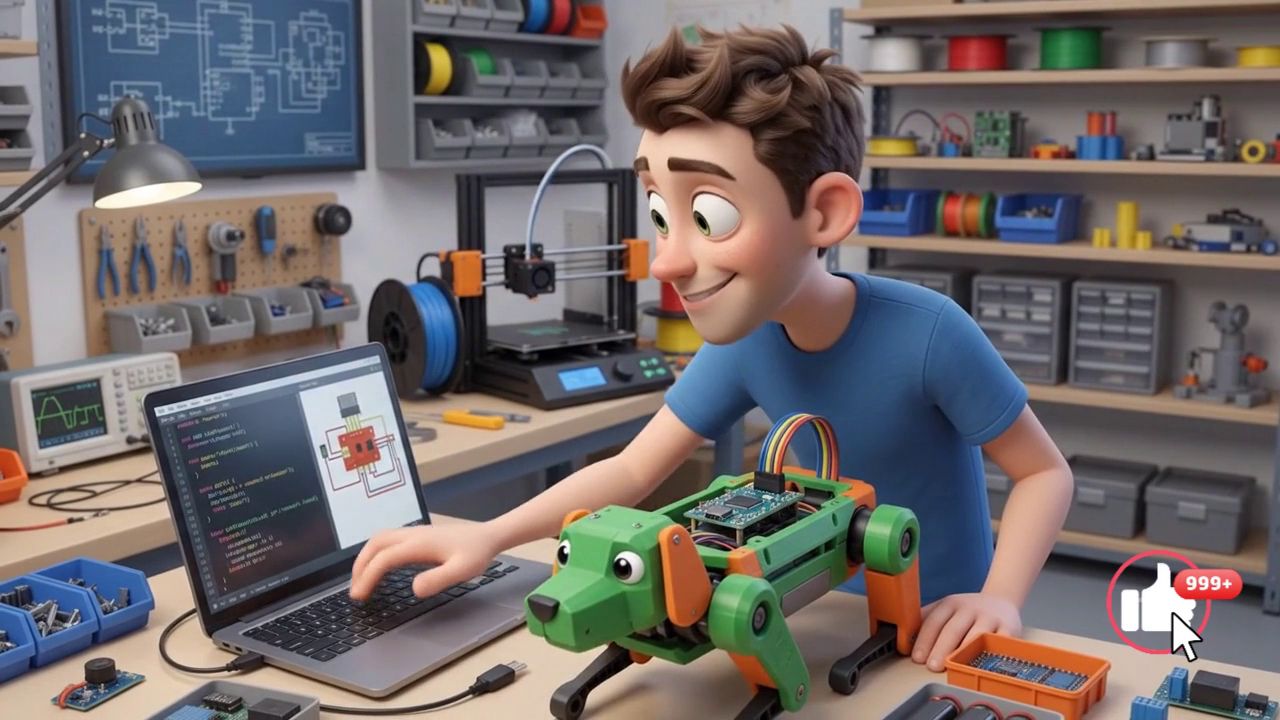
Build a Robot Dog with 3D Printing

The quadruped robot dog, made famous by companies like Boston Dynamics, is a dream for many robotics enthusiasts and engineers. Thanks to 3D printing, this complex project is no longer reserved for research laboratories, but has become an accessible reality for DIY makers and students. 3D printing is the cornerstone that makes these builds possible, affordable, and highly customizable.

Why 3D Printing is Essential
Using 3D printing (primarily FDM) in quadruped robotics offers fundamental advantages:
- Affordability and Low Cost: 3D printing lets you build the skeleton, chassis, and joints of your robot for a fraction of the cost of industrial materials or machined parts. It democratizes advanced robotics.
- Rapid Prototyping: The complexity of a quadruped robot lies in the precision of its kinematics (how the legs move). If an angle is wrong or a servo won't fit, 3D printing lets you modify and reprint the part in hours, drastically speeding up the design cycle.
- Lightweight Design and Integration: 3D printing lets you design hollow parts or lightweight lattice structures. Plus, you can build component housing directly into your design: supports for nuts, cable channels, and precise mounts for sensors and microcontrollers (Arduino, Raspberry Pi).
Critical 3D-Printed Components
Most of a DIY robot dog's structure is 3D printed. These parts need careful attention to strength and tolerance:
- The Chassis (Body): This is the central housing that holds the robot's "brain" (the control board, often an Arduino or microcomputer) and the battery. It must be robust enough to handle dynamic forces.
- Servo Motor Mounts: The parts that hold the servo motors (the robot's "muscles") must be printed with high precision. Too much play in tolerances can lead to imprecise movements and poor gait.
- Links and Feet: The robot's limbs need a rigid material and warp-free printing to ensure the geometry calculated by your code matches the actual physical motion.
Materials and Technical Requirements
Your choice of filament is key to robot performance:
- PLA: Often used for initial prototyping because it's easy to print and rigid. However, it may lack impact resistance.
- PETG: A better choice for parts under mechanical stress, as it's tougher and less brittle than PLA.
- ABS / ASA: Offer excellent mechanical and heat resistance, but require a heated chamber to prevent warping, especially for large chassis pieces.
- Tolerances: Make sure holes and mounts for screws and bearings are printed with the right clearance for smooth assembly.
The Open Source Community
The success of DIY robot dogs relies heavily on collaborative projects. Initiatives like OpenDog or educational platforms like Petoi Bittle provide free access to:
- STL Files: 3D models of all the parts.
- Parts Lists: The electronic components, motors, and fasteners you need.
- Software Code: Programming code for the microcontroller, which handles inverse kinematics (how to move the motors so the leg reaches a specific point).
3D printing empowers hobbyists to go from robotics spectators to active builders, opening the door to experimentation and innovation in autonomous machine design.