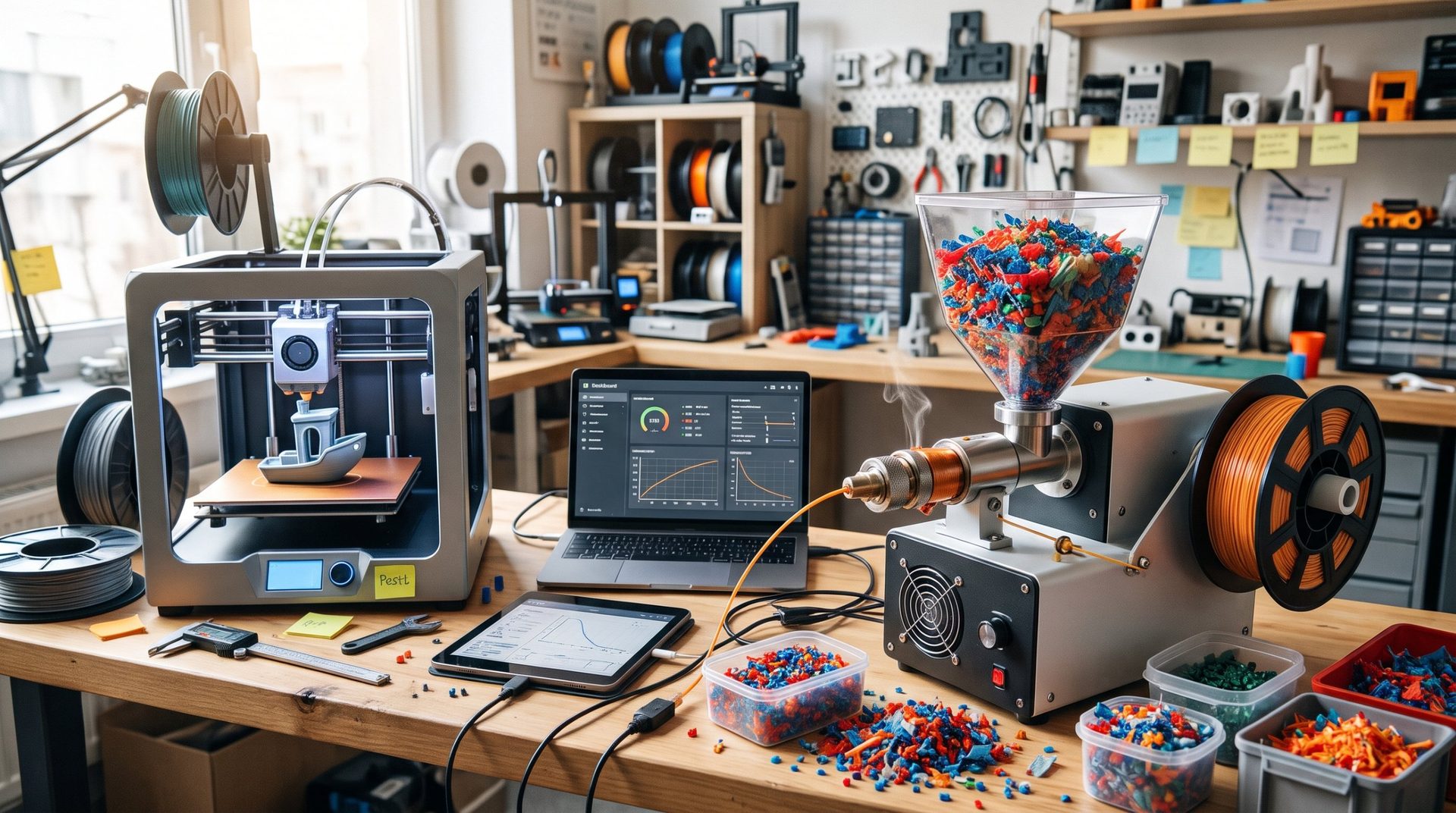
Creality Maker M1 & Shredder R1: Will the Future of 3D Printing Be 100% Recycled?

The 3D printing industry is increasingly moving toward sustainability, and Creality understands this well. With the duo Maker M1 and Shredder R1, the brand offers a complete ecosystem to recycle your failed prints and create your own filament at home.
Here's an overview of this "closed-loop" recycling solution.

♻️ The Concept: Turn Your Waste Into Resources
Waste is the dark side of FDM 3D printing (supports, failed prints, useless prototypes). Until now, recycling your plastic required expensive industrial machines or complex DIY setups.
Creality's system breaks down into two steps:
-
The Shredder R1: It shreds used plastic into small pellets.
-
The Maker M1: It extrudes these pellets to create a new spool of filament.
✅ Creality Shredder R1: The Compact Shredder
The Shredder R1 is designed to reduce your 3D models into uniform pellets.
-
High-strength blades: It uses alloyed steel cutters capable of shredding various types of plastic (PLA, ABS, PETG, etc.).
-
Optimized safety: Unlike industrial shredders, it's fully enclosed with automatic stop sensors if opened to prevent accidents.
-
Cutting consistency: The result is uniform enough to be used directly by the M1 extruder, preventing jams.
✅ Creality Maker M1: The Desktop Filament Factory
Once your pellets are ready, the Maker M1 takes over to produce the filament.
Key features:
-
Precise diameter control: Thanks to an integrated laser sensor, the machine adjusts its speed in real-time to guarantee consistent filament (typically 1.75 mm).
-
Integrated cooling: A ventilation system instantly cools the filament as it exits the nozzle to prevent warping.
-
Automatic winding: The filament is directly guided onto a motorized spool, saving you from having to do it manually.
💡 Advantages and Limitations
| Advantages | Limitations |
| Cost-effective: Significantly reduces the cost of filament per kilogram. | Noise: The shredder remains a fairly loud mechanical machine. |
| Eco-friendly: Gives failed prints a second life. | Purity: You need to sort your plastic types carefully to avoid mixing. |
| Independence: Ability to create custom colors. | Drying: Pellets must be completely dry for quality filament. |
✅ Is This For You?
This duo is ideal for print farms, FabLabs, or intensive enthusiasts who see their trash bins filling up with plastic. It's an investment that pays for itself over time while making your workshop much more "green".
Important note: For optimal results, it's often recommended to blend your recycled pellets with some virgin pellets to maintain the plastic's mechanical properties.
Unlike its standard printers which often go directly to retail, Creality chose the crowdfunding route for this ambitious project. The official launch was orchestrated via Kickstarter.