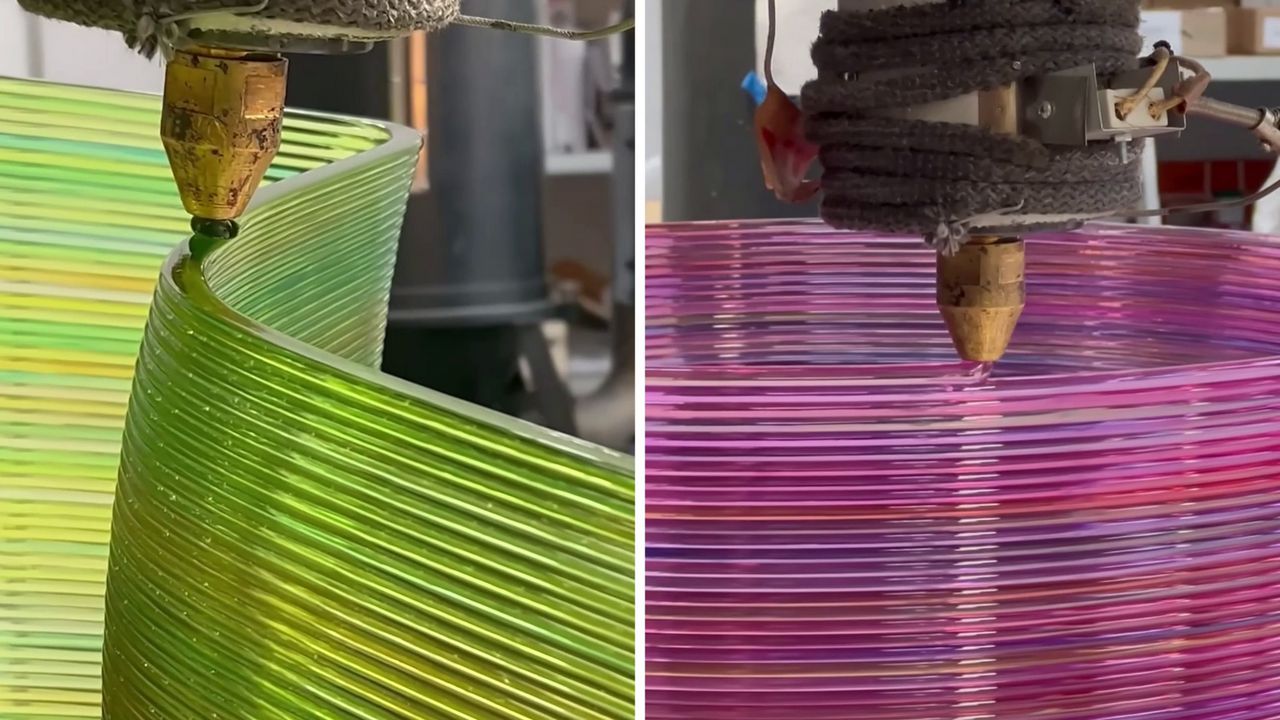
Making Furniture with 3D Printing

3D printing, once limited to rapid prototyping and small object manufacturing, is radically transforming the world of furniture and interior design. This is no longer science fiction: chairs, tables, lighting fixtures, and even entire modular structures can now be manufactured, in whole or in part, thanks to additive technologies. This revolution opens unprecedented possibilities for customization, sustainability, and structural innovation.

Unprecedented Design Freedom
One of the greatest advantages of 3D printing in furniture is design freedom. Traditional manufacturing methods (cutting, molding, assembly) often impose geometric constraints. 3D printing breaks free from these limitations, allowing the creation of organic forms, complex lattices, honeycomb structures, and interlocking patterns that were previously impossible or economically unfeasible.
- Complex and Organic Shapes: Imagine chairs whose backrest mimics the veins of a leaf, or tables whose legs intertwine like tree roots. 3D printing makes these fluid and intricate designs possible.
- Structural Optimization: Additive manufacturing allows the creation of lightweight yet incredibly strong structures thanks to optimized internal patterns. You can reduce the amount of material used while increasing the furniture's durability—a significant gain in weight and resource efficiency.
- Integrated Functionality: Features like hidden storage, built-in cable passages, or invisible assembly systems can be directly incorporated into the design and printing of pieces.

Customization and On-Demand Production
The era of uniform mass production is giving way to mass customization. 3D printing excels at "on-demand" manufacturing, which is ideal for furniture:
- Made-to-Order: Furniture can be precisely adapted to the dimensions of a space, the ergonomic preferences of a user, or a specific aesthetic. Want a taller table, a wider seat, or a particular pattern? It's now possible.
- Limited Editions and Unique Pieces: Designers can produce exclusive collections or functional art pieces without the costs and constraints of large-volume production.
- Waste Reduction: Additive manufacturing is an additive process that removes no material, significantly reducing production waste compared to traditional methods. Additionally, on-demand production limits overproduction.
What Materials and Technologies?
While FDM (Fused Deposition Modeling) is the most accessible technique, large-scale furniture manufacturing employs more advanced technologies and diverse materials:
- Large-Format FDM Printing: Giant FDM printers can extrude recycled or bio-based plastic pellets to create entire chairs and tables in a single piece or modular sections.
- Advanced Composites and Polymers: Materials like PETG, PLA, ABS, and fiber-reinforced composites with carbon or fiberglass offer the strength and durability needed for functional furniture.
- Pellet Extrusion Printing: This method uses recycled plastics in pellet form, reducing material costs and promoting a circular economy in the furniture industry.
- Concrete and Cementitious Materials: 3D concrete printing opens the door to creating benches, planters, and urban furniture with sculptural forms and exceptional durability.
Challenges and Future Prospects
Despite its potential, 3D printing in furniture faces challenges:
- Speed and Cost: Printing speed for very large pieces and the cost of industrial printers remain factors to optimize for mass production.
- Finishing: Visible layer lines (characteristic of FDM) may require post-processing for a smooth, aesthetic finish, adding time and costs.
- Certification and Standards: Ensuring the strength and safety of 3D-printed furniture according to existing standards is a major concern.
Nevertheless, advances are rapid. 3D printing promises to transform our interiors into more personalized, environmentally friendly, and innovative spaces. It gives designers a powerful tool to push the boundaries of creativity and consumers the ability to own truly unique furniture pieces. Will tomorrow's furniture be printed on demand and perfectly adapted to your life? The future will tell, but the foundations are already laid.