Bambu Lab: How This Brand Revolutionized 3D Printing in Record Time
Just a few years ago, buying a consumer 3D printer meant accepting a compromise: spending almost as much time tuning your machine (manual bed leveling, belt tension, first layer height, fighting stringing and warping) as actually printing real projects. Then Bambu Lab arrived, and the rules changed fast.
Founded in 2020 by former engineers from robotics and drones (including from DJI), the brand approached 3D printing not as a DIY kit, but as a precision device ready to use out of the box. Here's why Bambu Lab created such a shockwave in the maker community, and what makes its ecosystem so powerful.
1. Speed without sacrificing quality
Before Bambu Lab, printing fast almost always meant vibrations, surface defects (ringing) and inaccurate dimensions. By democratizing CoreXY architecture, with a rigid frame, a lightweight head and vibration compensation measured by accelerometer (input shaping), the brand cut print times in half, in thirds or more depending on the part.
A technical piece that took all night on an old Cartesian printer now comes out in a few hours, with stunning surface finish. This time savings changes how you design: you can prototype, test an assembly, correct a dimension and relaunch the print the same evening.
2. The "zero hassle" experience: sensors and automatic calibration
The real magic of the Bambu Lab experience is automating the steps that used to discourage beginners:
- Automatic leveling: before each print, the machine probes the build plate to compensate for any irregularity.
- Flow and pressure calibration: thanks to sensors built into the head (and the Lidar sensor on the older X1 series), the machine adjusts extrusion itself based on the filament used.
- Incident monitoring: camera to watch prints remotely, filament tangling detection, alert if a print fails (the "spaghetti detection") and resume after a power cut.
Result: unbox the machine, plug it in, and your first part often comes out in less than half an hour.
3. From AMS to tool changer: multi-material without compromise
If there's one innovation that captured everyone's attention, it's the AMS (Automatic Material System). Multi-color printing existed before, but it was complex, expensive and finicky. Bambu Lab turned it into a closed box that handles multiple spools effortlessly:
- Supports that come off cleanly: you print the part in PLA or PETG, and a dedicated interface material only on the contact layer. Supports peel away by hand leaving a smooth surface.
- Continuous printing: two spools of the same color running out? The AMS automatically switches to the second when the first is empty, without interrupting the print.
- Dry storage: slots for desiccant, and genuine integrated drying on the latest generations (AMS 2 Pro, AMS HT and the new 9-spool AMS 3H, which dries two spools at once).
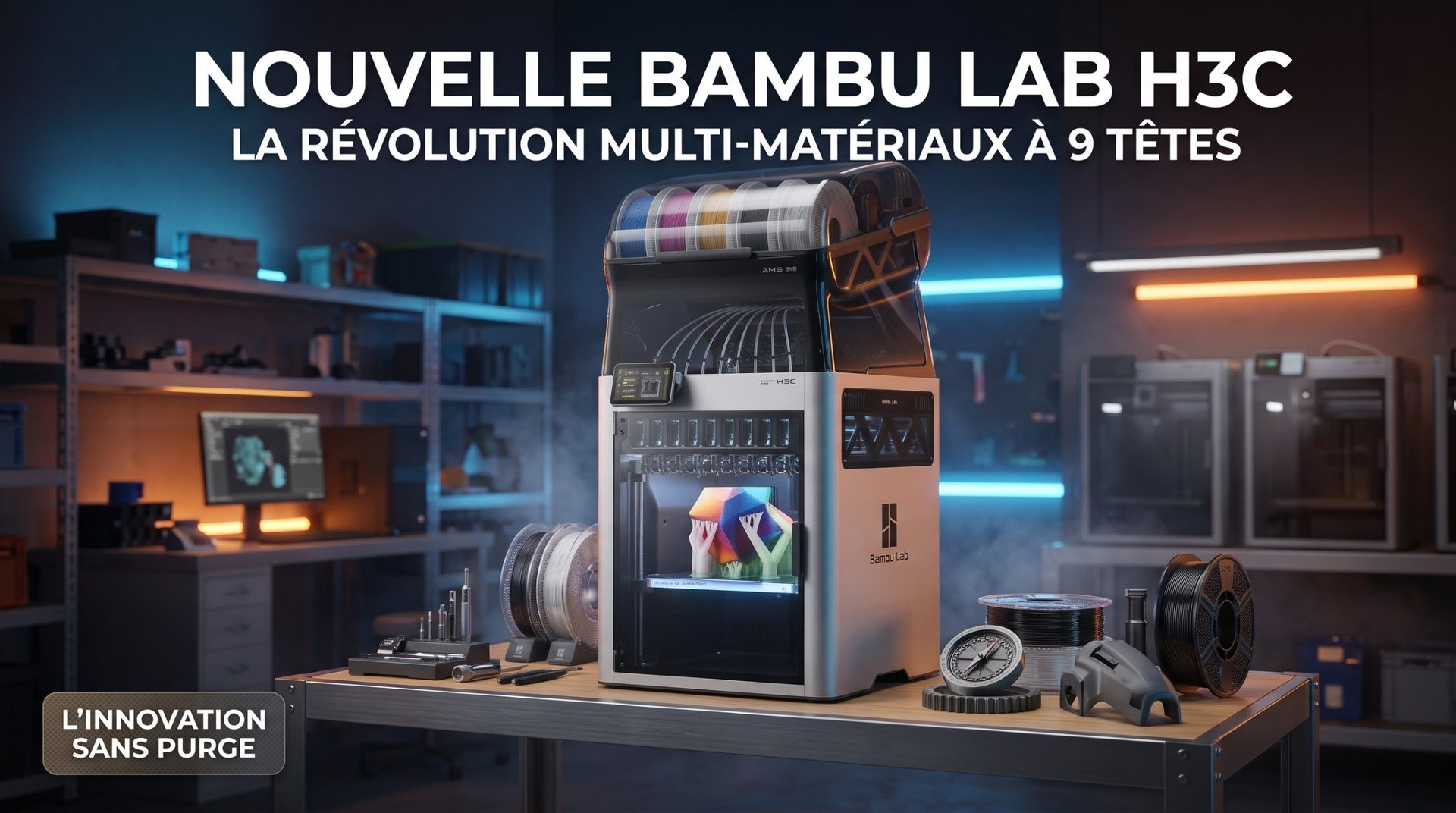
With the Bambu Lab H3C, unveiled November 3, 2026, the brand takes a leap forward with a true tool changer: 9 independent heads stay loaded in a 330 × 320 × 325 mm chamber, and switching colors or materials takes about 6 seconds with almost no purge.
4. A complete ecosystem: Bambu Studio, MakerWorld and RFID spools
Bambu Lab's strength isn't just in the hardware, but in integrating the entire chain:
- Bambu Studio: a modern, intuitive and very comprehensive slicer, with profiles tested for each material and nozzle. It has a hugely popular open-source cousin, OrcaSlicer: our comparison Bambu Studio vs OrcaSlicer helps you choose.
- MakerWorld: the brand's 3D model platform. Its specialty: each model comes with print profiles preset by the community. From the Bambu Handy app, pick an object, verify it matches your loaded spools and launch the print from your couch. This is also where we publish all our free 3D files.
- RFID spools: official filaments include a chip read by the AMS, which automatically tells you the material, color and settings without typing anything.
5. Which Bambu Lab model to choose for your needs?
| Model | Architecture | Strengths | Best for… |
|---|---|---|---|
| A1 / A1 mini | Cartesian (moving bed) | Quiet, very affordable, quick nozzle swap without tools, AMS Lite compatible | Beginners, PLA, PETG and TPU, tight budget |
| P2S | Enclosed CoreXY | Successor to the P1S: excellent performance-to-price ratio, touchscreen, enclosed chamber | Regular makers, functional parts (ABS, ASA), small production |
| X2D | CoreXY dual nozzle | Successor to the X1-Carbon (discontinued March 2026), two nozzles for soluble supports and dual-material | Demanding prototyping, technical materials |
| H2 (H2S, H2D, H2C) | Large-format CoreXY | 330 × 320 × 325 mm, heated and filtered chamber, dual nozzle on H2D, automatic nozzle swap (Vortek) on H2C | Large parts, multi-material, professional use |
| H3C | CoreXY tool changer | 9 heads (swap in ~6 seconds), 350 °C nozzle, chamber heated to 65 °C, comes with AMS 3H (9 spools, integrated drying) | Complex multi-material with minimal purge, high-temperature technical parts |
Trade-offs to keep in mind
No ecosystem is perfect, and choosing Bambu Lab means accepting two realities:
- A more closed environment: unlike open-source machines running Klipper, the firmware is proprietary and tied to the brand's cloud. You gain stability and simplicity at the cost of modification freedom. Some makers are even looking to disconnect from Bambu's cloud.
- Purges on single-nozzle models: on the A1 or P2S, each color change forces the machine to purge the old filament (the famous "purge blobs"), which wastes plastic and lengthens the print. Dual-nozzle, nozzle-swap or tool-changer machines like the H3C greatly reduce this problem.
What do you think? Has Bambu Lab changed how you print, or do you prefer the freedom of open machines?