The Ultimate Guide to Bambu Lab 3D Printers (Late 2026 Edition)

Updated November 16, 2026: X2D and H3C arrival, end of X1 and P1 series.
Bambu Lab has segmented its lineup to serve every profile, from casual hobbyists to professional workshops. Here's the complete overview of machines available in late 2026.
✅ The A1 Series: Affordability Without Compromise
These bed slinger printers are the simplest and quietest in the brand's lineup.
- A1 mini: Compact, ideal for getting started on a tight budget.
- A1: Same simplicity with a 256 mm build plate for larger parts.
- Strengths: Ultra-fast tool-free nozzle swap and AMS Lite included for color printing. Compatible with the AMS 2 Pro (an adapter is needed to take advantage of active drying).
✅ The P Series: From P1 to P2S
Launched in 2023, the P1 series made Bambu Lab's reputation: the P1P (open frame) and P1S (enclosed, the historic reference for ABS and ASA). The P1P is no longer in production, with the P2S taking over as its successor, launched in late 2025.
- P2S: A completely redesigned P series with touchscreen, smoother camera, AI-powered print failure detection, and quieter operation.
- Strengths: Today's best value-for-money option in the lineup for regular makers and technical parts.
✅ The X Series: From X1-Carbon to X2D
The X1-Carbon, the historic flagship with its Lidar sensor, is no longer in production as of March 31, 2026 (parts and support guaranteed until 2031). It is replaced by the X2D, launched in April 2026.
- X2D: Brings dual nozzles to the X series, enabling soluble support printing or two different materials without purge between them.
- Strengths: A machine designed for technical materials and filled filaments (carbon, glass).
✅ The H2 Series: Large Volume and High Performance
This is the "pro" lineup launched in 2025, with a large build volume of 330 × 320 × 325 mm.
- H2S: The single-head version, focused on speed (up to 1,000 mm/s).
- H2D: The dual extrusion specialist. Its two nozzles allow support materials (BVOH, PVA) without color mixing, with high precision on complex parts.
- H2C: The Vortek system automatically swaps between nozzles on a rack, drastically reducing filament waste in multi-color printing.
- Strengths: Actively heated chamber up to 65 °C and air filtration.
✅ The H3C: The 9-Head Tool Changer
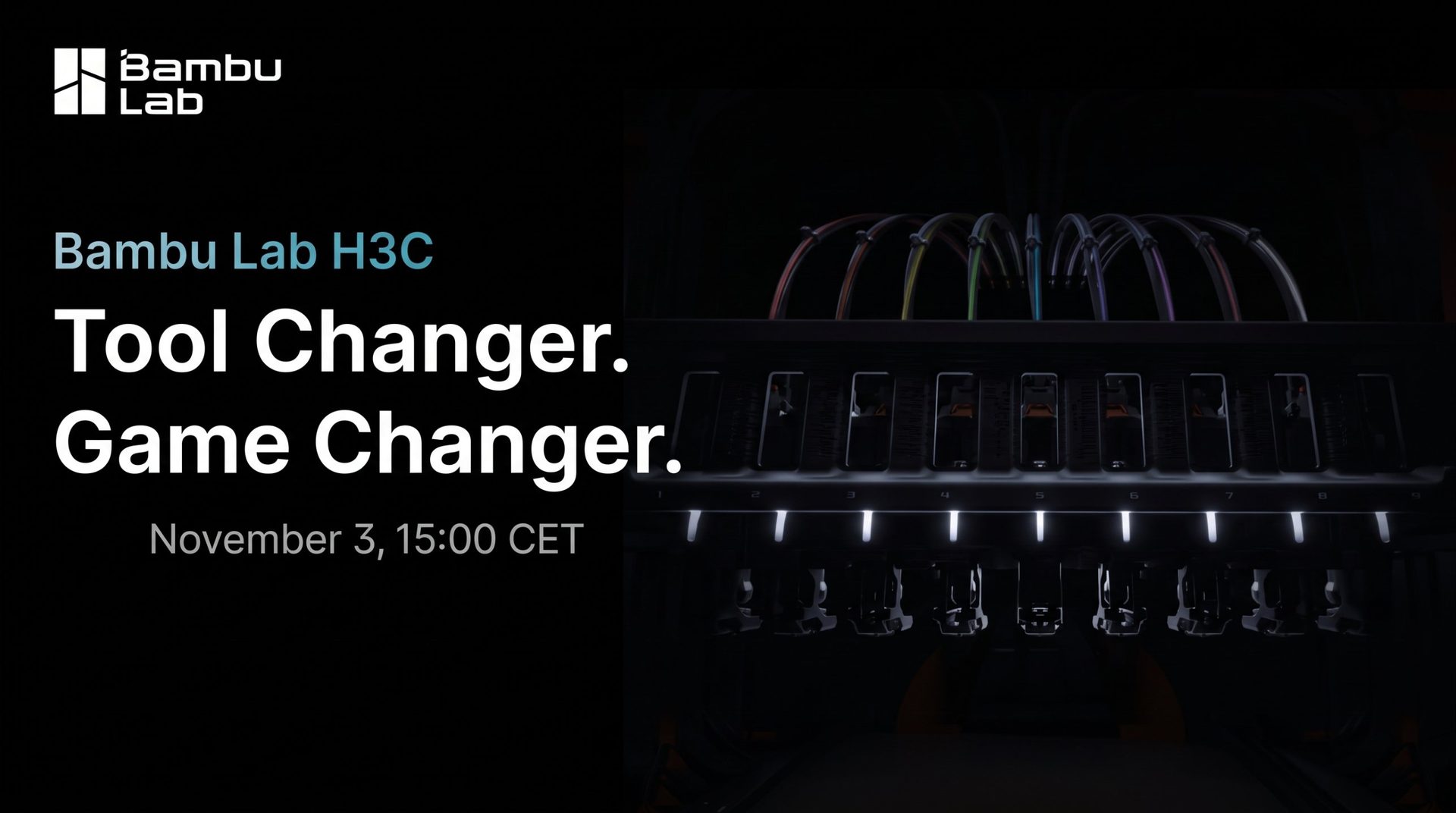
Unveiled on November 3, 2026, the Bambu Lab H3C is the brand's first true tool-changer printer.
- 9 independent heads: Each maintains its own filament; material changes take about 6 seconds with minimal purge.
- Versatile: 330 × 320 × 325 mm build volume, nozzle up to 350 °C, heated chamber to 65 °C, and a dedicated head for ultra-flexible TPU in 2.85 mm.
- Ships with AMS 3H: 9 spools with 2-spool simultaneous drying. Price: €2,499 in bundle in France.
✅ Summary: Which Bambu Lab Should You Choose?
| Model | Best For | Key Takeaway |
|---|---|---|
| A1 mini / A1 | Beginners, tight budget | Simple, quiet, optional AMS Lite |
| P2S | Regular makers | Best value for money, enclosed for ABS and ASA |
| X2D | Technical parts, soluble supports | Dual nozzle, successor to X1-Carbon |
| H2S / H2D / H2C | Large parts, professional use | Large volume, heated chamber, dual nozzle or Vortek |
| H3C | Demanding multi-material | 9 heads, minimal purge, AMS 3H included |
✅ The AMS Systems: Intelligent Filament Management
The AMS (Automatic Material System) loads, switches, and protects your spools. The range has expanded:
- AMS 2 Pro: 4 spools with active drying up to 65 °C, temperature and humidity sensors, RFID reading for Bambu Lab spools, and faster drive speed (up to 60% faster according to Bambu Lab). Some materials like ABS, ASA, or PC cannot be fully dried at this temperature.
- AMS HT: Single spool unit designed for technical materials and higher-temperature drying.
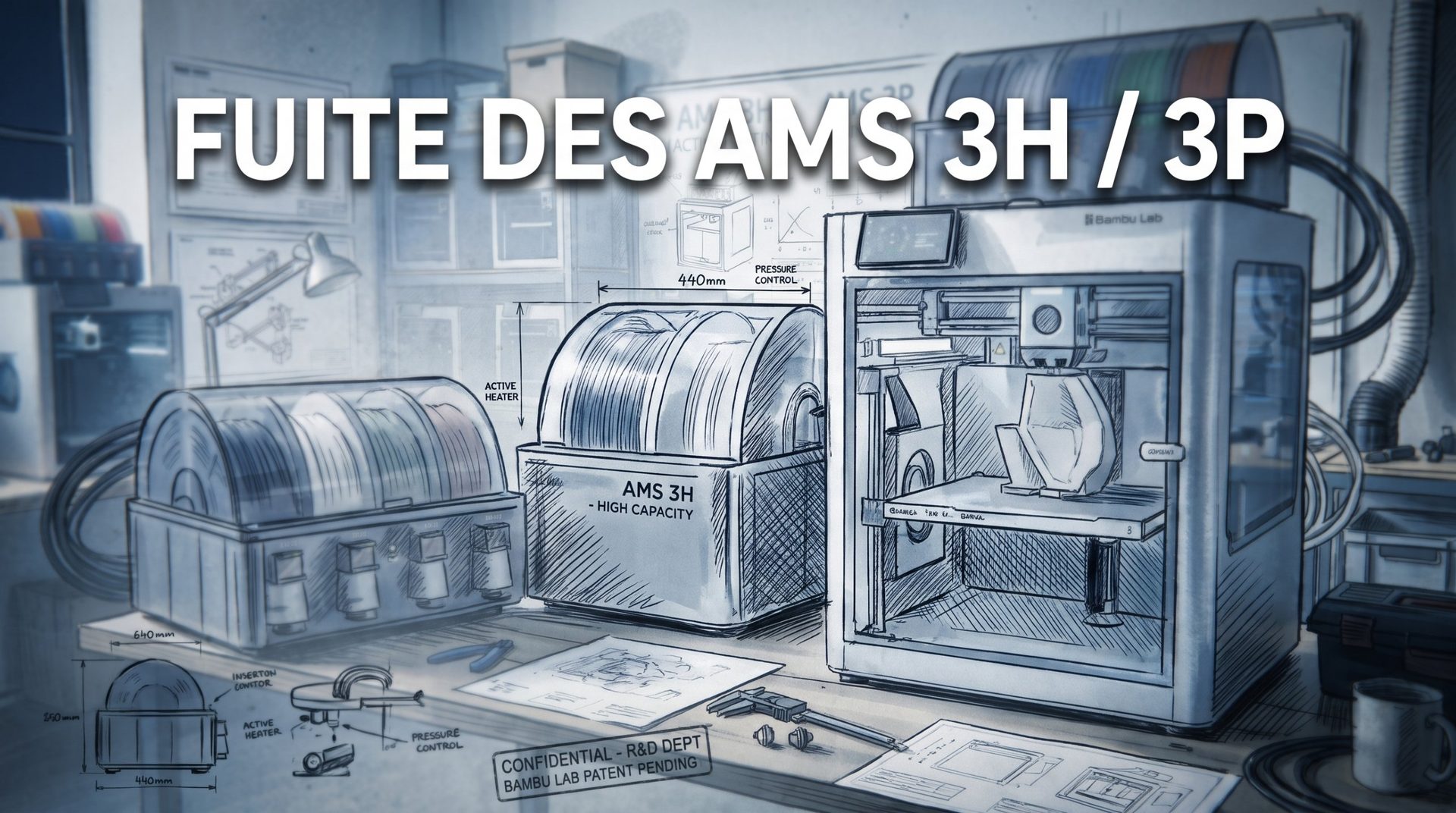
- AMS 3H: The new 9-spool module, included with the H3C, drying 2 spools simultaneously up to 85 °C.
Pro tip: You can connect up to 4 AMS 2 Pro and 8 AMS HT units to a compatible printer, for up to 24 spools total.
So, which way are you leaning?
- Favoring the A series for simplicity and quiet operation?
- Leaning toward P2S or X2D for regular, technical use?
- Ready to step up to the H2 or H3C for professional and multi-material projects?
Never underestimate what the AMS brings to the table: regardless of your machine, automatic filament and humidity management radically changes how you create. Once you've experienced it, it's hard to go back!