3D Printing Revolution in Cinema 📽
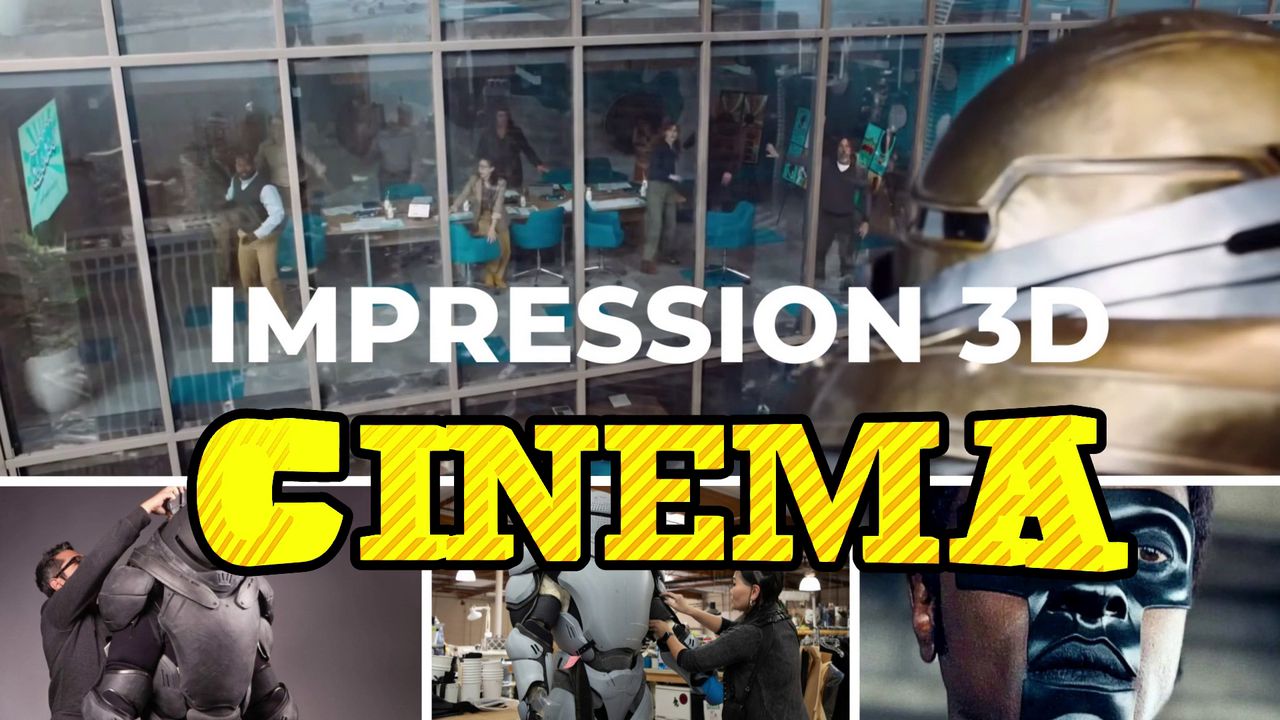
The film industry is undergoing a major transformation thanks to additive manufacturing. While digital special effects (CGI) have long ruled the roost, the resurgence of practical effects (real objects handled by actors) now relies on 3D printing to deliver speed and detail.
The film Superman (2025), directed by James Gunn, stands as the most recent and best-documented example of this technological revolution.

(Image and Video Source: Superman 2025 Film/Legacy Effects)
✅ The Superman (2025) Case Study
The creative studio Legacy Effects, renowned for its work on Iron Man and Avatar, revealed that it used a fleet of 3D printers (including Bambu Lab X1C models) to tackle the logistical challenges of the new Superman film.
Key elements printed for the film:
-
Mister Terrific's mask: The superhero's iconic "T"-shaped mask was printed in TPU (a flexible material). This allowed the mask to conform perfectly to the actor's facial expressions while remaining comfortable for long filming days.
-
Mister Terrific's flying chair: One of the most complex accessories. Its main structure was designed via FFF 3D printing for lightness, combined with metal joints for durability.
-
The "LexCorp Raptors" and "Hammer of Boravia" armor: Complete stunt costumes were printed. The advantage? If a piece broke during an action scene, the studio could reprint the exact piece the same day, avoiding production delays.
-
Ultra-fast prototyping: Before fabricating final costumes, teams printed test versions to verify actor mobility, allowing adjustments in hours instead of the weeks it once took.
✅ Why Cinema Can't Live Without 3D Printing
The use of 3D printing in blockbusters like Superman or recent Marvel films addresses three critical needs:
A. Surgical precision
3D printing makes it possible to create textures impossible to achieve by hand. For Black Panther's suit or the details of Batman's armor, high-resolution printers deposit millimeter-perfect patterns directly onto fabrics or plastic surfaces.
B. Actor comfort
Through 3D scanning, an actor's body can be modeled to the millimeter. The printed accessory then fits perfectly to their physique, reducing fatigue and enabling more natural movements.
C. Cost and time savings
"In the past, you'd sculpt in clay, create a mold, then cast resin. Today, you go from digital design to finished object overnight."
✅ The Most-Used Technologies on Set
| Technology | Primary Use in Film |
| SLA (Resin) | Jewelry, highly detailed small accessories, facial prosthetics. |
| FDM / FFF (Filament) | Large armor pieces, set structures, stunt prototypes. |
| SLS (Nylon Powder) | Functional mechanical parts, durable articulated props. |
The film Superman 2025 marks a turning point where 3D printing is no longer just a behind-the-scenes tool, but the central pillar of visual creation. By blending the digital and the tangible, James Gunn proves that to make a superhero believable, sometimes you have to swap pixels for filament and resin.