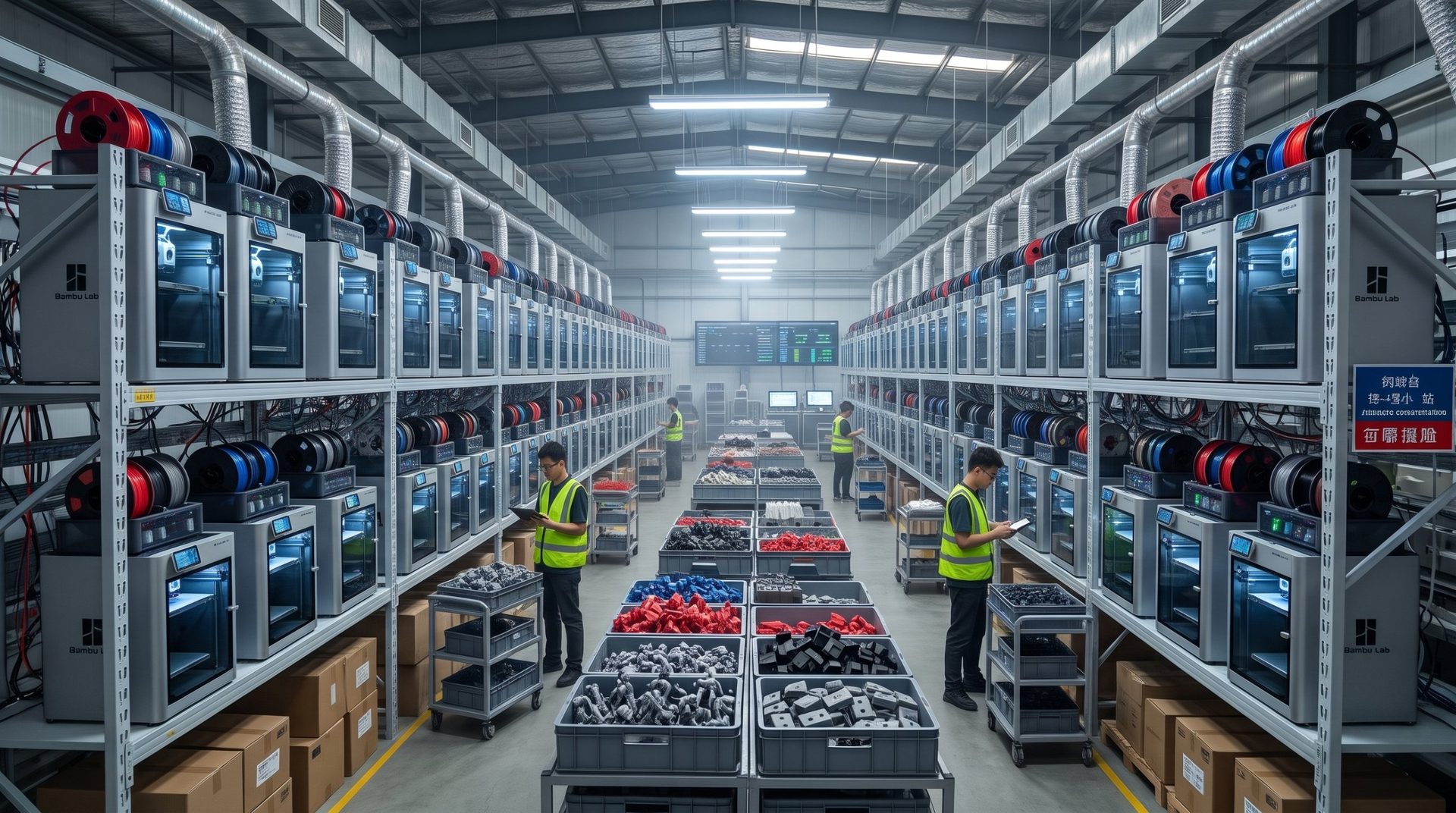
The 3D Printer Farm: The Factory of the Future, Flexible and Connected

3D printing, once confined to labs and enthusiast workshops, is entering a major new phase: industrialization. The emergence of 3D printer farms is radically transforming production, shifting from one-off prototyping to small and medium series manufacturing on demand. Imagine a factory where every machine can produce a different part, without costly tooling or long setup times. Welcome to the era of the 3D printing farm.

What Is a 3D Printer Farm?
A 3D printing farm is an organized and often automated collection of multiple 3D printers operating simultaneously, managed from a central hub. Unlike a single printer, which excels at rapid prototyping, a farm is designed for larger-scale production, flexibility, and resource optimization.
It can consist of:
- Dozens, even hundreds of printers (often FDM, but also SLA/DLP or SLS for more specialized applications).
- A centralized management software for file distribution, monitoring, task scheduling, and maintenance.
- Post-processing systems (cleaning, curing, finishing) that can be integrated or automated.
- Sometimes, robots for part and build plate handling.
It's a true miniaturized, scalable factory capable of adapting to changing market demands.
The Revolutionary Advantages of the 3D Printer Farm
Adopting a 3D printer farm brings significant benefits that redefine production strategies:
1. Production Flexibility and Agility
This is the key. Each printer in a farm is an independent production unit. This means you can:
- Produce a wide variety of parts simultaneously: While a traditional factory is optimized for a single product, a farm can simultaneously manufacture smartphone cases, spare parts for industrial machinery, and personalized figurines.
- Switch production quickly: No need for expensive retooling or long downtime. A simple file change lets you move from one part to another in a flash.
- Respond to fluctuating demand: Increase or decrease production capacity by activating or deactivating printers, without the constraints of a fixed assembly line.
2. Cost Reduction and Inventory Optimization
On-demand manufacturing, the hallmark of 3D printing, reaches its full potential in a farm.
- Zero finished product inventory: Produce only what is ordered, eliminating storage costs, obsolescence risks, and unsold stock.
- Reduced tooling costs: No more expensive molds for each new part or design change.
- Material optimization: Management software can batch orders to optimize filament use and reduce waste.
3. Scalability
A printer farm is inherently scalable. You can start with a few printers and add more as demand grows. It's a flexible way to increase production capacity without the massive upfront investments required by traditional factories.
4. Mass Customization at Scale
The 3D printer farm is the ideal tool for mass customization. Each part can be unique and tailored to customer specifications (dimensions, colors, patterns), while still being produced in semi-industrial volumes. This opens enormous opportunities in sectors like hearing aids, prosthetics, fashion, and promotional items.
5. Local Production and Supply Chain Reduction
By enabling agile, on-demand manufacturing, 3D printer farms encourage production relocation. This reduces dependence on complex global supply chains, shortens delivery times, and cuts the carbon footprint of transport. A part can be produced just kilometers from its end user.
The Challenges of Setting Up a 3D Printer Farm
Despite its advantages, implementing a 3D printer farm is not without challenges:
- Initial Cost: Acquiring multiple printers and advanced management software represents a significant investment.
- Management Complexity: Coordinating dozens (or even hundreds) of printers, managing queues, failures, maintenance, and consumables requires rigorous organization.
- Technical Skills: Staff must master not only printer operation, but also fleet management software and troubleshooting of complex issues.
- Post-Processing: While printing may be automated, post-processing of parts can still require significant human intervention, though roboticized solutions are emerging.
The Future of Manufacturing
The 3D printer farm is not a distant futuristic concept; it's already a reality reshaping the manufacturing landscape. From producing urgent spare parts to creating hyper-personalized products, these flexible and connected factories offer unprecedented agility and efficiency. They are concrete proof that 3D printing has moved beyond gadget status to become an industrial force capable of meeting the demands of an ever-changing market.
The era of the future factory, modular and digital, is upon us, driven by the growth of 3D printer farms.