
3D Print Farms in China: Why They're Outcompeting Injection Molding
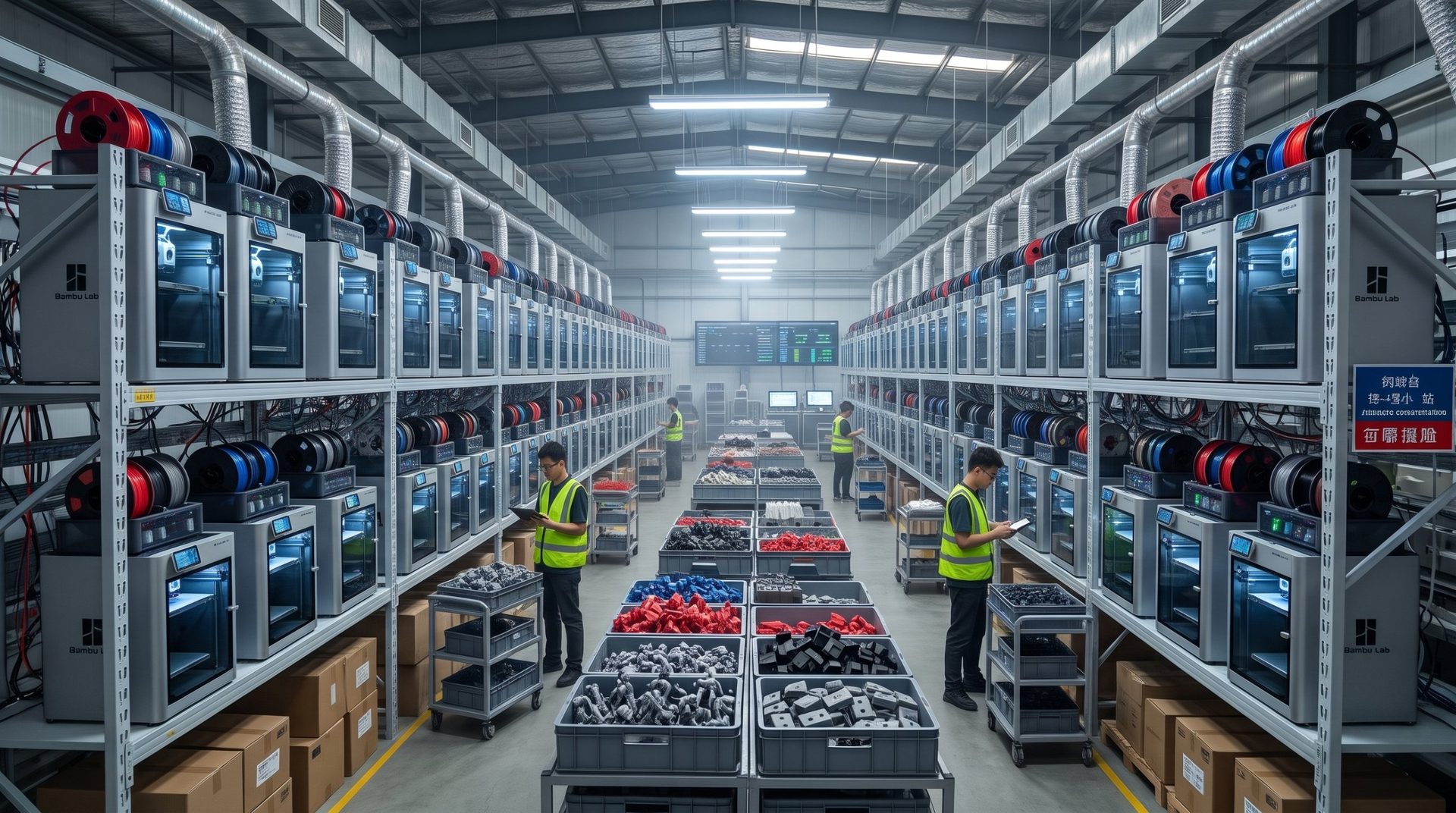
Entire warehouses lined with hundreds, even thousands of 3D printers running day and night: print farms are experiencing explosive growth in China. Far from being a simple maker hobby, they're now positioning themselves as a direct alternative to traditional manufacturing plants.
Why has this model taken hold so forcefully in Chinese industry? If you're new to the concept, start with our article on what a 3D print farm is.
1. No tooling to pay for
In traditional plastics manufacturing, injection molding requires a steel or aluminum mold. It typically costs anywhere from a few thousand to over €30,000 and requires several weeks of fabrication and setup.
- Massive flexibility: with a print farm, there's no mold. A modified file can be sent to 50 or 200 machines with just a few clicks using centralized management software.
- Profitable for small to medium runs: from dozens to thousands of parts, amortizing a mold is often impossible. The print farm fills this gap perfectly. Beyond that, injection typically becomes cheaper per unit again.
- No dead stock: production happens on demand. If a product stops selling, you simply stop printing it—no mold investment or lost inventory.
2. Cheaper machines and materials on-site
Print farms are growing worldwide, but China brings together conditions that are hard to replicate elsewhere. Here are some ballpark figures, which vary significantly by company:
| Cost item | Europe / North America | China |
|---|---|---|
| Printer | €400–€1,200 (taxes and import included) | Significantly cheaper, bought locally |
| PLA / PETG filament | €12–€22 per kilo | Often €4–€7 per kilo in bulk |
| Labor (sorting, finishing) | €25–€45 per hour (all charges) | A few euros per hour |
| Return on investment | Often over a year | Often just a few months |
Located near printer makers (Bambu Lab, Creality, Anycubic in Shenzhen, Flashforge in Zhejiang) and plastic producers, Chinese farms recoup their machine investments at record speed.
3. Software: a handful of operators for hundreds of printers
Gone are the days of operators running around with an SD card from machine to machine. The profitability of large farms relies on automation:
- Centralized monitoring: fleet management software watches every machine in real time (temperatures, nozzle status, filament end). Options exist for small shops too, like 3DPN Print Farm Manager.
- AI-powered error detection: cameras spot a "spaghetti mess" or lifted print and stop the machine before wasting the job.
- Automatic part removal: some farms use conveyor-belt build plates, plate changers, or robotic arms that grab cooled parts and launch the next print.
Result: a small team of operators can oversee tens, even hundreds of machines. We dig deeper into this shift in our article on autonomous print farms.
4. Demand drivers
- Hyper-responsive online commerce (TikTok Shop, Amazon, Temu): viral gadgets, articulated toys, phone stands, desk organizers—dreamed up Monday, sold by the thousands by Friday.
- Electronics and prototyping: custom enclosures for circuit boards, drone parts, tool shells.
- Mass personalization: logos, color-on-demand, limited runs, no setup surcharge.
To get a sense of the scale, here's a print farm in action:

Key takeaway
In China, the 3D print farm is no longer just a backup to injection molding—it's a full manufacturing model in its own right, one that has shrunk product cycles. Cheap materials, fast machines, and software-driven fleet management give brands a time-to-market speed that traditional methods struggle to match.
And for your own projects, no need to go all the way to China: we manufacture prototypes, small runs, and one-offs right here in France.


