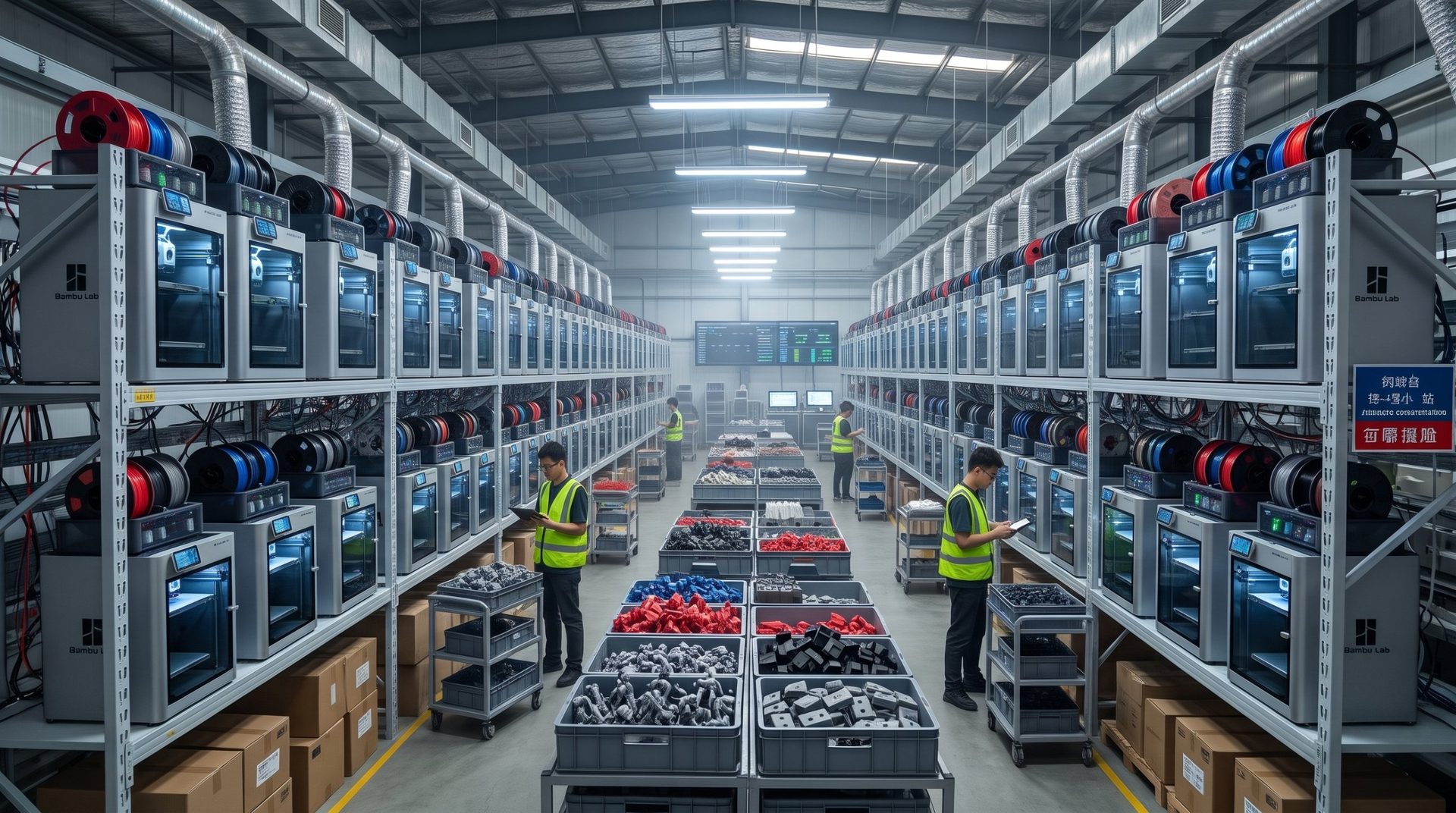
Production 4.0: How 3D Print Farms Are Replacing Traditional Molding

3D printing is no longer just about one-off prototypes. With the rise of 3D print farms, it's becoming a genuine alternative to traditional factory production for series manufacturing.
Here's a complete breakdown of this model that's transforming industry.

✅ How Does It Work?
A 3D print farm is a set of multiple printers (sometimes dozens or even hundreds) operating together as a networked system simultaneously.
-
Centralized Control: Unlike a hobbyist launching files one by one, a farm uses management software (like OctoFarm or proprietary AI-driven solutions) to distribute tasks. Send an order for 500 parts, and the software automatically allocates the work across available machines.
-
Automation: The most advanced farms integrate robotic arms or tilting platforms to remove finished parts without human intervention, enabling 24/7 production.
-
Preventive Maintenance: With sensors and AI, machines alert themselves to lubrication needs or clogged nozzle risks before breakdowns occur.
✅ Why Choose a Print Farm?
The main advantage is bridging the gap between single prototypes and injection molding (extremely expensive to set up).
-
Agility and Flexibility: Want to modify your part design at the 100th unit? Just update the digital file. No physical mold to remake.
-
Reduced Inventory (Just-In-Time): You only produce what sells. No need for massive warehouses stocking thousands of parts "just in case."
-
Complexity at No Extra Cost: In 3D printing, making a hollow sphere or complex lattice costs the same as printing a solid cube. This lets you create lighter, higher-performance parts.
-
"Horizontal" Economy of Scale: Instead of buying one giant machine worth millions, multiply affordable smaller machines. If one breaks down, the other 49 keep producing.
✅ The Future: Toward Industry 4.0
By 2026, several major trends are shaping the future of these farms:
-
AI as "Quality Controller": Cameras monitor every layer. If AI detects a defect (like a stringing artifact or layer delamination), it stops the machine or adjusts parameters in real-time to save the print.
-
Eco-Friendly Materials: The trend is toward industrial-grade recycled filament and bio-based materials. Farms become "circular" local production hubs, transforming local plastic waste into finished products.
-
Decentralization: Soon, a company will be able to own a "virtual farm" with machines across multiple countries, launching production as close as possible to end customers to eliminate shipping costs and associated carbon footprint.
In short: The 3D print farm transforms digital files into physical goods nearly instantly. It's the perfect tool for small to medium batch production (up to 10,000 or 15,000 parts).