
🎾 3D Printed Tennis Balls: The Sustainable, Air-Free Future

While tennis is a sport heavily dependent on ball quality and pressure, 3D printing brings a radical solution to a major problem: the short lifespan of traditional balls and their massive environmental impact. Additive manufacturing paves the way for designing airless balls, which are more durable and fully recyclable.
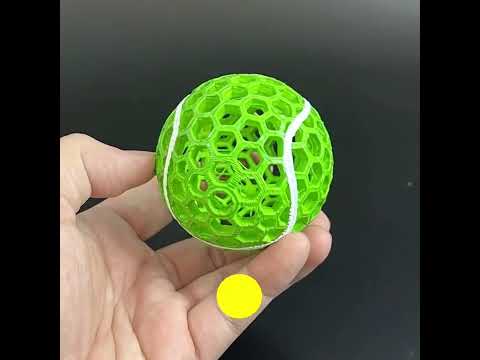
The Problem: Pressure, Waste, and Sustainability
Traditional tennis balls are pressurized and covered with felt. Once used, they quickly lose pressure and bounce, becoming unusable for competition.
-
Environmental Impact: More than 300 million balls are produced globally each year. Made of rubber and non-biodegradable materials, they often take up to 400 years to decompose in landfills, creating a massive waste problem.
-
Short Lifespan: In competition, a ball's useful life can be limited to just a few hours.
The 3D Solution: The Airless Ball
3D printing bypasses the internal pressure problem by creating complex internal structures that simulate the bounce of compressed air.
-
Lattice Structure: The secret lies in the design. Using 3D printing, designers can create a lattice or honeycomb internal structure. This geometry absorbs energy on impact and releases it, ensuring consistent bounce without ever requiring air or pressurization.
-
Durable Materials: Prototypes are often printed from flexible TPU polymers or high-resilience PLA (PLA-HR). These materials are more durable and, when recycled after use, can reduce the environmental footprint by 90% compared to a traditional ball.
-
The POINT Project: Industrial design initiatives have already created 3D-printed balls (like the POINT project) aimed at being fully recyclable, with their performance data actively being studied.
Advantages and Challenges for Tennis's Future
3D printing offers considerable advantages but also presents challenges to overcome before it takes over the courts:
-
Longevity and Consistency: The 3D-printed ball maintains consistent bounce and doesn't lose pressure. It can be used until the structure fails, ensuring a longer useful lifespan.
-
Customization: It's possible to adjust the internal structure (the lattice) to tailor the bounce to different playing styles, court speeds, or weather conditions, offering an unprecedented level of customization.
-
Production Challenges: The major challenge remains achieving performance characteristics exactly identical to a regulation pressurized ball. Additionally, the mass production cost is still high compared to traditional molding methods, and the effective integration of the felt coating (crucial for spin and control) must be perfected.
3D printing transforms the tennis ball from a disposable object into a sustainable, customizable, and technologically advanced component, promising to bring major innovation to the courts, from amateur to professional level.


