3D Print Pythagoras Cup
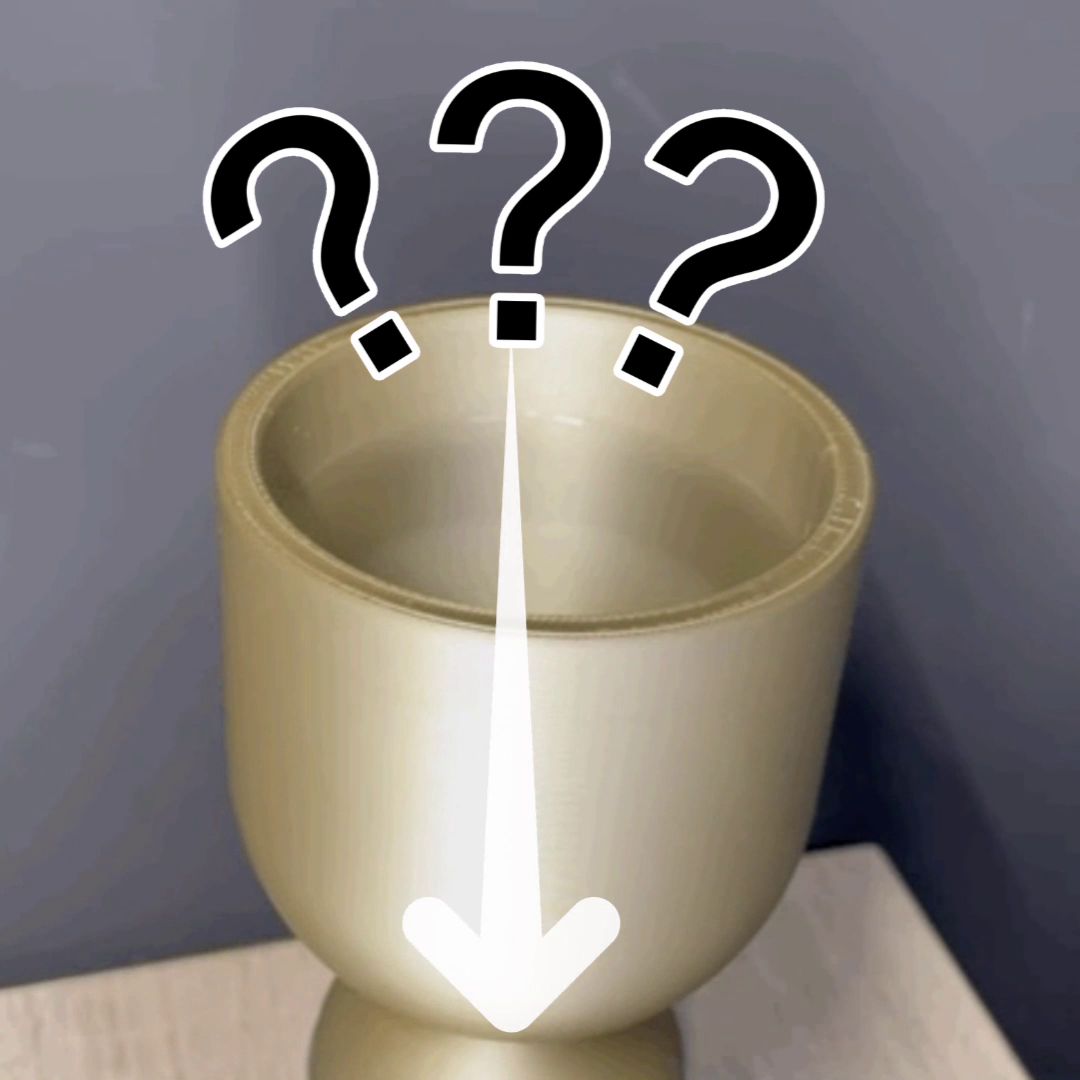
The Pythagoras Cup, also known as the Cup of Moderation or Cup of Justice, is a fascinating ancient object attributed to the Greek philosopher and mathematician Pythagoras of Samos. Designed over 2,500 years ago, it's an early example of simple hydraulic engineering.
Today, 3D printing makes this historic mechanism accessible, allowing anyone to recreate this physical puzzle at home.

(Image Source and 3D File: ptr via MakerWorld)
The Scientific Principle: The Law of the Siphon
The genius of the Pythagoras Cup lies in its simplicity and the application of hydrostatic and atmospheric pressure principles:
- The Secret Design: The cup resembles a normal goblet, but it has a hollow column at the center. Inside this column is an inverted "U"-shaped conduit—a siphon.
- The siphon inlet is at the bottom of the cup, inside the central column.
- The siphon's highest point (the tipping point) determines the maximum fill level.
- The siphon outlet is a discrete hole located under the cup's base.
- The Rule of Moderation:
- If the user fills the cup below the siphon's highest point, the beverage stays in the cup.
- If the user becomes "too greedy" and fills the cup above the siphon's highest point, the liquid rushes into the central tube.
- The Siphon Effect: Once the liquid reaches the siphon's highest point and begins flowing through the outlet, hydrostatic pressure takes over. The suction process begins and completely empties the cup through the bottom hole, punishing the user for their excess. Legend has it that Pythagoras invented it to teach moderation to his disciples.
The 3D Printing Challenge
Printing the Pythagoras Cup is an excellent project to test your 3D printer's precision, particularly regarding internal channels:
- FDM (Filament) Printing: The cup is typically printed as a single piece. The challenge lies in the internal siphon.
- Supports: It's essential to use supports to hold up the ceiling of the siphon's internal channel during printing. These supports must be easily removable without compromising the conduit's seal.
- Layer Height: A fine layer height (around 0.15 mm) is recommended to ensure precision of the small channels.
- Material: For use with liquids (water, wine, etc.), it's crucial to use a food-safe filament. PETG or food-grade PLA are the best choices, though seal integrity is always the primary concern.
- Sealing: For the siphon to function, the cup must be perfectly watertight:
- Increase the number of perimeters (shells) (4 to 6 perimeters).
- If needed, after printing, a sealing treatment (such as food-safe epoxy resin or varnish) can be applied to the inside to seal any micro-leaks.
Modeling: Precision Is Key
If you're not downloading a ready-made STL file (available on platforms like Cults3D or Thingiverse), modeling requires careful attention:
- You must design the internal chamber and siphon so that the tipping point is exactly where you want to place the "moderation" line.
- Internal channels must be smooth and free of obstructions from supports so water can flow freely and trigger the siphon.
By printing the Pythagoras Cup, the Maker doesn't just fabricate an object—they recreate a "magic" trick based on physics, offering a gift or playful, educational demonstration that spans millennia.