Why Start 3D Printing Today?
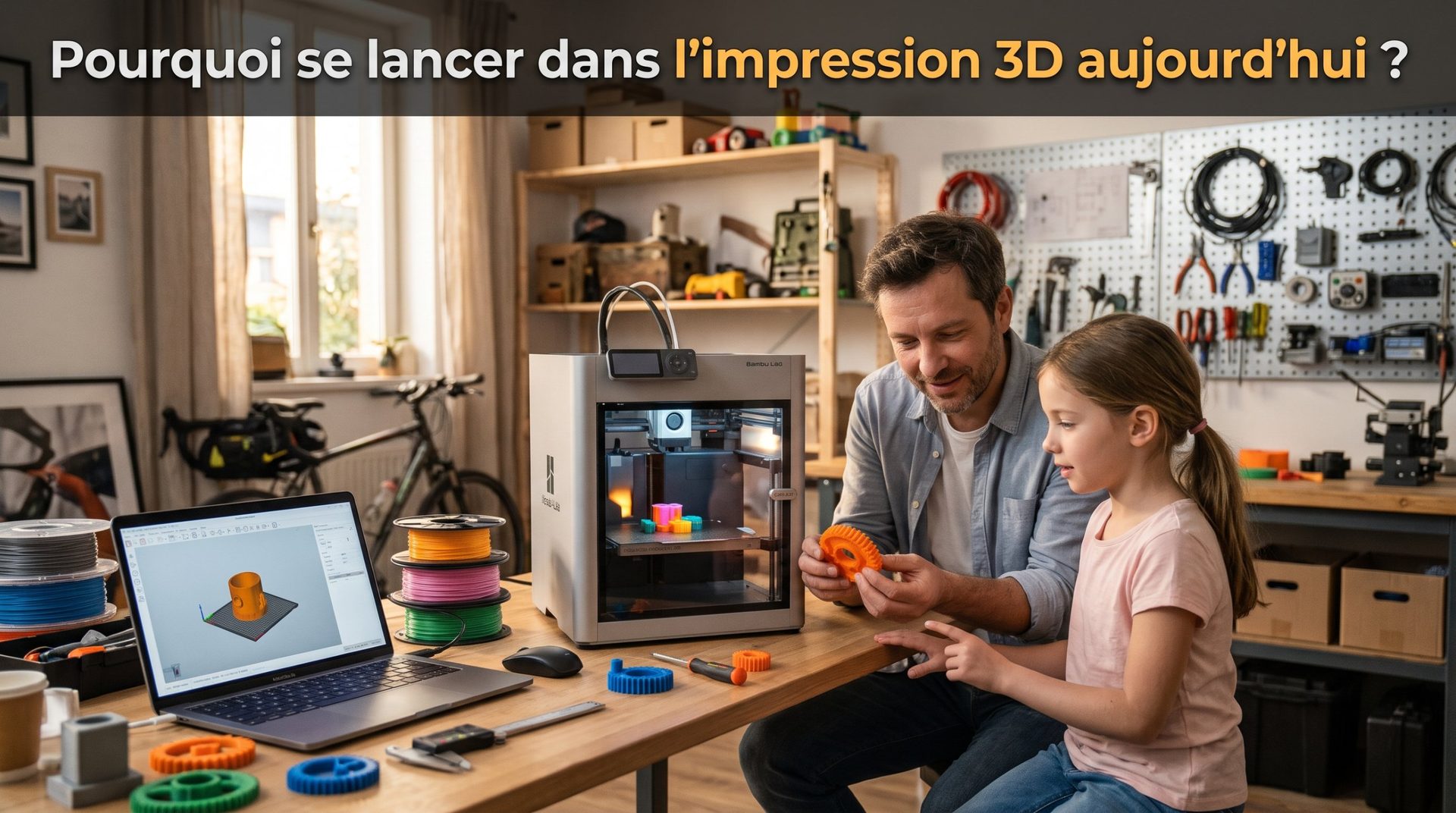
For more than a decade, 3D printing remained the domain of hardcore hobbyists—people who spent more time leveling their build plate with a sheet of paper than actually making useful objects. Clogged nozzles, parts peeling off after twelve hours, endless manual calibrations: many curious newcomers gave up.
Those days are gone. Modern motion systems, automatic sensor-based calibration, and smarter slicers have made the 3D printer a genuine reliable production tool. Getting started today is no longer an obstacle course: it's acquiring a practical skill that transforms how you relate to everyday objects.
1. Ending planned obsolescence at home
The most direct and cost-effective argument is the ability to repair instead of throw away. Appliances, garden tools, and furniture often become unusable because of a single broken plastic part—sold at a premium by the manufacturer or impossible to find:
- Dishwasher basket with broken wheels: a few cents' worth of PETG and half an hour of printing beats buying a whole new basket, often costing dozens of euros.
- Roller shutter handle, vacuum clip, food processor gear: thousands of replacement models are freely shared by the community on 3D file platforms (Printables, MakerWorld, Thingiverse).
- Less dependence on customer service: no more waiting weeks for a spare part; you print it at home in a few hours.
It's also a concrete step for the environment: we explain this in our article on 3D printing for the circular economy.
2. Total customization: adapting the world to your needs
Buying off the shelf means accepting dimensions and features designed for average use. 3D printing lets you tailor your environment to your actual constraints:
- Organizing your workshop and desk: hugely popular modular systems like Gridfinity let you create compartmentalized drawers to the millimeter for every wrench, drill bit, or cable.
- Electronics and home automation: a custom ventilated enclosure for a Raspberry Pi, a temperature sensor built into a wall switch, a charging cradle fitted to your car's dashboard…
- Rapid prototyping: for creators, designers, and craftspeople, an idea printed in the morning can be tested in the afternoon, then refined that evening—no industrial tooling required.
3. The technical barrier has collapsed
What makes now the right time—rather than five years ago—comes down to a few major breakthroughs:
| Then (2015–2020) | Today |
|---|---|
| Manual bed leveling with screws and paper | Automatic sensor probing or nozzle-based sensing; first-layer height adjusts itself |
| Slow speeds (40–60 mm/s) to avoid vibrations | Travel speeds of 250–500 mm/s with no visible quality loss |
| Frequent failures from clogs or tuning errors | Active vibration compensation (input shaping) and ready-to-use slicer profiles |
| Materials limited to rigid, brittle PLA | Tough PETG, flexible TPU, carbon-fiber-filled nylons (with hardened steel nozzles) |
Result: unboxing a modern printer, connecting it to your network, and launching your first useful print often takes less than half an hour.
4. A concrete gateway to CAD
You can easily start by downloading existing files. But the real breakthrough comes when you begin modeling your own solutions.
Learning the basics of free computer-aided design (CAD) software—FreeCAD, Onshape, or Fusion (free for personal use)—builds a technical skill that extends far beyond your printer. Our comparison of 3D modeling software helps you choose. Very quickly:
- you learn to measure precisely with calipers;
- you understand part strength, layer orientation, and assembly constraints;
- you shift from consumer to independent designer-maker.
5. The opportunity for local micro-production
For many, the adventure doesn't stop at home. Today's machines' reliability makes it possible to sell small batches:
- custom parts for sports clubs, nonprofits, or weddings;
- subcontracted technical parts in small series for local craftspeople or repair shops;
- specialized accessories (sim-racing, cosplay, model building, audio) for passionate communities.
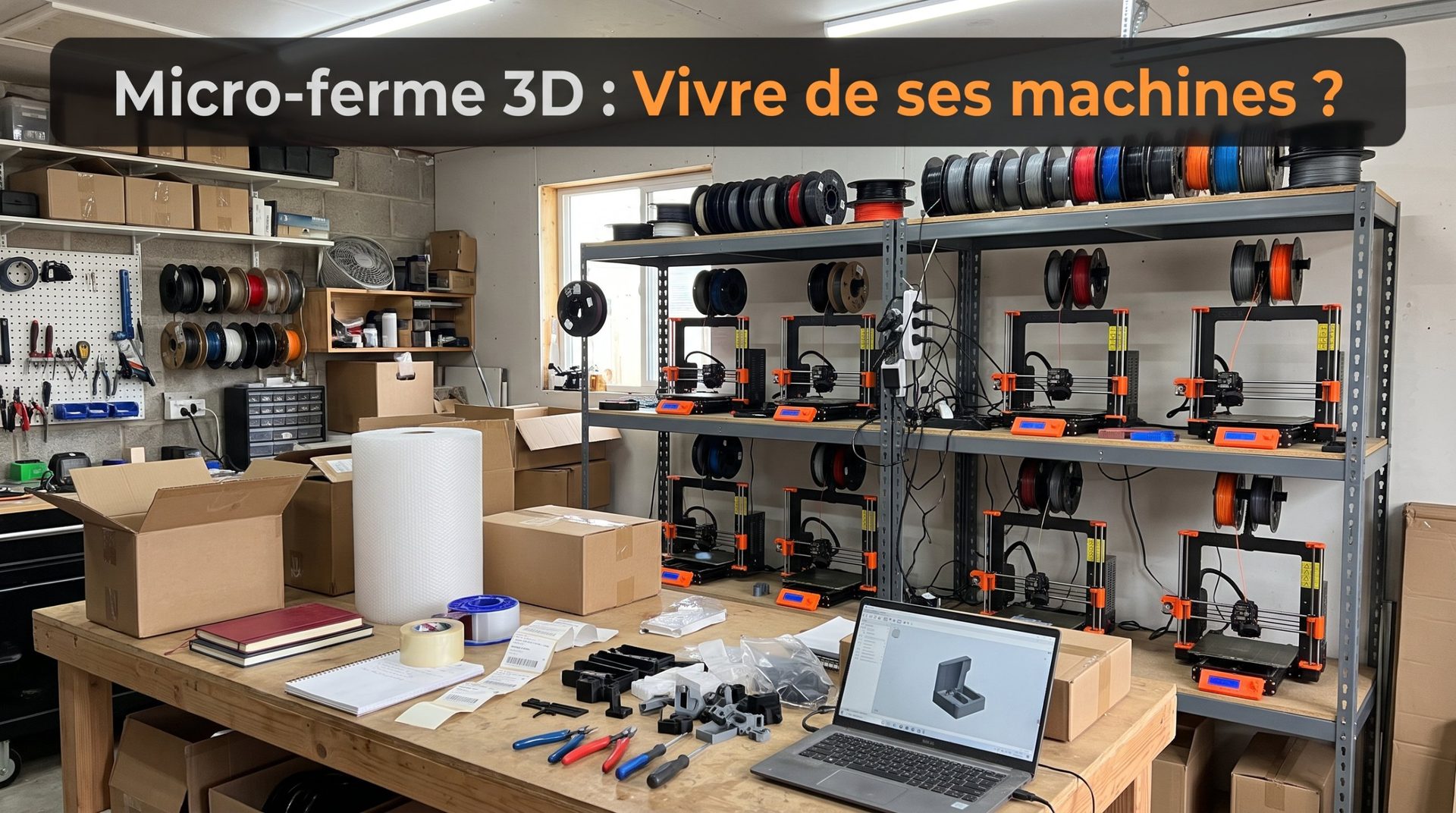
Be careful not to dream of easy money, though: before investing in multiple machines, read our analysis on the real margins of a 3D micro-farm.
The universal toolbox of the 21st century
3D printing is no longer a demo gadget or a distant promise. It's the modern equivalent of your toolbox: cost-effective, durable, and ready to work immediately—for anyone who wants to take control of the objects in their daily life.