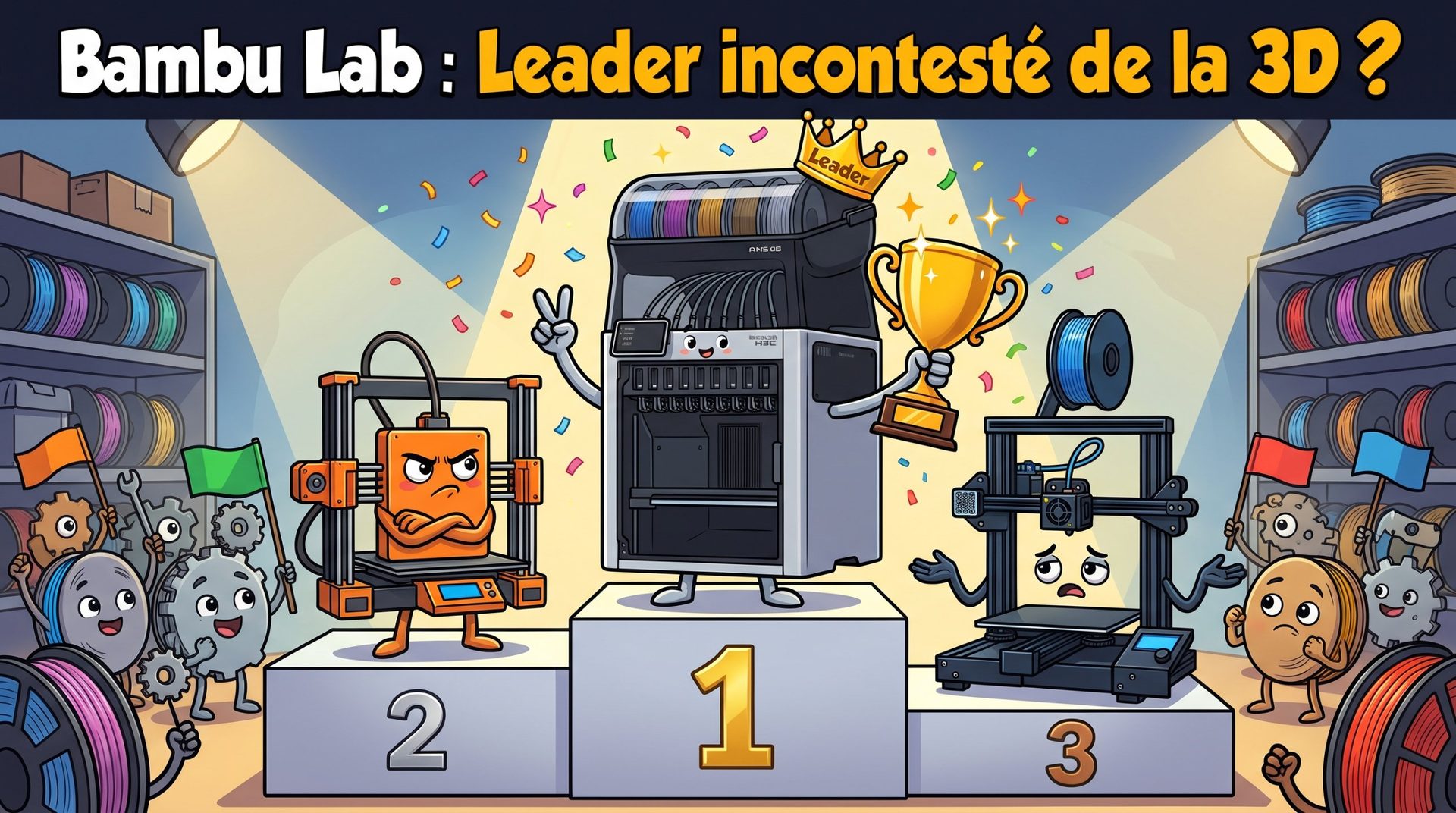
2026 Buyer's Guide: How to Choose a 3D Printer Without Making Mistakes
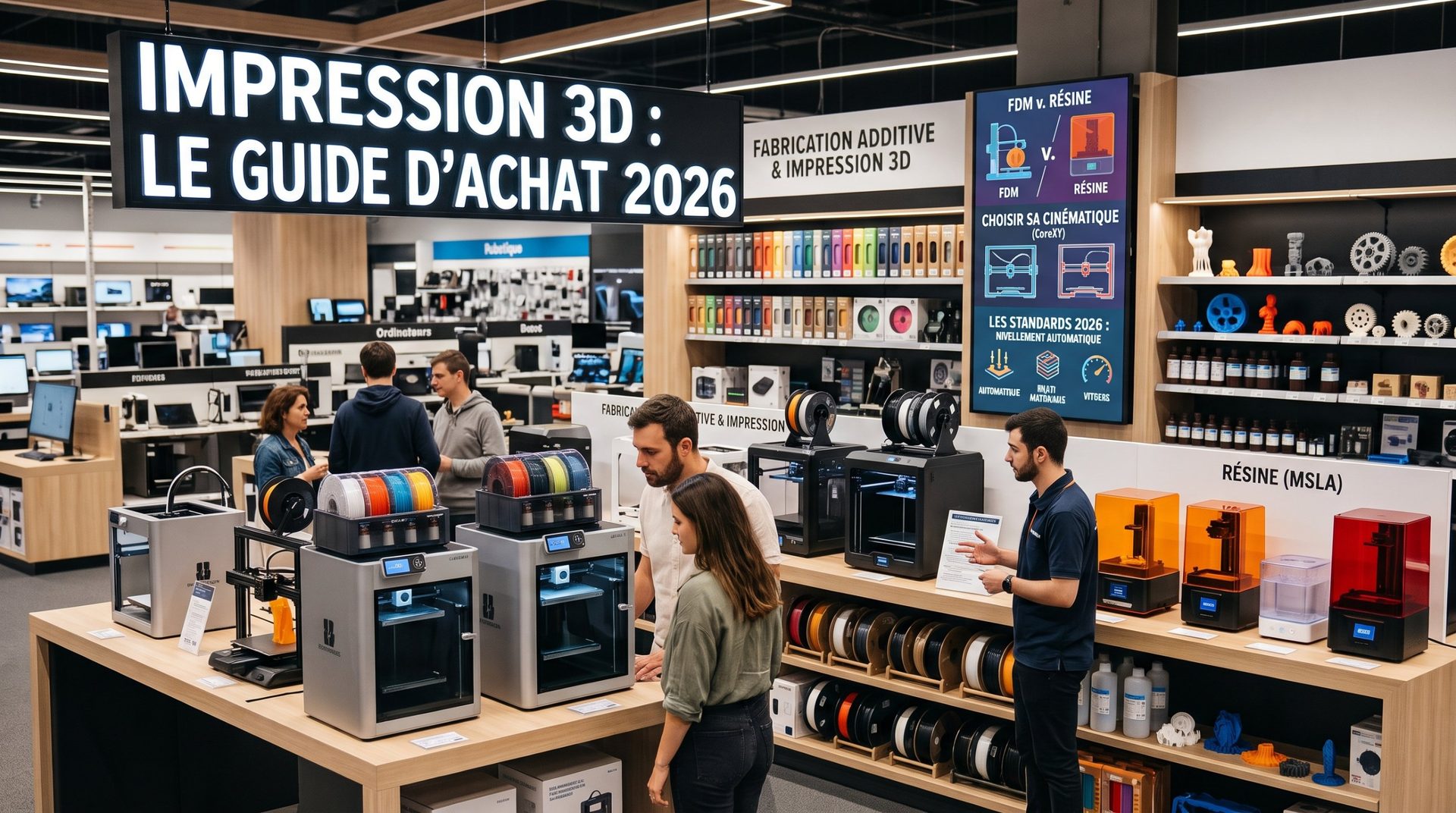
The 3D printing market has undergone a profound transformation. The era of mandatory tinkering, manual leveling with a sheet of paper, and 40 mm/s print speeds is long gone. In 2026, the 3D printer has become a fast, reliable, and automated tool. To make the right choice, here are the essential criteria and trends to watch.
1. FDM or resin (MSLA): Define your primary use
Before diving into spec sheets, clarify the purpose of your prints (see our FDM vs resin comparison):
- FDM (Fused Deposition Modeling): the ultimate versatile choice. Ideal for mechanical parts, rapid prototyping, large decorative objects, and functional household and workshop pieces. It's the cleanest and most economical process to operate.
- Resin (MSLA / LCD): reserved for ultra-precision work (collectible figurines, tabletop gaming miniatures, jewelry, dental applications). Details are unmatched, but the process comes with real constraints: chemical handling, mandatory PPE (gloves, proper mask), a ventilated space, and obligatory post-processing steps like isopropyl alcohol washing and UV curing.
2. Essential criteria for an FDM machine in 2026
In 2026, don't buy a machine that skips these standards:
- Closed CoreXY kinematics: "bed-slinger" architectures remain valid at the budget entry level, but the precision standard for high-speed printing (300–600 mm/s) now relies on CoreXY architectures. An enclosed chamber is essential if you plan to print ABS, ASA, or carbon-filled nylons (PA-CF).
- 100% automatic leveling and Z-offset: pressure sensors under the build plate or direct optical probes must manage first-layer adhesion without any manual intervention.
- All-metal hotend reaching 300 °C minimum: essential to go beyond basic PLA and print PETG, TPU (elastomer), PC, or technical composites.
- Camera monitoring and active vibration compensation: accelerometers (Input Shaping) eliminate resonance effects (ghosting), while smart camera detection catches first-layer failures or "spaghetti" before wasting an entire spool.
3. Open ecosystem vs closed ecosystem: the real trade-off
The manufacturer landscape splits into two distinct visions (overview of all 3D printer brands).
Integrated turnkey solutions (e.g., Bambu Lab, Creality K series)
- Advantages: immediate setup, motorized multi-filament systems (like AMS), pre-calibrated print profiles, automatic spool detection via RFID.
- Disadvantages: dependence on the manufacturer's cloud, wear parts sometimes proprietary.
Open source and repairable ecosystem (e.g., Prusa, Voron, Klipper-native machines)
- Advantages: complete data privacy (no mandatory cloud connection), infinite repairability, component upgradability, and totally transparent slicing.
- Disadvantages: initial investment sometimes higher at equivalent specification level.
4. Comparison table: which machine for which profile?
| Profile | Recommended technology | Average budget | Target materials | Technical priority |
|---|---|---|---|---|
| Beginner / family | Compact open FDM | $200–350 | PLA, PETG, flexible TPU | First-layer reliability, quiet operation |
| Advanced maker / prototyper | Closed CoreXY FDM | $500–1,000 | PLA, ABS, ASA, PA-CF | Fast multi-material, ventilated and filtered chamber |
| Miniature painter / modeler | Resin (MSLA 12K/14K) | $300–600 | Standard resins, ABS-like | Fine XY resolution (< 20 microns), wash and cure station |
| Engineering firm / production workshop | Compact industrial FDM | $1,200–2,500 | PC, PEEK, carbon composites | Active heated chamber, dual extrusion or tool changer |
3 pitfalls to avoid before ordering
- Overlooking consumable costs: a cheap machine with a proprietary chip-locked filament system costs more over time than a printer accepting all standard commercial filaments.
- Forgetting ventilation and installation location: even with an active charcoal filter, a machine printing technical plastics (ABS, resins) emits volatile organic compounds (VOCs) and microparticles. It has no place in a bedroom.
- Paying for unnecessary theoretical speeds: a machine advertised at "600 mm/s" only reaches that speed on long straight lines. What really matters is acceleration (beyond 10,000 mm/s²) and nozzle volumetric flow rate (mm³/s).
Still unsure? Ask our assistant: we're happy to help.