Setting Up a 3D Printing Micro-Farm: The Passive Income Myth vs. Real Margins
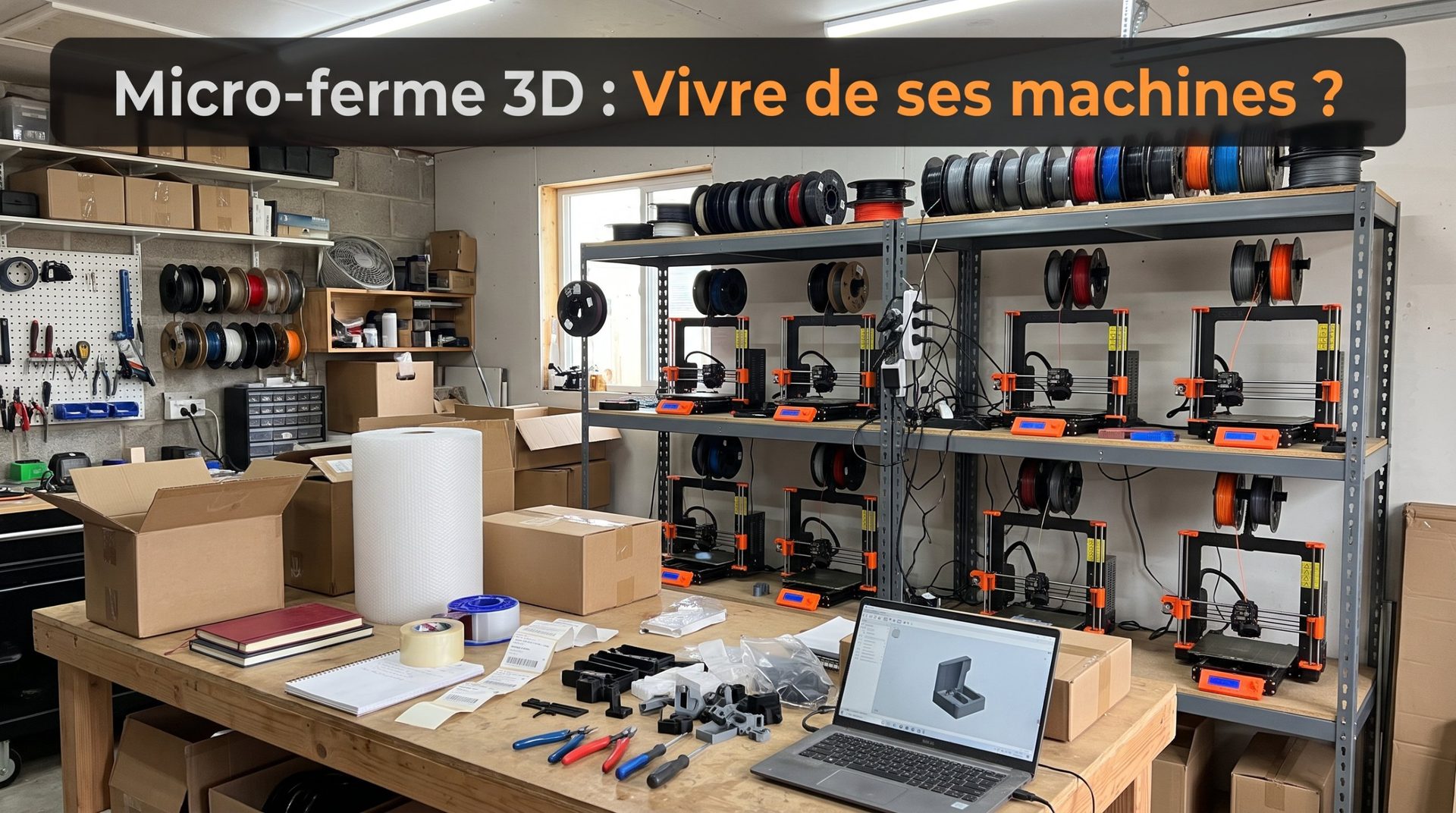
Turning your hobbyist workshop into a fleet of 5 to 10 printers running day and night—that's the number one fantasy of the modern maker. On social media, the equation looks crystal clear: a fast printer for €600, filament at €15 a kilo, parts selling for €25 on Etsy or your own shop… and the money rolling in while you sleep.
In reality, scaling from one-off prints to small-batch production doesn't make you a plastic rentier—it makes you a logistics coordinator, an on-call maintenance technician, and a complaint manager. Before lining ten machines on a shelf, here's the financial, technical, and legal reality of running a small-scale 3D printing farm.
1. The Margin Trap: Why "Cost of Filament × 3" Is an Illusion
The classic mistake is calculating profitability based solely on spool cost: selling price minus material cost.
For a 100 g part sold for €20, with PLA at €15 per kilo, material costs €1.50. The profit looks huge: €18.50. But this ignores the actual costs that eat into a farm's bottom line:
| Expense Category | Cost per 100 g Part | Notes |
|---|---|---|
| Material (Standard PLA) | ≈ €1.50 | Excludes color-change purges and waste |
| Failed Prints (≈ 8%) | ≈ €0.30 | Bed adhesion failure, clogged nozzle, spaghetti |
| Electricity (≈ €0.25/kWh) | ≈ €0.40 | 5 hour print at ~300 W |
| Machine Wear | ≈ €1.00 | €600 printer depreciated over 3,000 print hours |
| Packaging and Padding | ≈ €1.50 to €2.50 | Double-wall cardboard, kraft paper, mailer |
| Platform Commissions | ≈ €2.50 | ~10–12% of total paid, including shipping (transaction and payment fees) |
| Social Contributions | ≈ €2.50 to €3 | Micro-business, goods sales: 12.3% of revenue received |
| Your Time (Removal, Packing, Support) | ≈ €4.00 | 10 minutes per order, valued at €24/hour |
| Real Net Profit | ≈ €4.50 to €6 | If customer pays shipping on top of €20 |
| … With Free Shipping | ≈ €0 to €1 | Tracked delivery costs ~€5–6.50: it wipes out nearly all margin |
On a €20 part, only a few euros remain after everything's paid, and almost nothing if you offer free shipping to stay competitive. To clear €2,000 net per month, you need to sell at least 350–450 parts, meaning 15–20 shipments per business day… before workshop rent. Calculate your own numbers with our 3D printing cost calculator.
2. The Legal Wall: Licenses and Product Safety
Downloading a popular model from Printables, MakerWorld, or Thingiverse and selling it is the fastest path to a seller account ban, or worse—a cease-and-desist for infringement. We covered this in our investigation on illegal sales on Vinted and Etsy.
- Non-Commercial Licenses (CC BY-NC): The vast majority of popular free models ban commercial use. Tweaking the file slightly doesn't lift that ban.
- Commercial Licenses by Subscription: Many creators offer a "commercial license" tier on Patreon or similar, usually €5–30 per month per creator. That's a fixed cost whether you sell one part or none.
- Product Safety: Once a part is sold in the EU, your liability kicks in, and EU general product safety rules apply. A cookie cutter (food contact), a toy (mandatory CE marking, choking hazard), or a dashboard mount exposed to 70°C in direct sun all have strict requirements. Selling PLA for car interiors guarantees returns for warping.
The only sustainable path: sell your own designs, or strike a deal with designers (licensing or royalty per part sold). Learn more in our 3D printing and intellectual property guide.
3. A Fleet Running 24/7: The Automation Illusion
Scaling from one machine to eight doesn't just multiply production—it multiplies failures too.
- 1 machine: About one issue per week, fixed in the evening.
- 8 machines: Statistically, more than one incident per day.
Monitoring and Alerts
Running machines overnight requires surveillance. AI-powered "spaghetti detection" cameras reduce waste, but don't solve the core problem: a machine down at 2 AM means 6 hours lost on the schedule. Fleet management software helps track all machines at a glance.
Preventive Maintenance
Every printing hour wears the mechanics. Rough guidance:
- Every ~200 hours: Clean and lubricate axes and Z-axis screws, dust out fans.
- Every ~500 hours: Replace PTFE tubing, check extruder wheel wear, recalibrate vibration dampeners.
- A stock of spares: Can't wait 4 days for a thermistor. Keep at least two complete hotends, some build plates, belts, and fans on hand.
4. Packaging and Shipping: Plastic Parts vs. Sorting Centers
An FDM part is rigid but fragile to impact, especially along layer lines. A package takes repeated drops on conveyor belts and ends up crushed under 15 kg of cardboard.
- Cardboard Over Bubble Mailers: Parts shipped in mailers arrive broken far more often. Rigid cardboard with crumpled kraft paper padding is essential.
- The Hidden Cost of Breakage: A part arriving damaged means a second shipment on your dime (postage, box, material, labor). With a few euros margin per order, every broken package erases profit from two or three successful ones.
The Calculation That Matters: Your Machine's Hourly Cost
To know if an order or recurring part is profitable, calculate your machine's hourly cost:
Hourly Cost = (Annual Depreciation + Annual Maintenance) ÷ Actual Annual Print Hours + Hourly Electricity + Wear
Example: a €700 printer depreciated over 2 years, printing 2,500 hours yearly, costs €0.14/h. Add ~€0.10/h for wear parts and €0.08/h for electricity: a running machine costs at least €0.32 per hour before material, rent, your salary, or taxes.
So, Should You Launch?
A micro-farm can become a real business, but only if you run it like one: designs you own or properly licensed ones, prices calculated to the cent, planned maintenance, and flawless packaging. Passive income, though? That remains a myth.
- Have you tried selling prints? What ate your margin?
- At how many machines did management become real work?
- Do you offer free shipping or charge the customer?
Share your experience in the comments!