STL vs 3MF: What Are the Key Differences?

Of course! The STL file is the veteran of 3D printing, while 3MF (3D Manufacturing Format) is its modern successor, designed to meet the growing demands of additive manufacturing. Here are the key differences between these two formats:
STL (STereoLithography): The Historical Standard
The STL format has been the de facto standard in 3D printing since its creation in 1987 by 3D Systems.
How does it work?
- It represents the surface of a 3D object as a mesh of interconnected triangles. The more detailed or curved the surface, the more triangles there are.
- Each triangle is defined by the coordinates of its three vertices and a normal vector (which indicates the outside of the surface).
- It exists in ASCII (human-readable, bulky) or binary (compressed, lighter) version.
Advantages:
- Simplicity: Its simple structure makes it easy to generate and interpret.
- Universality: Almost all CAD software and 3D printers recognize and use STL files. It's the historical common language.
- Lightweight (in binary): For simple models, the binary format is relatively compact.
Disadvantages:
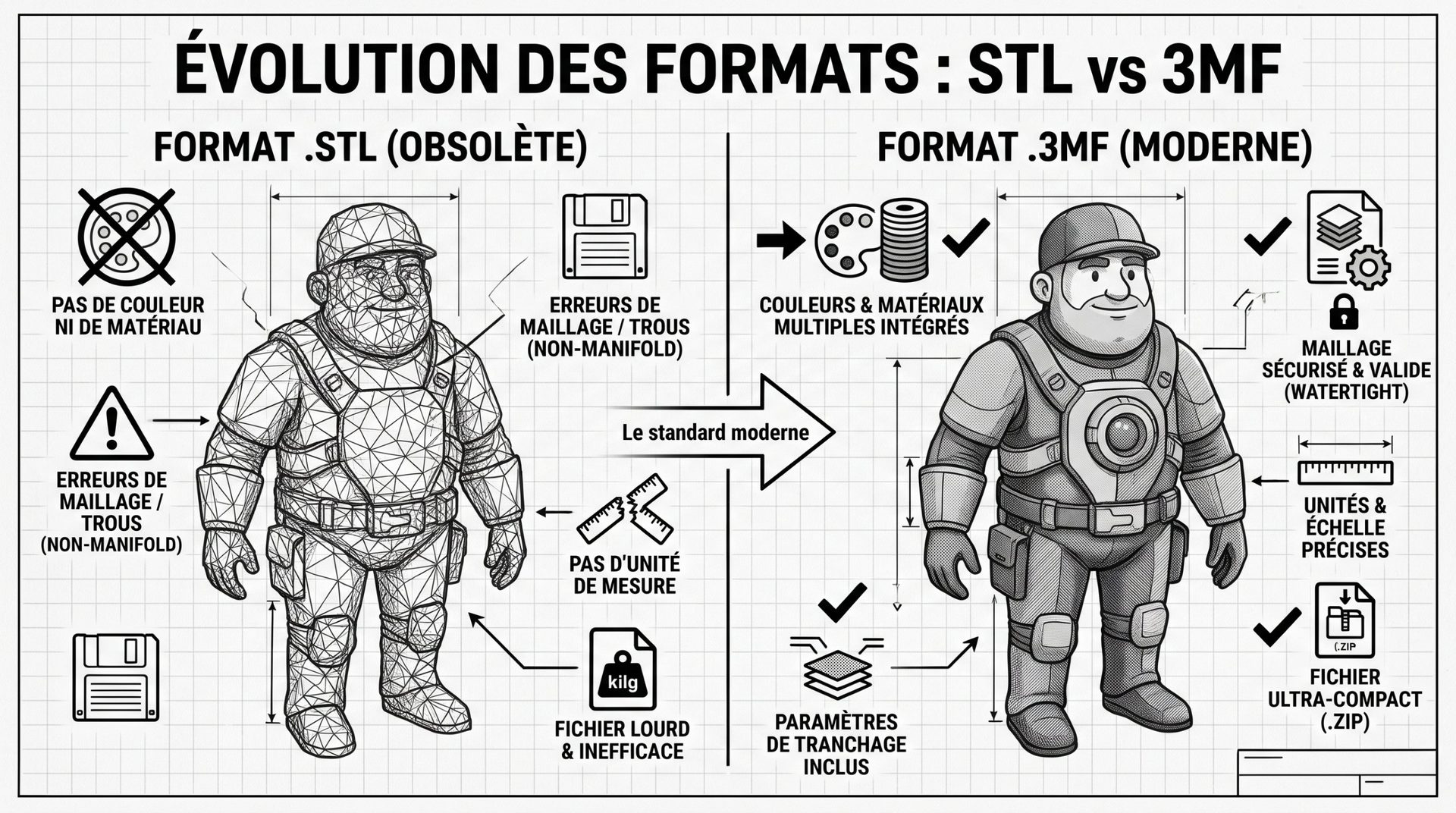
- Lack of information: This is its biggest weakness. An STL file contains no information about:
- The color or texture of the object.
- The material(s) used.
- The units of measurement (millimeters, inches, etc.). This can cause scaling issues if the software doesn't interpret correctly.
- Support structure information or other manufacturing parameters.
- Assembly information for multiple parts.
- Geometric approximation (faceting): Curves are represented by flat facets. If the mesh resolution is too low, the printed object may have a visible "polygonized" appearance.
- Mesh problems: STL files can easily contain errors (holes, inverted triangles, non-manifold edges) that can cause print failures or require manual repairs.
- No multi-material/color support: For multi-color or multi-material prints, you need to use multiple STL files, which complicates the workflow.
3MF (3D Manufacturing Format): The Integrated Future
The 3MF format was developed by the 3MF Consortium (including giants like Microsoft, HP, Autodesk, Dassault Systèmes, etc.) to address STL's shortcomings and offer a more complete and reliable solution for modern additive manufacturing.
How does it work?
- 3MF is an XML-based format that brings together all relevant information in a single compressed file (.3mf). It's like a ZIP file containing all the necessary data.
- It describes the geometry of the object, but much more.
Advantages (compared to STL):
- Rich Integrated Information:
- Color and Texture: 3MF can include color information (per vertex, per face) and textures (standard, PBR - Physically Based Rendering), enabling photorealistic prints.
- Multiple Materials: It can define and assign different materials to different parts of the model in a single file, essential for multi-material printers.
- Units of Measurement: Units are explicitly defined in the file, eliminating scaling issues.
- Support Information: Can include data about generated supports or other print-specific instructions.
- Metadata: Allows you to integrate information about the author, license, model properties, etc.
- Reliable and Improved Geometry:
- Designed to ensure "watertight" mesh without errors, significantly reducing common STL problems (holes, inverted normals).
- Can represent volumetric information (not just surface) and even complex geometries (like implicit shapes) more efficiently.
- One File, Everything Included: Instead of having an STL file for geometry, image files for textures, and notes for materials, 3MF contains all this data in a single package. This simplifies project management, sharing, and reduces errors.
- Open and Extensible: The format is open and can be extended for future features or industry-specific needs (for example, extensions for slice management, build material handling, etc.).
Quick Comparison Table: STL vs 3MF

The STL format remains a proven standard, adequate for simple 3D prints, single-material and without color. Its simplicity is both its strength and weakness.
3MF, on the other hand, is the format of choice for modern and industrial 3D printing applications, which require rich information, multi-material management, increased precision, and a more reliable and integrated workflow. While STL won't disappear anytime soon, 3MF is clearly the format of the future for more complex and connected additive manufacturing.
👉 Where to find STL and 3MF files ready to print? Check out our selection of 3D file platforms.