Free Your 3D Prints With Soluble Filaments

3D printing of complex structures often hits a physical limit: gravity. To print overhangs or internal cavities, support structures are necessary. Soluble filament is the "haute couture" solution for FDM 3D printing.
Here's a complete guide to this technology that lets you break free from classical geometric constraints.

✅ What is a soluble filament?
Unlike classic support structures that must be manually removed with pliers, soluble filament is designed to dissolve completely in a liquid.
This allows you to achieve perfect surface finish on contact areas and print articulated mechanisms in a single run, even when supports are inaccessible deep inside the part.
✅ Main types of soluble filaments
The choice of soluble filament depends primarily on the main material used for your part.
| Filament Type | Required Solvent | Compatible Material | Strengths |
| PVA (Polyvinyl Alcohol) | Water (warm) | PLA, PETG | Most common, non-toxic, easy to find. |
| BVOH | Water | PLA, PETG, ABS, Nylon | Dissolves faster than PVA, better adhesion. |
| HIPS | D-Limonene | ABS, ASA | Very stable, ideal for high-temperature materials. |
| PVA+ / S-PVA | Water | PLA, PETG | Improved PVA version, more moisture-resistant. |
✅ Advantages and Disadvantages
The strengths ✔️
-
Complex geometries: Enables printing of hollow spheres, internal gears, or organic architectures impossible to clean by hand.
-
Flawless finish: No scar marks or plastic residue on the final part.
-
Time saved on post-processing: Dip the part in water and let chemistry do the work.
The challenges ⚠️
-
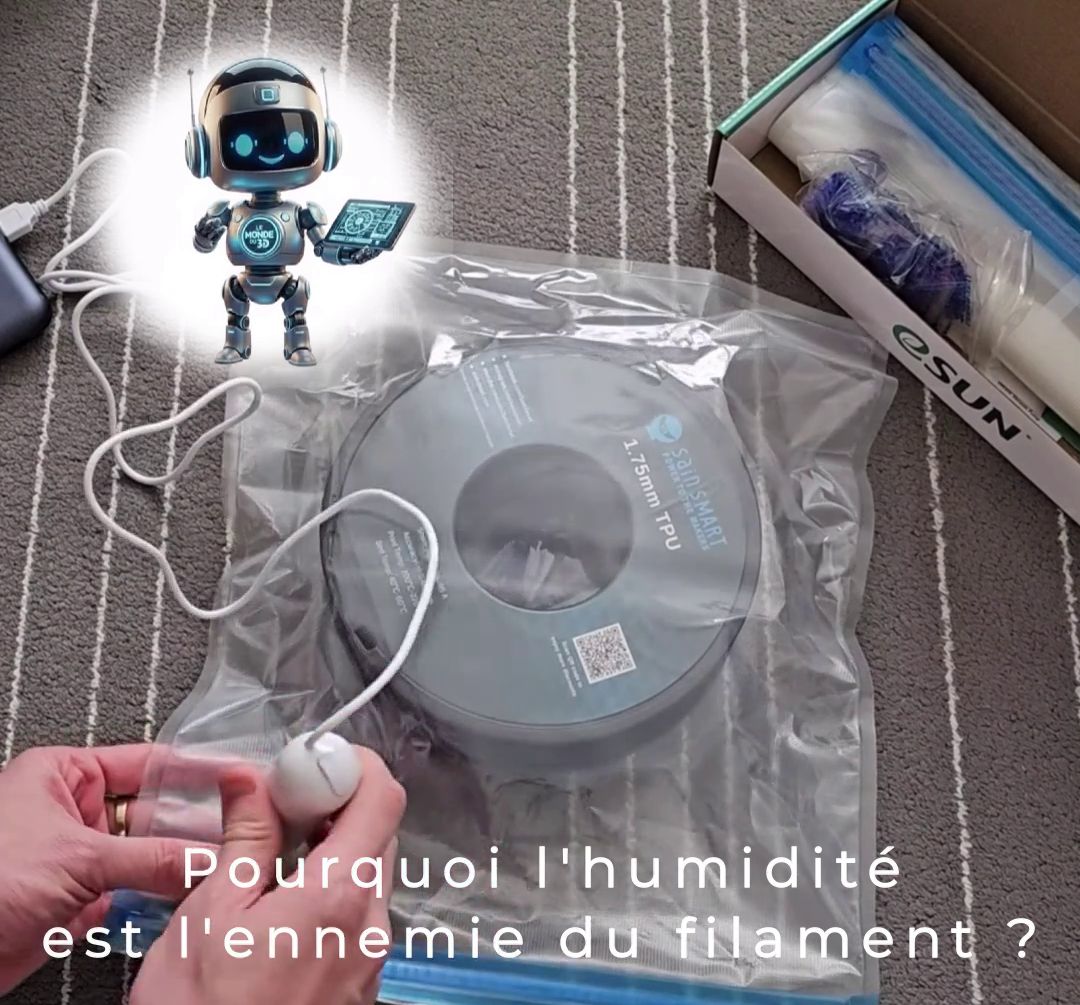
Extreme hygroscopicity: These filaments (especially PVA and BVOH) absorb moisture from the air. A damp filament becomes sticky, foams in the nozzle, and causes clogs. Storage in an airtight box with desiccant is mandatory.
-
Dual extrusion required: You must have a printer with two nozzles (IDEX or switchable head) or a filament management system (like AMS or MMU).
- Cost: These materials are often 2 to 3 times more expensive than standard PLA filament.
✅ Tips for successful printing
-
Z-offset adjustment: Unlike classic supports, set the gap between support and part to 0 mm. This ensures a perfectly flat base for your part.
-
Temperature: Don't let soluble filament sit idle in the hot nozzle without printing (risk of carbonization and permanent clogs).
-
The dissolution bath: For PVA, use warm water (around 30–40°C) and, if possible, a circulation pump or ultrasonic bath to speed up the process.
-
Drying: If your PVA "crackles" during printing, run it through a filament dryer for 4 to 6 hours at 45°C before restarting.
While it represents higher cost and meticulous moisture management, soluble filament remains the ultimate solution for impossible prints. Whether you choose PVA for its ease of use with water or HIPS for compatibility with technical materials, trying it means rediscovering the full potential of your 3D printer. To succeed, keep two golden rules in mind: perfect seal during storage and precise dual extrusion setup.
What soluble material do you use for your most ambitious projects? Share your experiences in the comments!
To compare materials at a glance, use our filament selector tool.