
Soft Robotics in 3D Printing: Workshop Reality or Engineering Challenge?
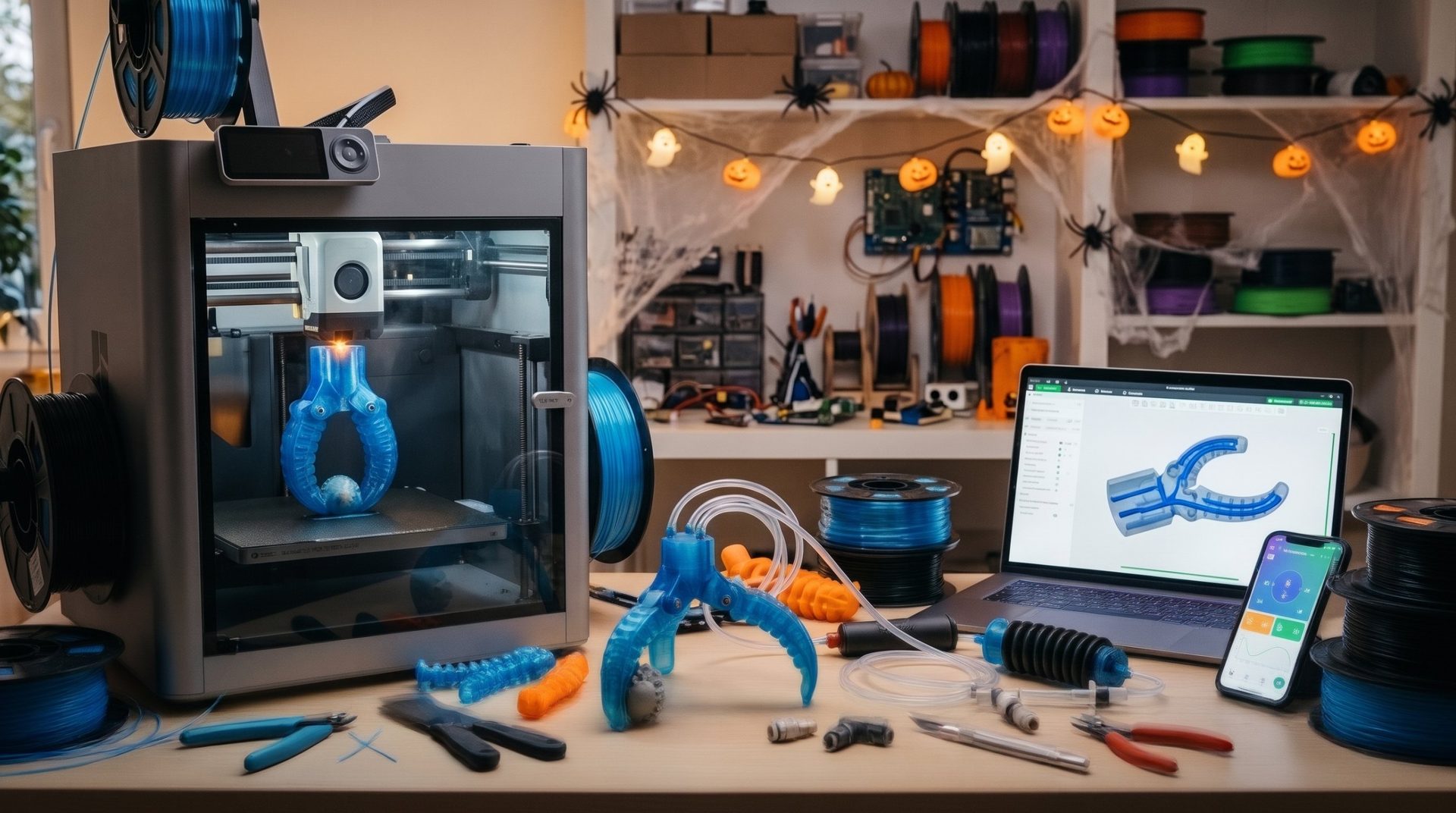
In the collective imagination, a robot remains a rigid assembly: aluminum bars, machined gears, and servo motors tuned to the millimeter. Yet in laboratories and among experienced makers, another approach is gaining momentum: soft robotics.
The idea? Replace mechanical joints with deformable elastomer structures (TPU) capable of bending or curling through simple air inflation, much like a tentacle or human finger.
But between lab demonstrations and the reality of an FDM workshop, there are real physical constraints. Can you actually fabricate soft actuators at home? Here's the technical reality, pitfalls to avoid, and essential settings.
1. How Does a 3D-Printed Soft Actuator Work?
In a soft cylinder or bio-inspired gripper, there's no internal motor. The geometry of the walls creates the movement:
- Internal cavities: the part integrates air chambers connected to each other.
- Varying wall thickness: one face of the actuator has a thick wall (the zone that doesn't stretch), the other has a thin accordion-like wall (the zone that expands).
- Pneumatic effect: when you inject air, usually at low pressure, the thin cavities dilate and force the entire module to bend.
2. Challenge #1: Air Sealing
This is where most projects fail. FDM printing deposits strands of material side by side and leaves invisible microporosity. If air escapes between two layers, pressure drops and the gripper won't move.
Slicer Settings for Strong Layer Bonding
- More perimeters: forget thin walls. Plan for at least 4 to 6 perimeters and increase the overlap between infill and perimeters (25 to 30%).
- Slight over-extrusion: increase flow by 3 to 5% so material fills micro-voids.
- Rather high temperature: aim for the high end of the manufacturer's range (often 230–240 °C for TPU 95A) so layers fuse properly.
The finishing trick: for lasting air sealing, printing alone reaches its limits. A flexible varnish, a thin layer of polyurethane glue, or liquid latex on the walls remains the most reliable shop solution against micro-leaks.
3. Which Shore Hardness to Choose, and How to Print It Without Clogging?
The softness of an elastomer is measured on the Shore A scale: the lower the number, the softer the material.
| Hardness | Behavior | FDM Feasibility |
|---|---|---|
| TPU 95A | Semi-rigid (like a cart wheel) | Easy on all recent Direct Drive heads. Ideal for hinges and housings, but requires more air pressure to bend. |
| TPU 85A | Flexible (like a leather belt) | Tricky: the right balance for an actuator that bends without strain. Requires a very short, guided filament path and slow speed (20–30 mm/s). |
| TPE 70A and softer | Very soft (like a shoe sole) | Complex: the filament bends and coils around the drive wheels. Pouring silicone into a 3D-printed mold is often preferred. |
The golden rule: with a Bowden system (remote PTFE tube), soft TPU (under 90A) is very difficult to print consistently. A Direct Drive head is strongly recommended. To understand the difference, see our comparison Bowden or Direct Drive, and our tips for printing TPU.
4. Rigid and Flexible in One Part: Watch Adhesion
To build a complete robot, it's tempting to combine rigid structure and flexible joints using multi-material printing. But not all materials bond equally well:
- TPU + PLA: adhesion is variable. The assembly holds for light use but can peel under repeated flexing.
- TPU + PETG: generally a better combination, with stronger and longer-lasting bonding.
In both cases, interlocking shapes (dovetails, anchors, through-holes) significantly reinforce the joint. Always run a small test before printing the final part.
Workshop Reality or Engineering Challenge?
Both. A pneumatic soft gripper is entirely feasible with a consumer printer, provided you choose the right hardness, care for sealing, and accept some trial-and-error. If the topic interests you, also discover what's possible for printing a robot at home.
Which Filament for Your Mechanism?
Pneumatic gripper, chassis bushing, or impact-resistant gear: your material choice determines assembly success. Rigidity, flexibility, friction, or heat resistance: our selector compares 12 filaments based on your constraints.


