
3D Robotic Hand: Merging 3D Printing with Artificial Intelligence

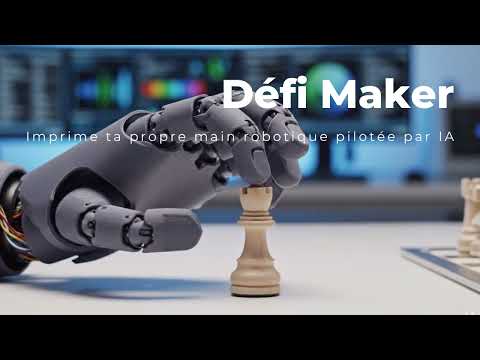
Tired of robotic grippers that only open and close? Let's level up. This project combines printed mechanics, servo actuators, and a layer of artificial intelligence for gesture recognition.
⚙️ The Hardware Stack (BOM)
To bring this project out of the printer, here's what you need in your workshop:
-
Structure: STL files (like InMoov or FlexiHand). We recommend PETG for strength or PLA+ for joint precision.
-
Muscles: 5x high-precision servo motors (MG996R type for torque or DS3218 for durability).
-
Tendons: Nylon fishing line (30lb+) or sheathed steel braided cable.
-
Brain: A Raspberry Pi 4 (4GB) or Jetson Nano to run AI locally. An Arduino Mega can serve as an intermediate PWM controller.
-
Vision: A simple USB camera or the Pi Camera V2 module.
💻 The Software Pipeline: How to Make It "Intelligent"
The idea isn't to code each movement, but to let AI interpret your own gestures via the camera.
-
Hand tracking: Using the MediaPipe library (by Google). It extracts 21 key points (landmarks) from your hand in real time.
-
Mapping: We convert the coordinates (x, y, z) of human hand points into rotation angles for the servos.
-
Example: If the distance between your thumb tip and index finger is < 20mm, the AI sends a close command to the concerned servo.
-
-
Python Logic:
Python
# Simplified mapping excerpt
def map_gesture_to_servos(hand_landmarks):
    finger_closure = calculate_distance(points[8], points[0])
    servo_angle = interp(finger_closure, [50, 250], [0, 180])
    kit.servo[0].angle = servo_angle
💡 Maker Tips for 3D Printing
-
Tolerances: Watch out for joint axes. If your printer isn't calibrated to $0.1mm$ precision, have a file handy.
-
Infill: 20% gyroid for a good strength-to-weight ratio. Bump it to 50% for servo mounting parts.
-
The Secret to Fingers: Use TPU (flexible filament) on the fingertips to add grip. Without it, your robotic hand will slide off smooth objects.
🚀 Next-Level Upgrades
Once the hand is moving, you can add:
-
FSR sensors (Force Sensitive Resistor) on the fingertips to prevent the AI from crushing your objects.
-
A Deep Learning model so the hand learns to play "Rock-Paper-Scissors" on its own.
Ready to Print the Future?
It's time to move from theory to practice. You have the STL files, the code is accessible, and the components are ready to be assembled.
Building an AI-powered robotic hand isn't just another project for the shelf; it's a complete challenge that will test your skills in 3D printing, electronics, and Python development. It's the kind of project where you learn the most by tackling real-world calibration and mapping issues.
What about you? Will you take on the challenge and test this maker project?
Grab your PETG spools, fire up the soldering iron, and prep your IDE. Don't forget to share your iterations and your fails (we all learn from them!) with the community. The future of collaborative robotics starts in your workshop.


