Filament Drying Temperature Selector: Complete Guide to Rescue Wet Filaments
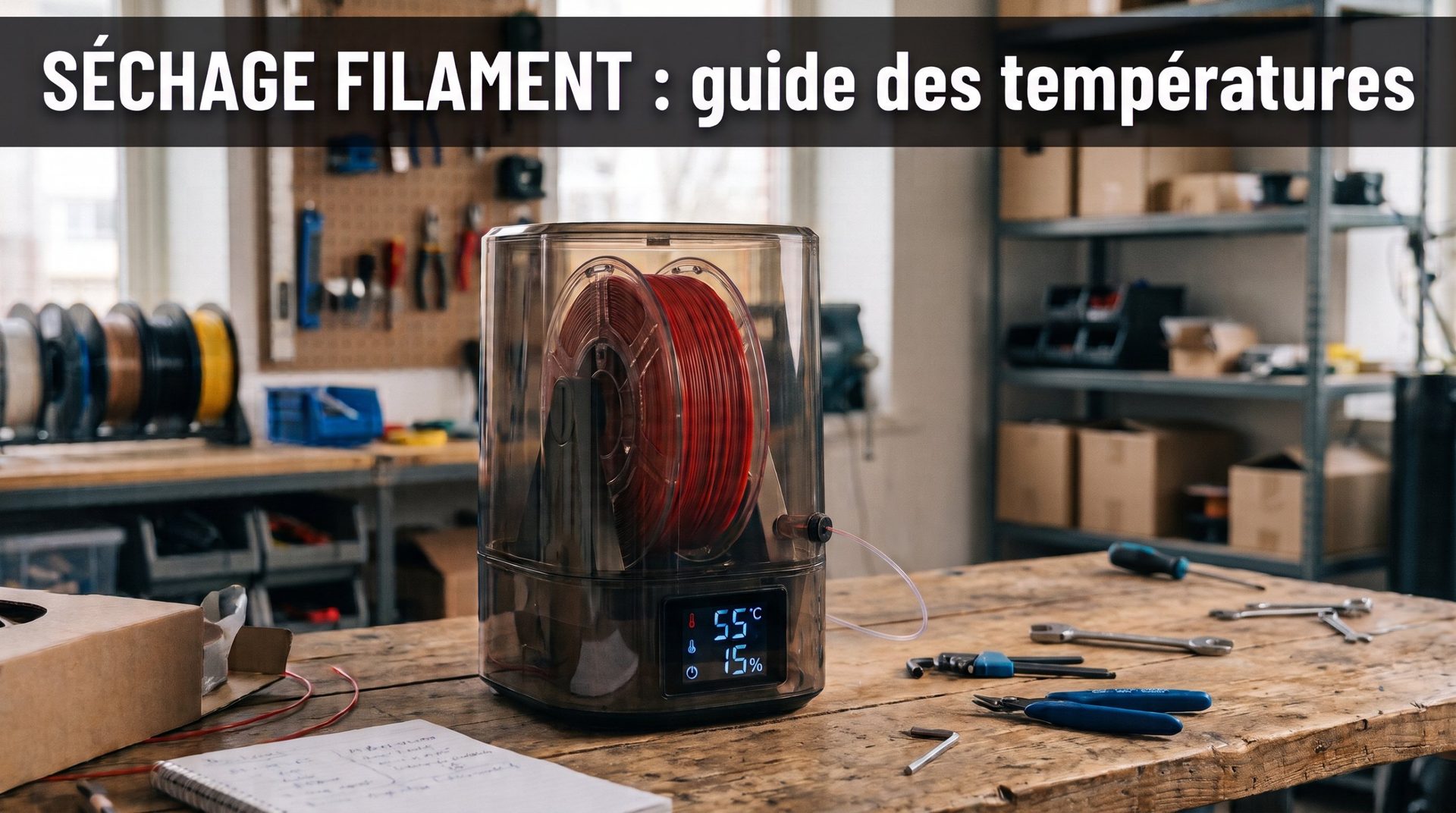
Moisture is the invisible enemy of 3D printing. A filament that has absorbed water from the air causes immediate defects: stringing between parts, tiny bubbles that pop at the nozzle exit, rough surface, and poor layer adhesion. No need to tweak all your settings or toss a finicky spool: in most cases, a proper drying cycle restores it to its original qualities.
But you need to heat it to the right temperature. Each material softens above a certain threshold (its glass transition temperature): too hot, and the coils stick together on the spool; not hot enough, and the water trapped inside the filament won't evaporate.
👉 Choose your material in our drying selector to get the right settings in one click.
🔥 Drying Parameter Selector
Moisture sensitivity: –
Indicative values for a filament dryer or food dehydrator, based on manufacturer recommendations (Bambu Lab, Prusa, Polymaker). The information on your spool's label takes priority.
Drying temperature and duration table by material
| Material | Temperature | Duration | Target storage humidity | Moisture sensitivity |
|---|---|---|---|---|
| PLA | 45 to 55 °C | 4 to 8 h | < 20 % | Low, but promotes stringing |
| PETG | 60 to 70 °C | 6 to 8 h | < 20 % | Moderate: lots of spider webs |
| TPU (flexible) | 60 to 70 °C | 6 to 12 h | < 15 % | High: bubbles and foamy surface |
| ABS / ASA | 70 to 80 °C | 4 to 8 h | < 15 % | Low to moderate |
| Nylon (PA) | 80 to 90 °C | 8 to 12 h (up to 16 h if very wet) | < 10 % | Extreme: drying mandatory before printing |
| PC (polycarbonate) | 80 to 90 °C | 6 to 8 h | < 10 % | High |
| PVA (soluble) | 45 to 55 °C | 8 to 12 h | < 15 % | Extreme: softens and sticks if overheated |
3 golden rules for safe and effective drying
- Watch out for spool material: cardboard spools handle heat well, but some cheap plastic spools warp at 60 to 70 °C. Before drying nylon or polycarbonate at 80 to 90 °C, check that your spool can handle it (Bambu Lab reusable spools, for example, are rated for it), or rewind the filament onto a heat-resistant spool.
- Your kitchen oven is a false economy: most home ovens deviate 10 °C or more from the displayed temperature, with hot spots near the heating elements. An oven set to 50 °C for PLA can climb much higher and fuse an entire spool. Use a dedicated dryer (Sunlu, Creality, eSUN, etc.) or a food dehydrator instead.
- Drying while printing: highly moisture-sensitive materials like nylon or TPU reabsorb humidity from the air in just a few hours. Print them by feeding filament directly from the running dryer or from a sealed dry box.
After drying, store your spools in airtight containers with color-changing silica gel beads. A cheap hygrometer placed inside the box lets you check at a glance that humidity stays below the recommended level.
To recognize wet filament and understand why it absorbs water, read our article do you need to dry 3D printer filament? And if your spool is partially used, check with our filament remaining calculator that you have enough for your next print.