3D Printer: Why Isopropyl Alcohol Is Your Best Ally?
Isopropyl alcohol (often called IPA) is one of the most indispensable tools for any 3D printer user. Whether you're using a Fused Deposition Modeling (FDM) printer or a resin (SLA) printer, its role is crucial to ensuring your prints succeed.
Here's a complete guide on using IPA for maintaining your equipment.

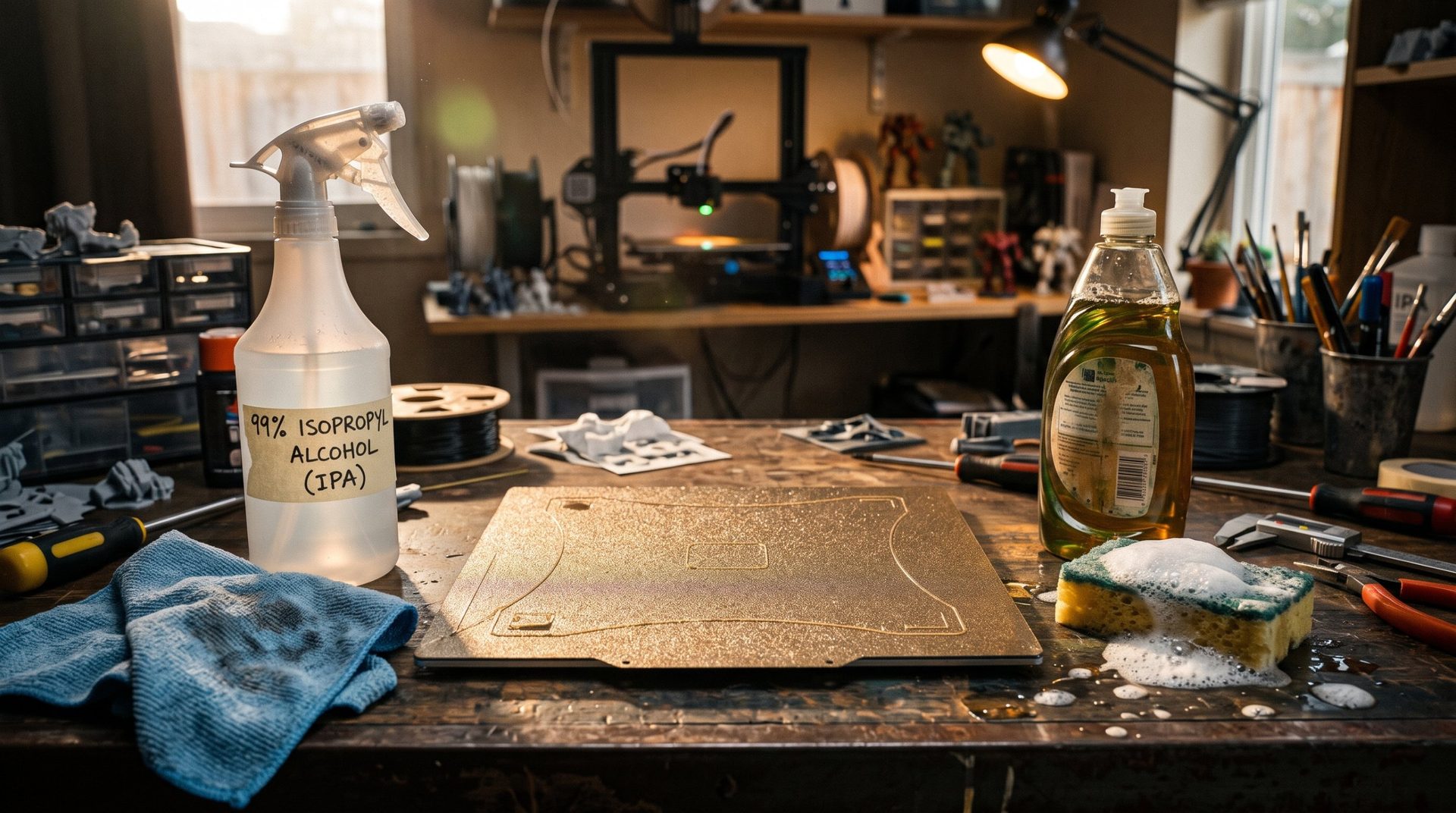
✅ For FDM Printers (Filament): Adhesion First
The #1 problem in FDM printing is model detachment (warping). This is often due to fingerprints or dust on the build plate.
-
Why clean? Natural oils from your skin prevent melted plastic from sticking to the plate.
-
When to use it? Ideally before every print, when the plate is cold.
-
How to do it? 1. Spray IPA (70% to 99% concentration) on a lint-free cloth or paper towel. 2. Vigorously rub the print surface (PEI, glass, or metal). 3. Let it evaporate for a few seconds.
✅ For SLA Printers (Resin): Post-Processing
In resin printing, IPA isn't just a cleaner—it's a step in the manufacturing process.
-
Washing prints: Once printing is complete, the part is covered in viscous liquid resin. You submerge the part in an IPA bath to dissolve excess resin.
-
Vat (tank) cleaning: If a print fails, you must clean the FEP film at the bottom of the vat. IPA removes resin residue without scratching the delicate film.
-
Screen maintenance: A drop of resin that falls on the LCD screen can be gently removed with a cotton swab soaked in IPA.
✅ A Versatile Product: Other Uses for IPA
Isopropyl alcohol is a true "Swiss Army knife" for home and industrial use thanks to its solvent properties and ultra-fast evaporation. Here are its most common applications:
-
Electronics and IT: It's the ideal cleaner for sensitive components (motherboards, processors, sensors). It removes dust and thermal paste without leaving residue and without risk of short-circuit (unlike water).
-
Optics and screens: Used with a microfiber cloth, it perfectly degreases camera lenses, glasses, and smartphone or computer screens.
-
Tough household cleaning: It effectively dissolves sticky residue (labels), permanent marker ink on smooth surfaces, and stubborn grease on countertops or tools.
-
Automotive: It serves as a degreaser before applying stickers or protective films, and can be used to quickly de-ice locks or small body parts in winter.
✅ Which Concentration to Choose?
You'll generally find two types of isopropyl alcohol on the market:
| Concentration | Recommended Use |
| IPA 70% | Highly effective for disinfecting and cleaning work surfaces or FDM printer build plates. |
| IPA 99% | The "gold standard" for resin printing (SLA). It dissolves resin much faster and evaporates without leaving traces. |
⚠️ Safety Precautions
Isopropyl alcohol is a powerful chemical that must be handled with care:
-
Flammability: Keep it away from heat sources and flames (watch out for heated build plates!).
-
Ventilation: Fumes can cause headaches. Work in a well-ventilated area.
-
Protection: Wear gloves (especially for SLA) because IPA severely dries out skin and can facilitate skin absorption of resin.
✅ The Essential for Your Workshop
Whether you're a passionate maker or a professional, isopropyl alcohol is a cornerstone of the 3D printing ecosystem. Much more than just a cleaner, it's a true guarantee of reliability for your prints: it ensures your equipment's longevity, maximizes first-layer adhesion, and enhances the final quality of your resin parts.
Versatile, economical, and incredibly effective, it deserves a place on every workbench. However, never forget that it's a powerful product: responsible use (with protection and ventilation) is key to enjoying all its benefits safely.
By making IPA cleaning a habit, you drastically reduce print failures and extend the life of your machines.
📦 Partner Links
AMAZON: https://amzn.to/4qqSPRi