BOFA 3D PrintPRO: Industrial Air Filtration Standard for 3D Printing Workshops
When 3D printing transitions from occasional prototyping to serious production—whether in a business, makerspace, school, or print farm—the filters built into machines quickly show their limits. Facing continuous emissions of volatile organic compounds (VOCs) and ultrafine particles, the BOFA 3D PrintPRO line has established itself as the gold standard for air extraction and purification dedicated to additive manufacturing.
Designed by British specialist BOFA International, now part of the Donaldson group, these external systems deliver reliable air handling where workplace safety demands nothing less than precision engineering.
1. Why Move to External Filtration?
The small filters built into enclosed printers (Bambu Lab, Creality, Prusa…) have two key limitations:
- Limited activated charcoal capacity: the small cartridge saturates quickly with high-emission materials like ABS, ASA, or resin.
- A compromise between temperature and airflow: a small fan can't pull hard without creating cold drafts that cause large prints to lift off the plate.
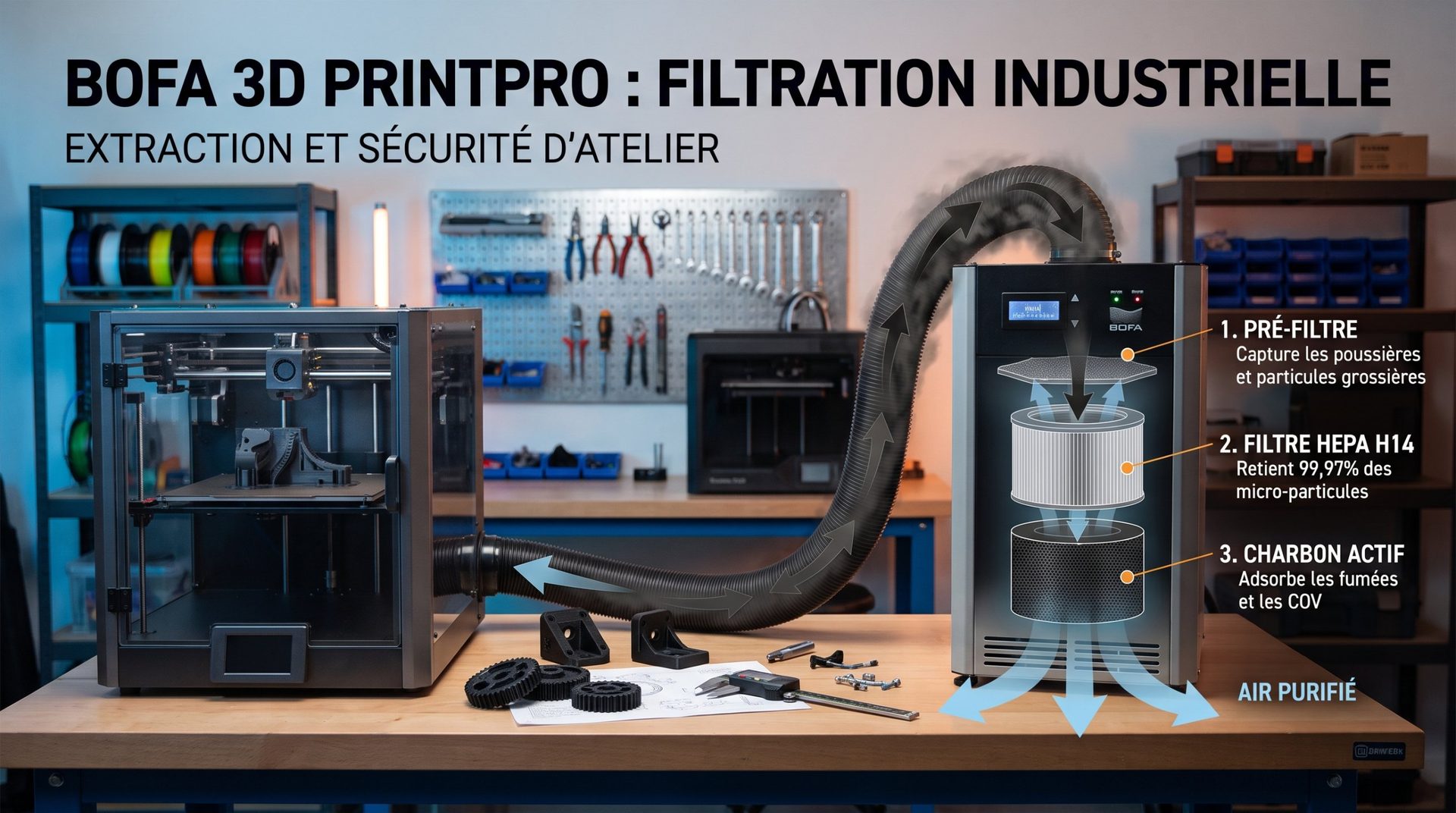
An external extractor like the BOFA 3D PrintPRO connects to the printer via a hose. It draws air from the chamber, passes it through much larger filters, then returns it purified to the room, outside, or back into the chamber (recirculation). By pulling gently, it also prevents fumes from escaping through gaps in the machine.
2. Three-Stage Filtration
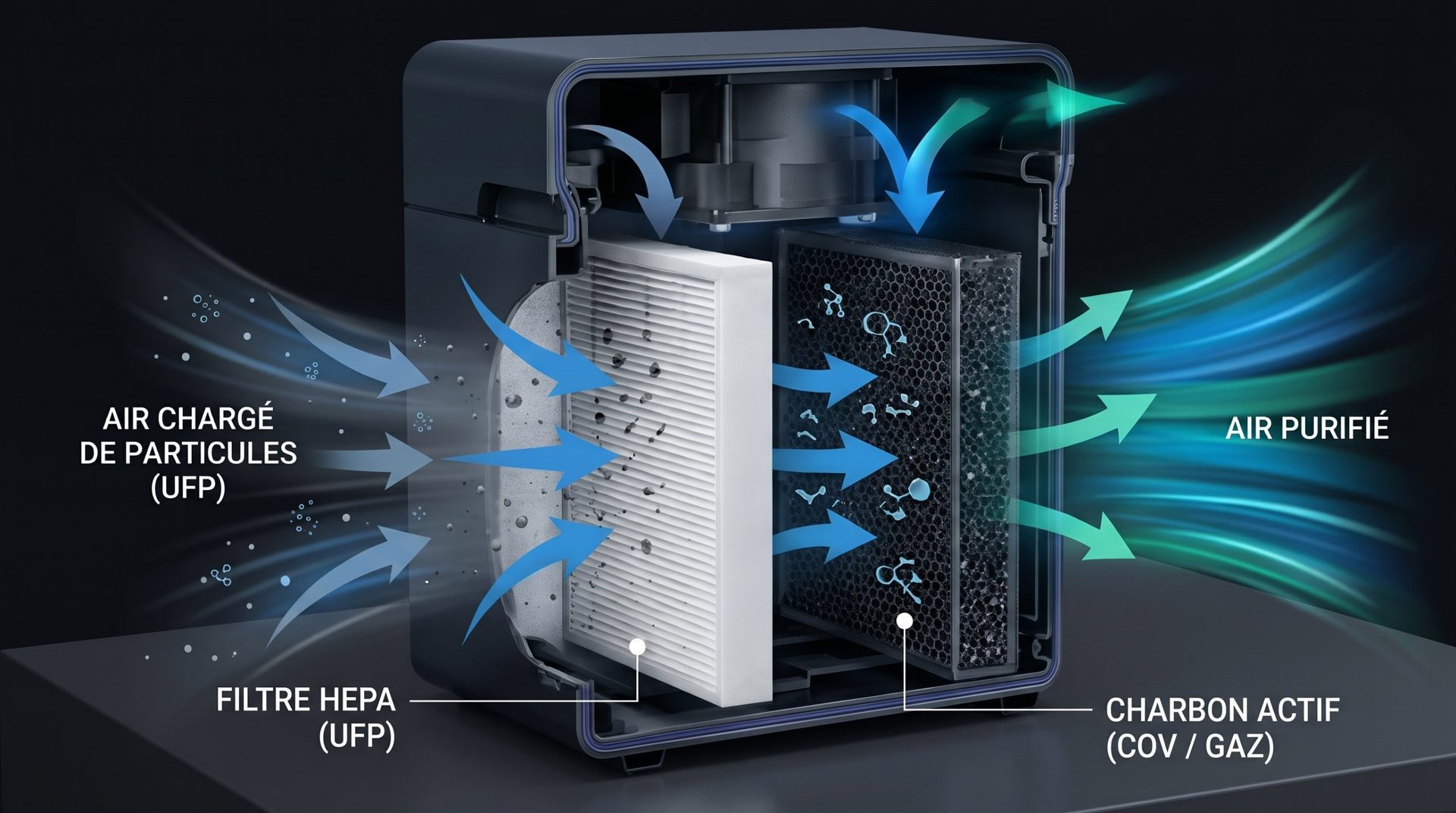
Printer air → prefilter → HEPA filter → activated charcoal → clean air
- The prefilter: traps dust and larger particles before they reach the fine filters, significantly extending their lifespan.
- The HEPA filter: rated by BOFA at 99.997% efficiency on 0.3-micron particles, it also captures most ultrafine particles released at high temperatures.
- Activated charcoal: far more voluminous than the small cartridges in consumer printers, it removes gases and odors—styrene, resin fumes, formaldehyde, and more.
3. The BOFA 3D PrintPRO Range: Which Model to Choose?
| Model | Best For | Key Features |
|---|---|---|
| 3D PrintPRO 2 | Single desktop printer, including open-frame | Compact and discreet. Designed to extract fumes without cooling the print zone. Optional remote on/off control. |
| 3D PrintPRO 3 | Medium enclosed printers | More power and filter capacity than the Model 2. |
| 3D PrintPRO 4 | Large enclosed printers, workshops, and multi-machine farms | Airflow around 165 m³/h, deep-pleat prefilter, under 49 dB, filter change indicator. |
At launch in France, prices ranged from roughly €650 excl. tax for the PrintPRO 2 to nearly €1,500 excl. tax for the PrintPRO 4, not including replacement filters. Check with a dealer for current pricing.
4. What Sets It Apart from a DIY Setup
- Filter monitoring: sensors track clogging and alert you when to change the prefilter or HEPA/charcoal cartridge.
- Remote control: the extractor can link to the printer to start with printing and continue filtering for minutes after it ends.
- Quiet operation and durability: steel housing, low noise level, wheels, and electrical certifications (CE).
- Workplace hygiene: for businesses, schools, and makerspaces, a professional system helps meet employee and student air quality and safety obligations.
Is a BOFA Extractor Worth the Investment?
For a maker printing mostly PLA or PETG on weekends, a well-ventilated room and maybe an internal filter like a "Bento Box" are plenty.
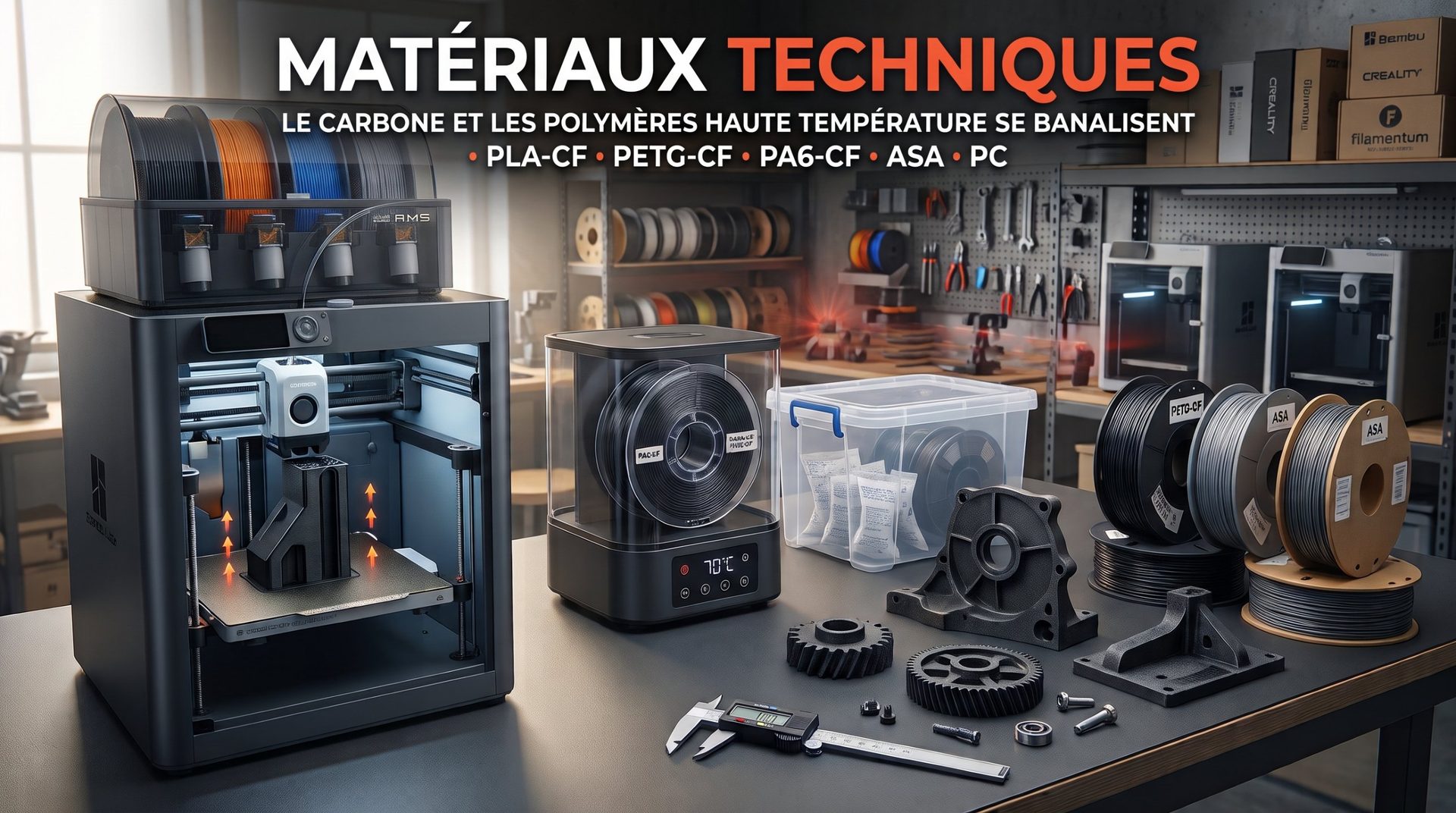
But the moment a workshop regularly prints ABS, ASA, carbon-filled filaments, or resin—or runs multiple machines at once in an enclosed space—a BOFA 3D PrintPRO turns a health concern into a safe, managed routine. To understand emissions and integrated filtration solutions, also read our guide on managing high-temperature polymers and securing your workshop, as well as our article on health risks from 3D printing.