High-Speed Filaments: Marketing Hype or Real Thermal Revolution?
With the democratization of CoreXY printers capable of accelerations over 20,000 mm/s² and speeds of 300 to 600 mm/s, additive manufacturing has reached a new scale.
Yet a reality quickly emerged in workshops: on these high-performance machines, a spool of entry-level PLA or PETG often produces fragile, dull, porous prints or falls victim to chronic underextrusion. In response, catalogs filled with Hyper, High-Flow, Super Speed, or HS claims.
What do these labels actually hide? Simple marketing packaging to justify a price bump, or essential chemical formulation needed to print fast and strong?
1. The Physics of the Problem: The Volumetric Flow Wall
To understand the appeal of a fast filament, forget linear speed (mm/s) in favor of volumetric flow (mm³/s):
Volumetric flow = line width × layer height × speed
With a standard 0.4 mm nozzle and 0.2 mm layers:
- at 50 mm/s, you need roughly 4 mm³/s;
- at 300 mm/s, you need 24 mm³/s;
- at 500 mm/s, demand climbs to 40 mm³/s.
Yet polymers conduct heat poorly, and in a standard hotend the filament only spends a fraction of a second in the melt zone:
- Incomplete melting: the filament core stays lukewarm and viscous, while its surface barely starts to melt.
- Back pressure: the nozzle opposes strong resistance, and the extruder motor slips, skips steps, or grinds the filament.
- Internal underextrusion: less material comes out than the slicer calculated.
We detail this phenomenon in our article on high-speed 3D printing.
2. What Does High-Speed Filament Formulation Actually Change?
A High-Speed filament is more than new packaging. To reduce melt time without degrading the polymer, manufacturers leverage three key factors:
A. Molecular Chain Length
In standard filament, molecular chains are long to guarantee excellent strength. High-Flow resins use shorter, more uniform chains: the material melts with less energy and becomes much more fluid (Melt Flow Index significantly higher).
B. Plasticizing Additives
They reduce friction between molten plastic and nozzle walls. Flow becomes more consistent, without micro-blockages at high throughput.
C. Cooling Speed
This is the paradox of high speed: material must melt faster, yet solidify instantly at the nozzle exit under fan airflow. Nucleating agents accelerate plastic crystallization and prevent bridges and overhangs from sagging.
3. The Silent Trap: Strength vs. Surface Quality
This is the most common mistake: judging a fast print by appearance alone. A piece printed too quickly with standard filament may look flawless on the surface yet be mechanically useless. At high speed, layers don't have time to fuse together: the part delaminates and snaps cleanly along extrusion lines under any stress.
| Criterion | Standard filament at high speed | Dedicated High-Speed filament |
|---|---|---|
| Max observed flow | 12 to 16 mm³/s | 24 to 35 mm³/s and higher |
| Surface finish | Dull, bleached, irregular | Glossy or uniform matte |
| Layer adhesion | Weak (brittle rupture) | Preserved |
| Bridges | Stringing, deformation | Fast and clean solidification |
| Clogging risk | High (back pressure) | Low (fluid flow) |
Indicative values, which vary by brand, nozzle, and hotend.
4. Getting the Best Results in Your Slicer
Switching to a High-Speed spool isn't enough if your profiles stay generic. Three steps are essential:
- Max flow test: print a flow calibration tower with OrcaSlicer or Bambu Studio, find where material starts to weaken, and set your limit about 10% below that point.
- Adjust nozzle temperature: fast filaments typically need 10 to 20 °C more than standard PLA (often 220–230 °C for PLA HS). A temperature tower will help you dial in the right setting.
- Hardware: a fast filament shines with an extended heat-zone hotend (ceramic blocks, split-channel nozzles like CHT, or elongated Volcano-style blocks).
Beyond Speed: Which Filament for Which Job?
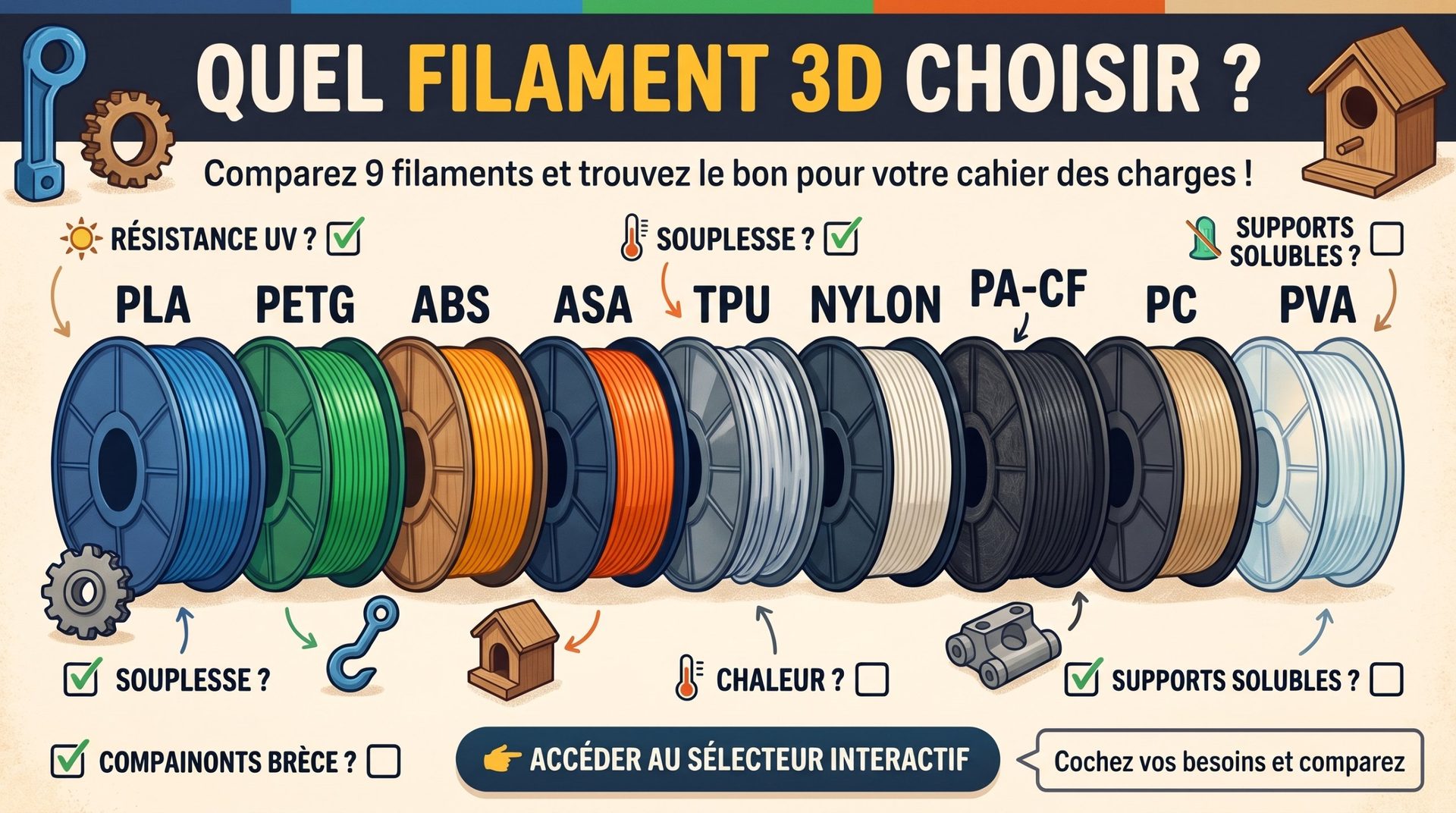
High-Speed ranges now exist in PLA, PETG, TPU, and even ABS or ASA. But speed should never overshadow the part's final purpose: UV resistance, hydrocarbon toughness, flexion, or heat tolerance. Our selector compares 12 filaments with a "fast print" criterion and guides you based on your constraints.