Filament Length Calculator: How to Know If You Have Enough Material Before Printing
Starting a multi-hour print with a partially used spool always creates the same doubt: is there enough filament to finish, or will the machine stop at 92% due to lack of material?
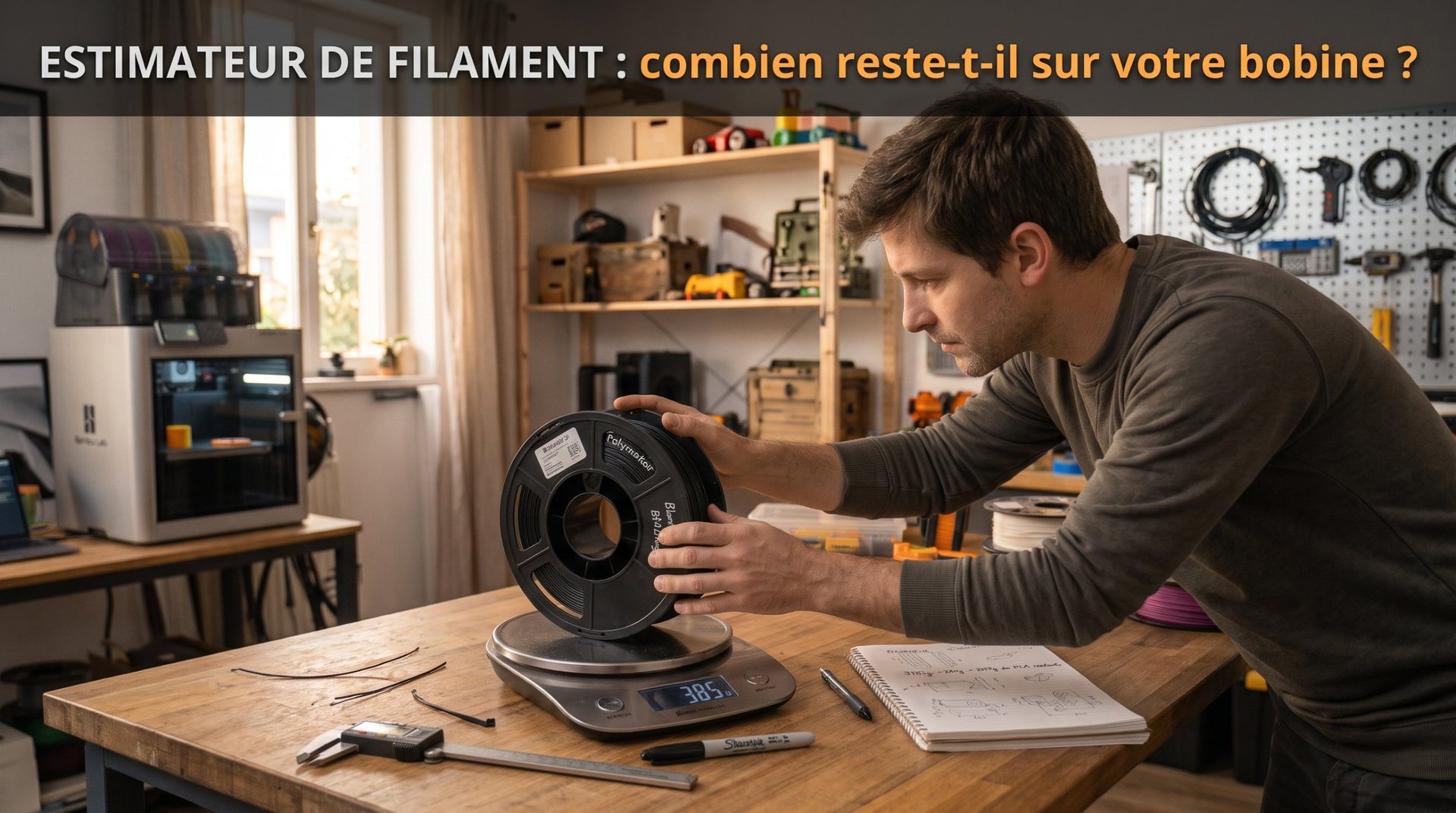
Even if your printer has a filament runout detector, resuming mid-print often leaves a visible mark on the wall or requires close machine monitoring. A simple kitchen scale and a quick calculation are all you need to know, to the gram and meter, exactly how much filament is left on the spool.
👉 In a hurry? Use our filament calculator below.
1. The 3-Step Method
Your slicer (OrcaSlicer, Bambu Studio, PrusaSlicer, Cura) always shows before printing the weight of filament needed (in grams) and its length (in meters). To know if your spool is enough:
- Weigh the partially used spool on a kitchen scale accurate to the gram: this is the gross weight.
- Subtract the empty spool weight (the "tare"), which depends on the brand and spool type (plastic or cardboard): remaining filament = gross weight − empty spool weight.
- Convert to meters if needed, depending on the material (for 1.75 mm filament):
- PLA: 1 kg ≈ 335 m, or about 3 g per meter;
- PETG: 1 kg ≈ 330 m, or about 3.05 g per meter;
- ABS / ASA: 1 kg ≈ 390 to 400 m, or about 2.5 to 2.6 g per meter;
- TPU 95A: 1 kg ≈ 345 m, or about 2.9 g per meter.
🧮 Filament Calculator
Approximate estimate: empty spool weights vary by series, sometimes by 20 g or more. For an exact result, weigh an empty spool from your brand or note the tare when you first open it (see tips below).
2. Common Empty Spool Weights (1 kg format)
Empty spool weight varies greatly between manufacturers, and sometimes between series from the same brand. Here are reference values, collected from manufacturers and the community:
| Brand | Spool type | Empty weight | Notes |
|---|---|---|---|
| Bambu Lab | Reusable plastic | ≈ 250 g (245 to 260 g) | Very consistent weight |
| Prusament | Plastic flanges, without NFC chip | ≈ 200 g (192 to 207 g) | Older spools |
| Prusament | With NFC chip | ≈ 278 g | Recent spools, noticeably heavier |
| Polymaker | Cardboard (PolyLite, PolyTerra…) | ≈ 140 g (133 to 147 g) | Add ring weight if used for AMS |
| Sunlu | Plastic | 133 to 189 g | Varies by spool model: weigh yours |
| eSUN | Plastic | ≈ 220 g (209 to 265 g) | Variations across product lines |
| eSUN | Cardboard | 150 to 170 g | Mainly on PLA and PLA+ |
| Elegoo | Cardboard | ≈ 154 g | Often requires a ring in multi-spool systems |
| Creality | Plastic | ≈ 140 g | Few measurements available: verify |
3. Three Good Habits to Never Get Caught Short
- Always keep a 10% buffer: don't start a print requiring 145 g if only 148 g theoretically remains on the spool. Spool weight variations, color-change purges, and the priming line consume several extra grams.
- Note the tare when you open it: weigh each new 1 kg spool as soon as you open it. If it reads 1,245 g, write "tare: 245 g" with a marker or label on the side. You'll never need to look up its empty weight again.
- Watch out for accessories: adapter rings printed to rotate a cardboard spool in a multi-filament system (AMS, ACE Pro, CFS), desiccant cartridge slipped in the center… Remove them before weighing, or add their weight to the tare.
And to keep filament on your partially used spools printing beautifully, store it dry: check our tips on how to dry and protect your filament from moisture. Still unsure about the material for your next project?