Bambu Lab E1 Air Purifier: An Air Purifier Designed for the Maker’s Workshop
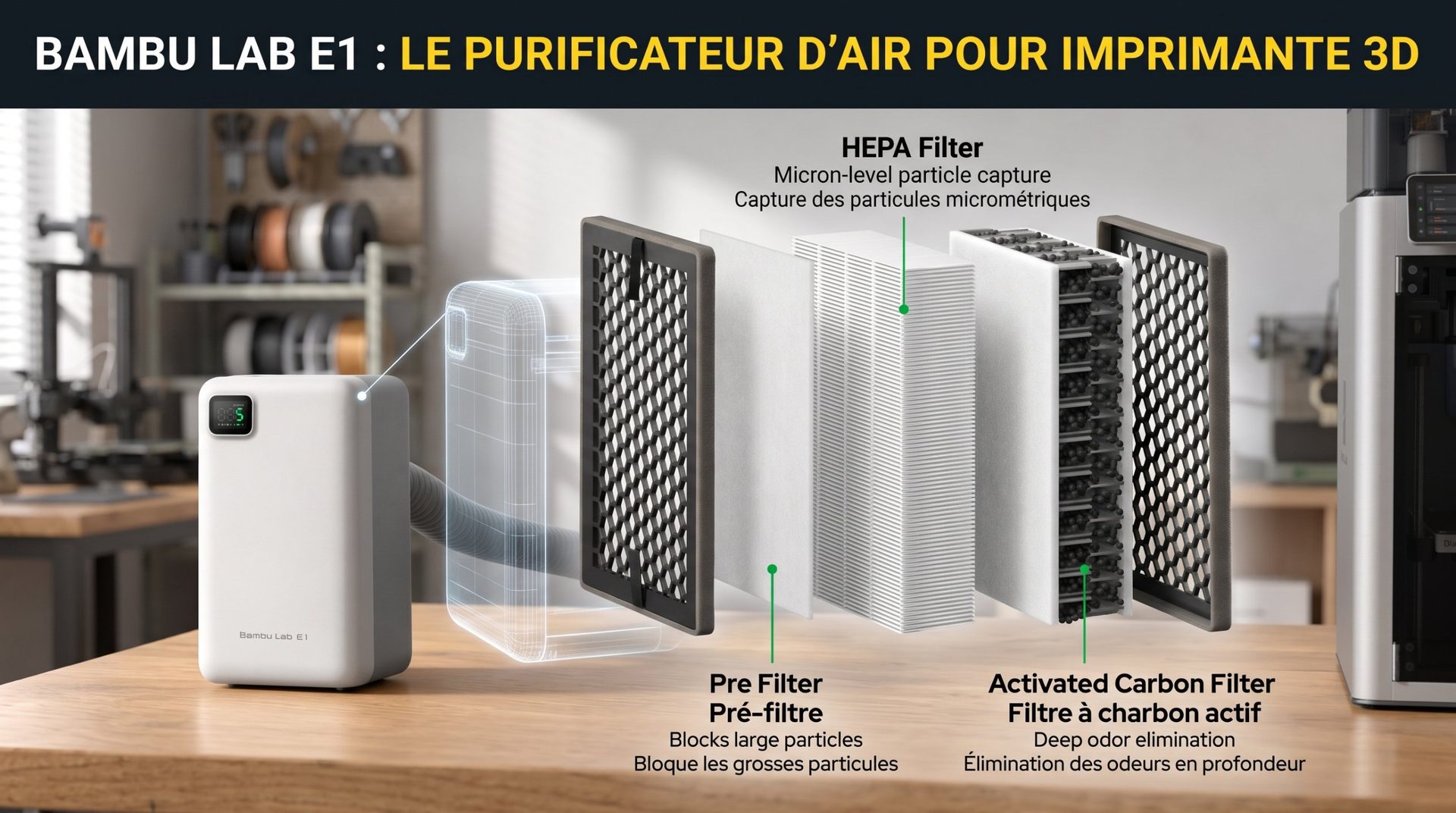
As 3D printers move into our offices, living rooms and home workshops, with increasingly technical materials such as ABS, ASA, nylon or filled filaments, air quality is becoming a real concern. With the Bambu Lab E1 Air Purifier, the brand tackles the filtration of ultrafine particles and volatile organic compounds (VOCs) released during printing.
1. Why a Purifier Dedicated to 3D Printing?
Even on an enclosed machine, every heating and extrusion phase releases two kinds of invisible emissions:
- Ultrafine particles: released even with PLA or PETG, they stay suspended in the room for a long time.
- VOCs and odours (styrene for ABS, caprolactam for nylon…): especially present with engineering filaments (ABS, ASA, PC, PA).
A standard household air purifier often lacks enough activated carbon to trap these vapours effectively. To understand the issues better, read our guide to the health risks of 3D printing.
2. What the Bambu Lab E1 Air Purifier Offers
Note that this isn’t a purifier you put in the middle of the room: the E1 is an external filtration module that connects with a hose to the air outlet of an enclosed printer. It draws air from the chamber and filters it before releasing it into the room.
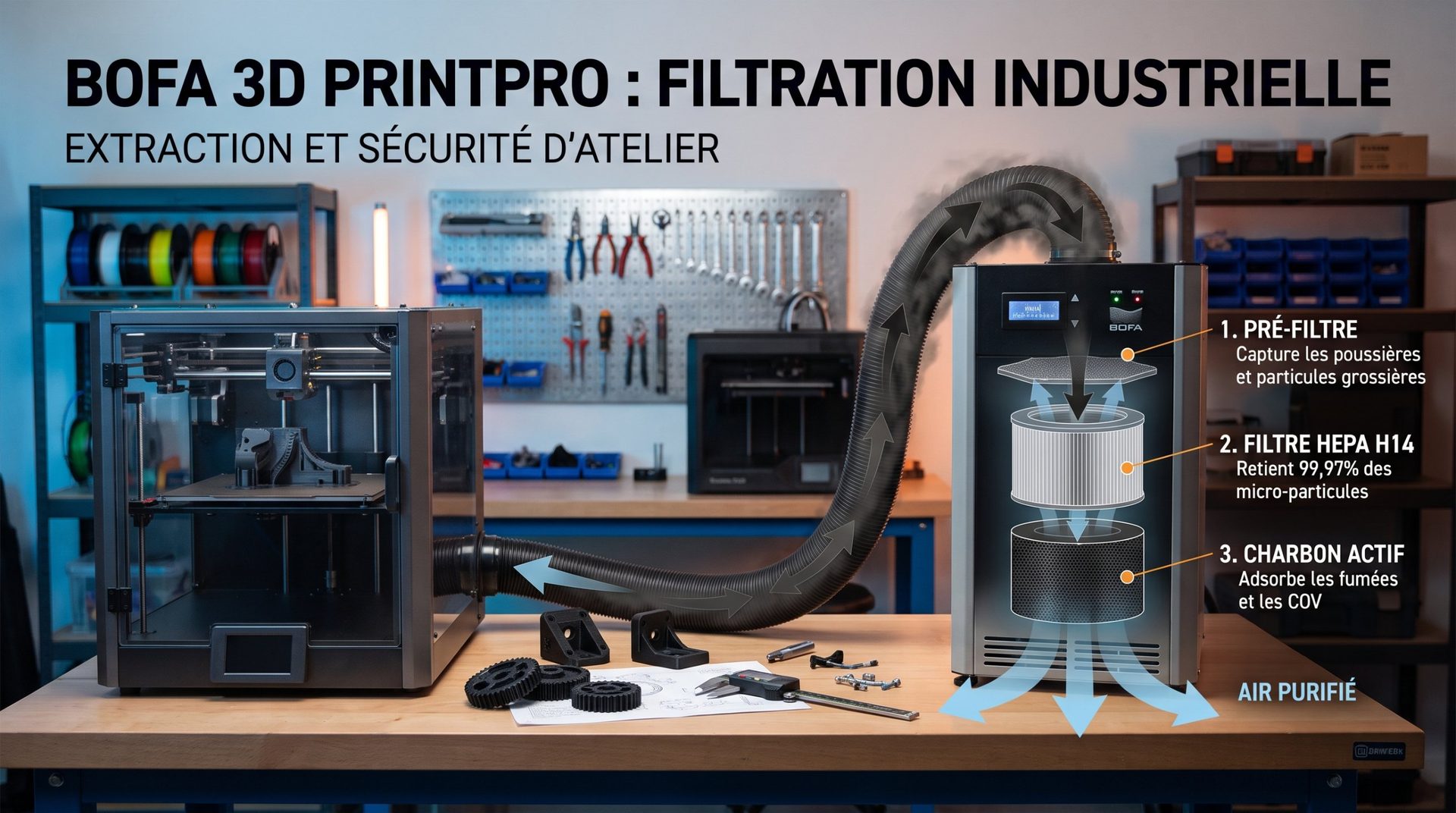
- Three-stage filtration: a cotton pre-filter for large particles, a HEPA layer rated at over 99.97% efficiency for fine particles, and a thick activated carbon layer (0.45 kg of coconut shell carbon, 40 mm deep) against VOCs and odours.
- Controlled by the printer: linked by a Bambu Bus cable, the E1 runs in automatic mode (switching on when the print needs it) or manual mode, and is controlled from the printer.
- Quiet: from 38 dB in quiet mode, according to the manufacturer, handy for overnight prints.
- Compatibility: Bambu Lab enclosed printers, including the X1, P1S, P2S and H2 series (H2D, H2S, H2C) and the new H3C.
For maintenance, Bambu Lab recommends changing the filters about once a month with heavy use, and every three months at most with occasional use, or as soon as the smell returns at the outlet.
Important: the E1 is not designed for laser engraving or cutting fumes, which are much heavier. Lasers need dedicated extraction or filtration.
3. Venting Outside or Closed-Loop Filtration: Which to Choose?
The E1 is aimed first at makers who print indoors and can’t drill a wall or run a duct through a window:
| Setup | Advantages | Limits |
|---|---|---|
| E1 purifier connected to the printer | Installed in 15 to 30 minutes, no building work, heat stays in the room in winter. | Filters (HEPA and carbon) to replace regularly, depending on the materials printed. |
| Direct venting outside (duct and window) | Fumes removed from the home, no consumables. | Heat loss in winter, awkward installation through a window or wall. |
For an enclosed printer used in an office, combining a well-sealed chamber with a dedicated purifier like the E1 greatly reduces ABS or ASA odours. The E1 sells for €199 on the Bambu Lab store. For a fleet of several machines, professional solutions such as the BOFA 3D PrintPro take over.
And You, How Do You Manage Air Quality in Your Workshop?
Venting through the window, filtration built into the printer or a dedicated purifier: which system do you use every day? Tell us in the comments!